Early in his walk along the Sandymount
Strand in Proteus, Stephen sees two women come
"down the steps from Leahy's terrace." Much later in the day,
as Bloom sits on the same beach in Nausicaa he can see
a man lighting "the lamp at Leahy's terrace." At the time of
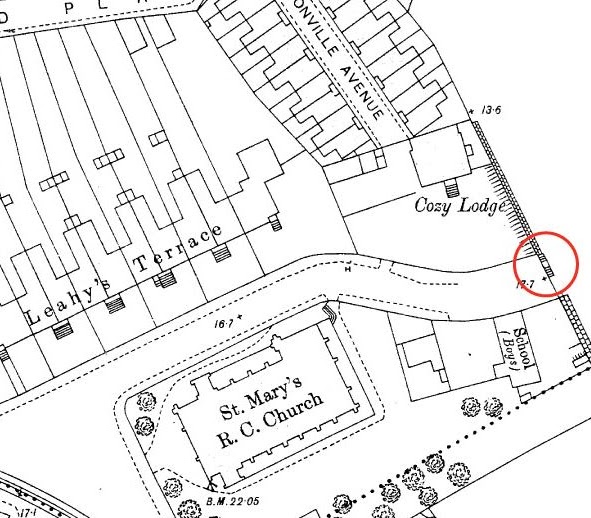
the novel Leahy's Terrace, named for a housing development
which William Leahy built across from the Star of the Sea church in
the 1860s, was a short road running northeast from Sandymount
Road toward the bay. It terminated at the seawall bordering
the strand, and a gap in that wall opened onto some steps
leading down to the beach. Since then Irishtown has expanded
eastward on land reclaimed from the sea and Leahy's Terrace,
which has been lengthened, no longer ends at the shore.
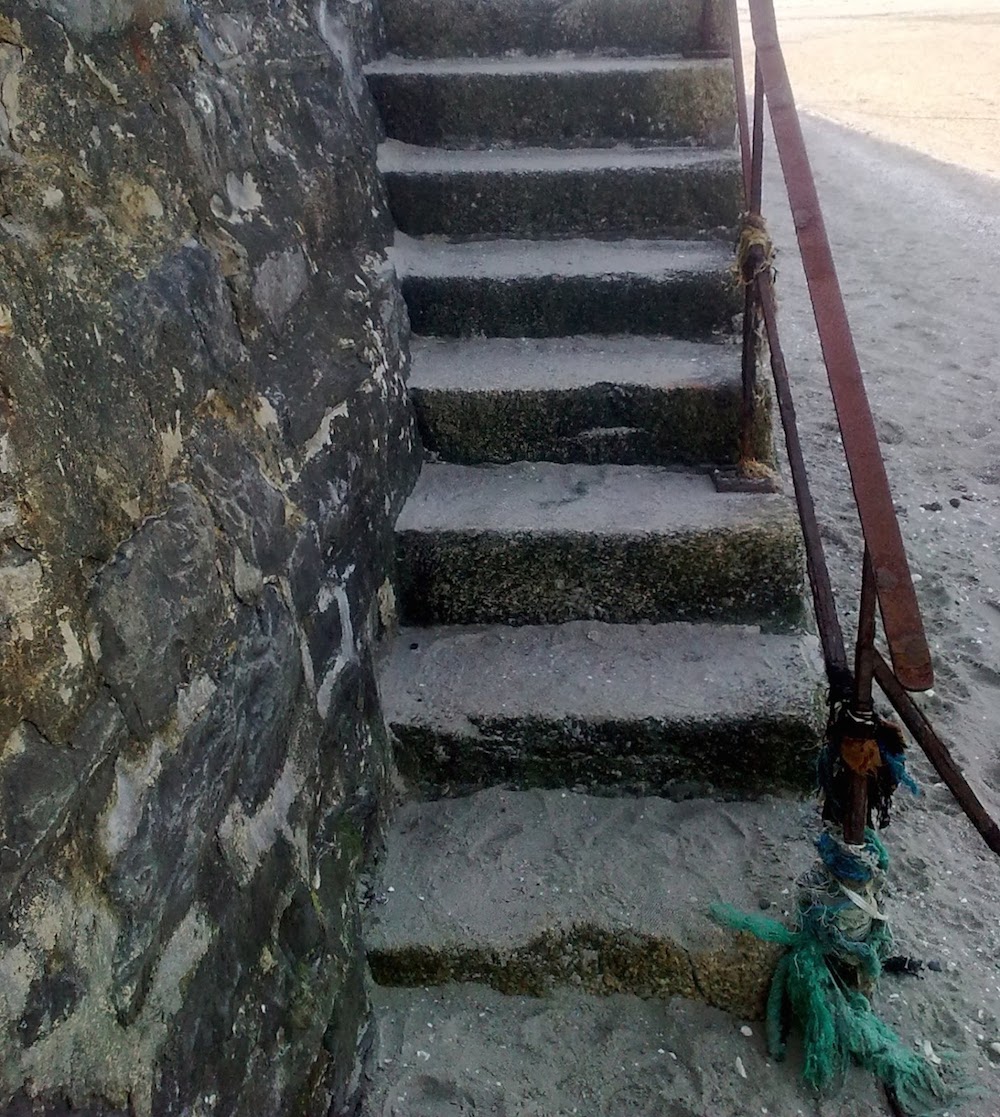
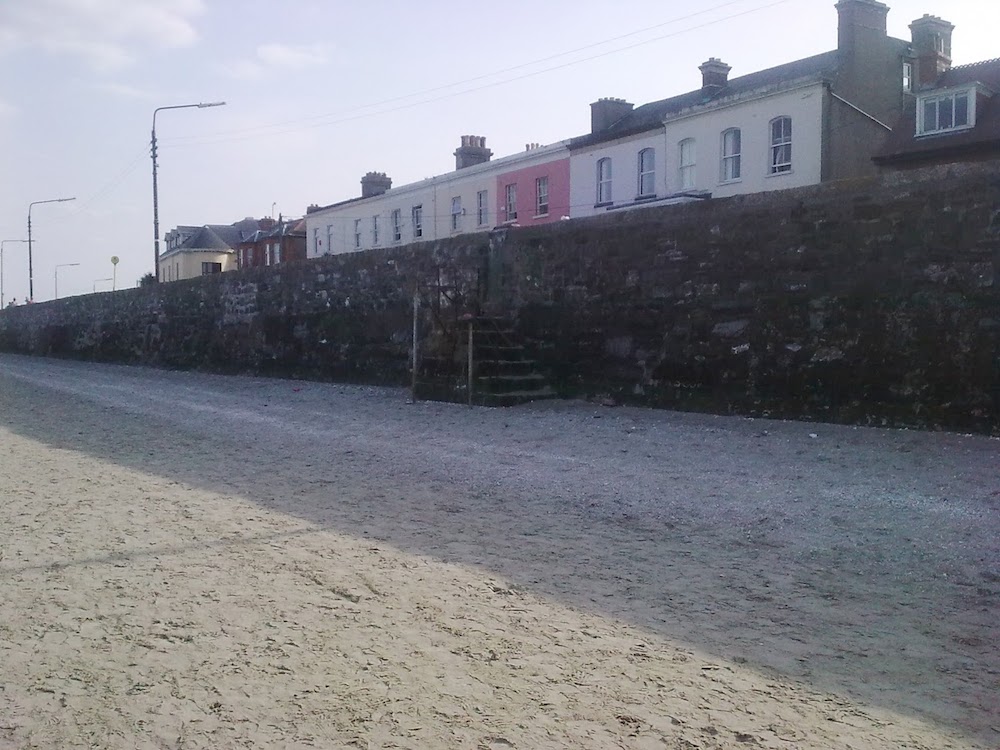
Although Stephen's steps have disappeared, others on the
seawall can give an idea of what they looked like. Their chief
function in the novel is to place Stephen and Bloom on the
same stretch of sand on the same day.
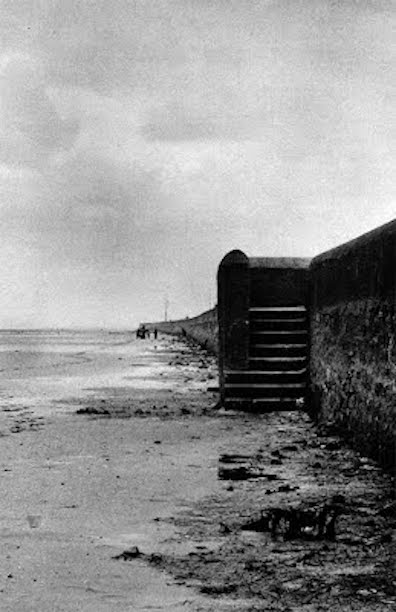
In the summer of 1954, before the Irishtown reclamation
project took place, William York Tindall published a
photograph of some stone steps that he assumed were the ones
mentioned in the novel. He published it in the beautiful
little book of photographs titled The Joyce Country
(1960, 1972), and it became a familiar part of Ulysses
lore, reproduced among other places in Hart and Gunn's
James Joyce's Dublin (2004). But Ian Gunn subsequently
reported in a short 2014 JJON article that a smaller
section of the strand was reclaimed in the 1920s, meaning that
Tindall was mistaken: even at the time he took his photograph
the steps referenced in Ulysses had ceased to exist.
Photographs of other openings in the seawall can join with
Tindall's to give a good sense of the scene, but they cannot
show exactly what Joyce had in mind.
For readers new to the novel, though, the widely separated
references to "the steps from Leahy's terrace" and "the
lamp at Leahy's terrace" will hold interest chiefly
because they place Stephen, late in the morning, and Bloom,
late in the evening, at the same spot on Sandymount Strand. In
Ulysses such peripatetic convergences invite attention.
In Wandering Rocks Stephen reads a passage about
winning a woman's love in a volume on a bookcart and wonders,
"Who has passed here before me?" One cannot know, but one
cannot help but wonder whether Bloom, who also is seen
visiting bookstalls in the chapter, has owned this book. In Nausicaa
Bloom spots "a piece of paper on the strand. He brought it
near his eyes and peered. Letter?" Again, one wonders: could
this be part of the letter from which Stephen removed a piece
in Proteus? That seems unlikely, as he wants to
preserve the poetry he writes down on the torn-off scrap and
he appears to give the remaining part of the letter to the
newspaper editor in Aeolus. But the suggestion is
hard to ignore.
For both men, the strand is a place to gaze on women they
don't know and ponder the sexual possibilities in their lives.
For both, it is also the site of an abortive attempt at
writing. Stephen scribbles down some fragments of melodious
but derivative verse on Deasy's letter before moving on to
other thoughts. Bloom picks up a stick and writes "I. AM. A."
in the sand, before deciding that Gerty will never read the
words and erasing them with his foot. It is, as Eumaeus
says, "as if both their minds were travelling, so to speak, in
the one train of thought." Their thoughts coincide because
Joyce's mind traveled in that same train. His first date with
Nora in 1904, on the beach in nearby Ringsend, initiated a major change in his erotic life
and also in his vocation as a
writer.