Episode 4 begins a new section of the novel, marked by a
Roman numeral II in print
editions. Joyce is loosely imitating the structure of Homer's
Odyssey, which introduces Telemachus for several
books before telling the backstory of Odysseus' wanderings
after the fall of Troy. But instead of starting in medias
res and then going back in time, he starts June 16
twice, making Leopold Bloom's first three chapters cover the
same period of time as Stephen's, from 8 AM to noon. (Like Telemachus,
Bloom's first episode begins near the hour of 8:00 and ends at 8:45.) He also
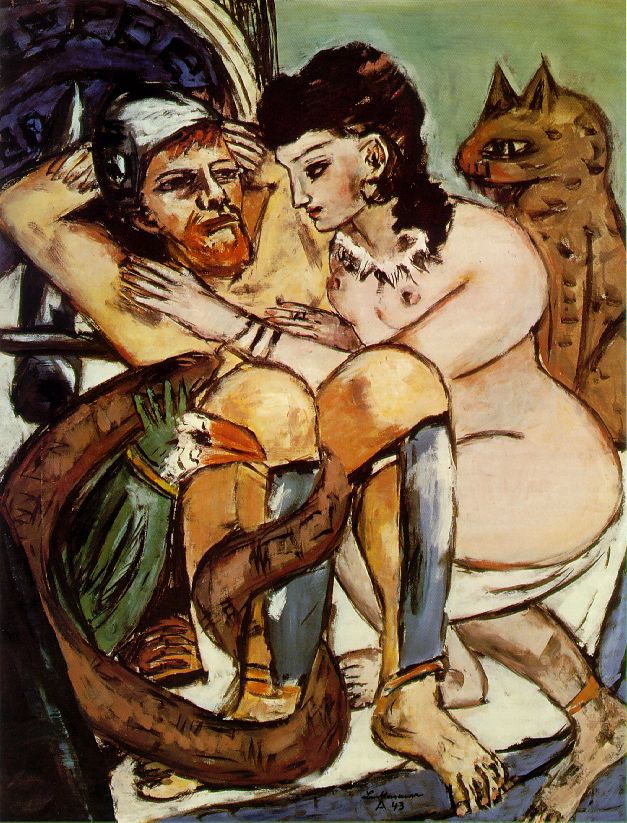
tinkers with Homer's spatial plan. The title suggested by his
schemas, "Calypso," recalls
the state of unhappy exile in which the Odyssey
introduces its hero, held captive by a beautiful nymph on an
island far from Ithaca. But Bloom's day starts at home with
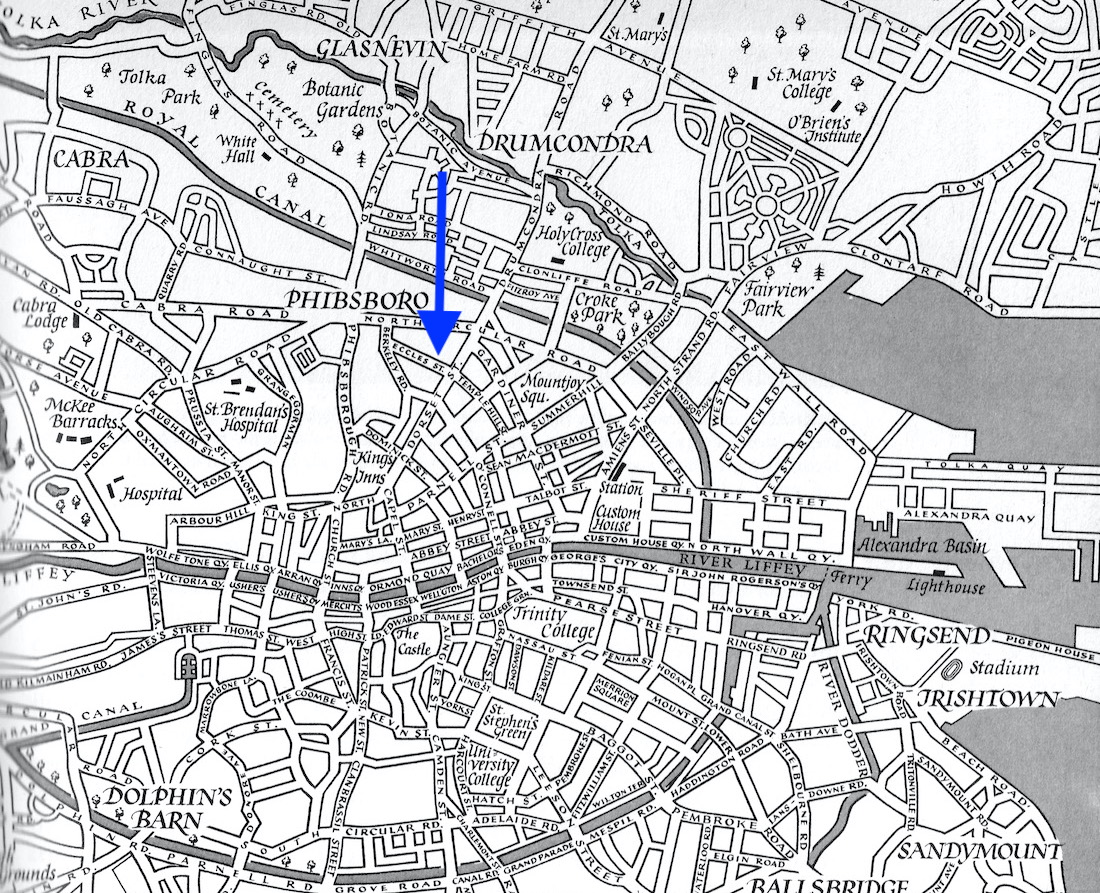
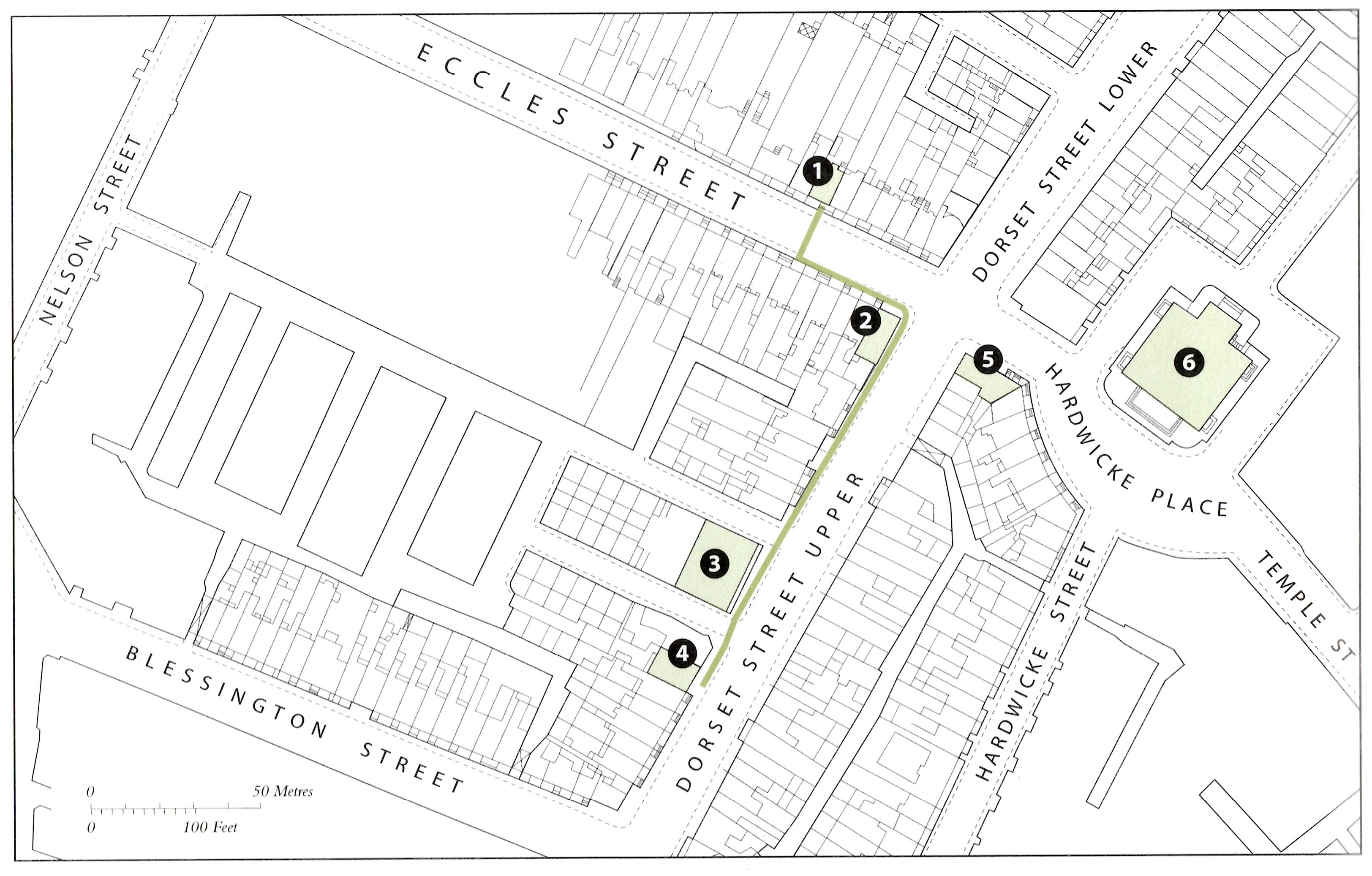
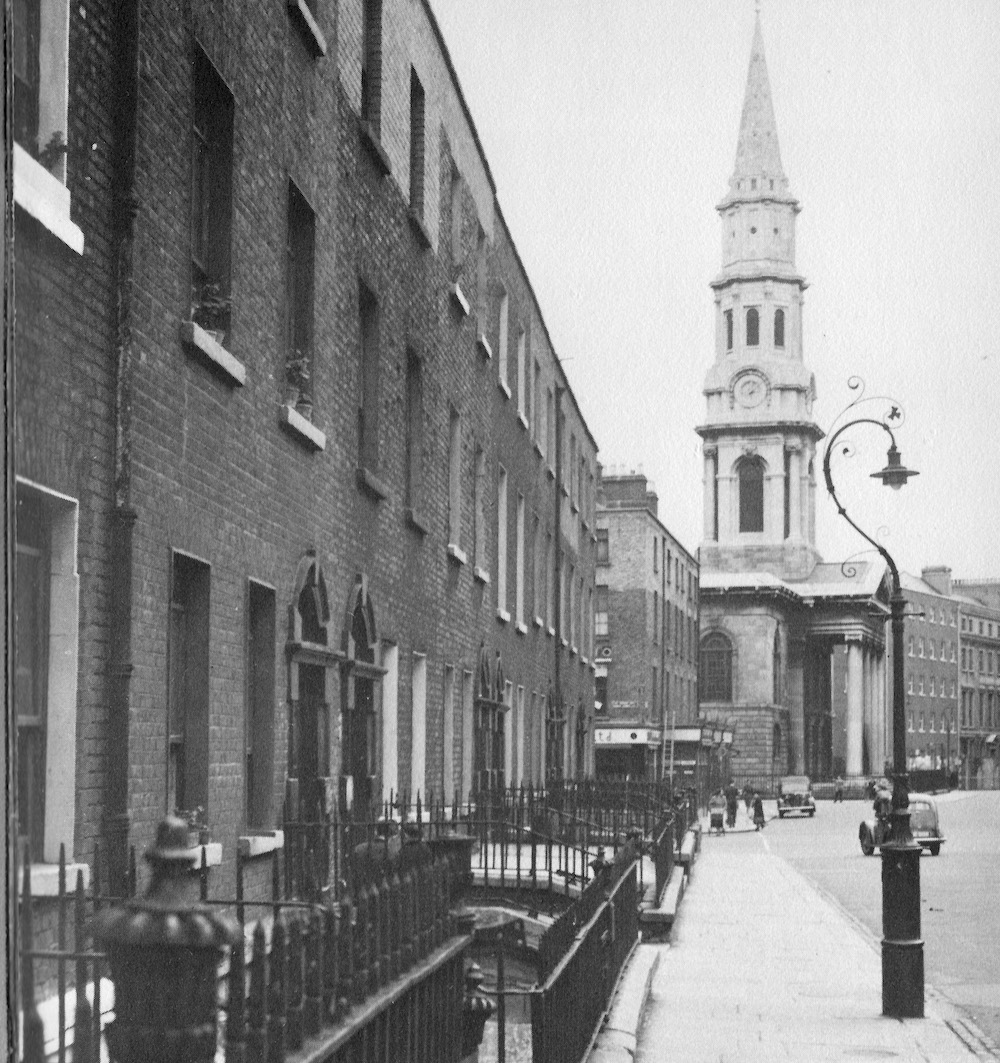
his wife Molly, on Eccles
Street near the northern edge of central Dublin. The
implication: all's not well at home.
Leaving aside all of the questions attendant upon Joyce
recasting Odysseus as a socially marginal middle-class ad
salesman, it is worth asking why and how he associated Bloom's
hour at home with Calypso's island—beyond the obvious reason
that this is where Homer starts the story of Odysseus. The
fifth book of the Odyssey finds the hero marooned on
an island called Ogygia, desperately unhappy and longing to
return to Ithaca. He has been away from home for twenty years,
seven of them in the company of a demi-goddess who gives him
her love, her body, and the promise of immortality, but not
the freedom to return home. At the end of the poem he regains
his palace and his wife, a conclusion that Joyce reenacted by
calling the penultimate chapter of his novel "Ithaca," and the
last chapter "Penelope."
Bloom's narrative begins at home, for the necessary reason
that this is where he begins every day. But Joyce conceived
the chapter as a reenactment of Odysseus' exile. He did not
have to follow Homer's order of events—as the second section
of Ulysses goes on, he freely alters that order—so the
reader should reflect upon the fact that as Bloom more or less
contentedly begins another ordinary day, bringing meat to his
house and preparing breakfast, collecting the mail, discussing
things with his wife, tending to the needs of his cat, and
clearing his bowels and his bladder, he is symbolically
presented as a hero in exile. By identifying Molly here with
Calypso (as well as Penelope at the end of the novel), Joyce
suggests that the Blooms' home is a place of dissatisfaction
as much as contentment.
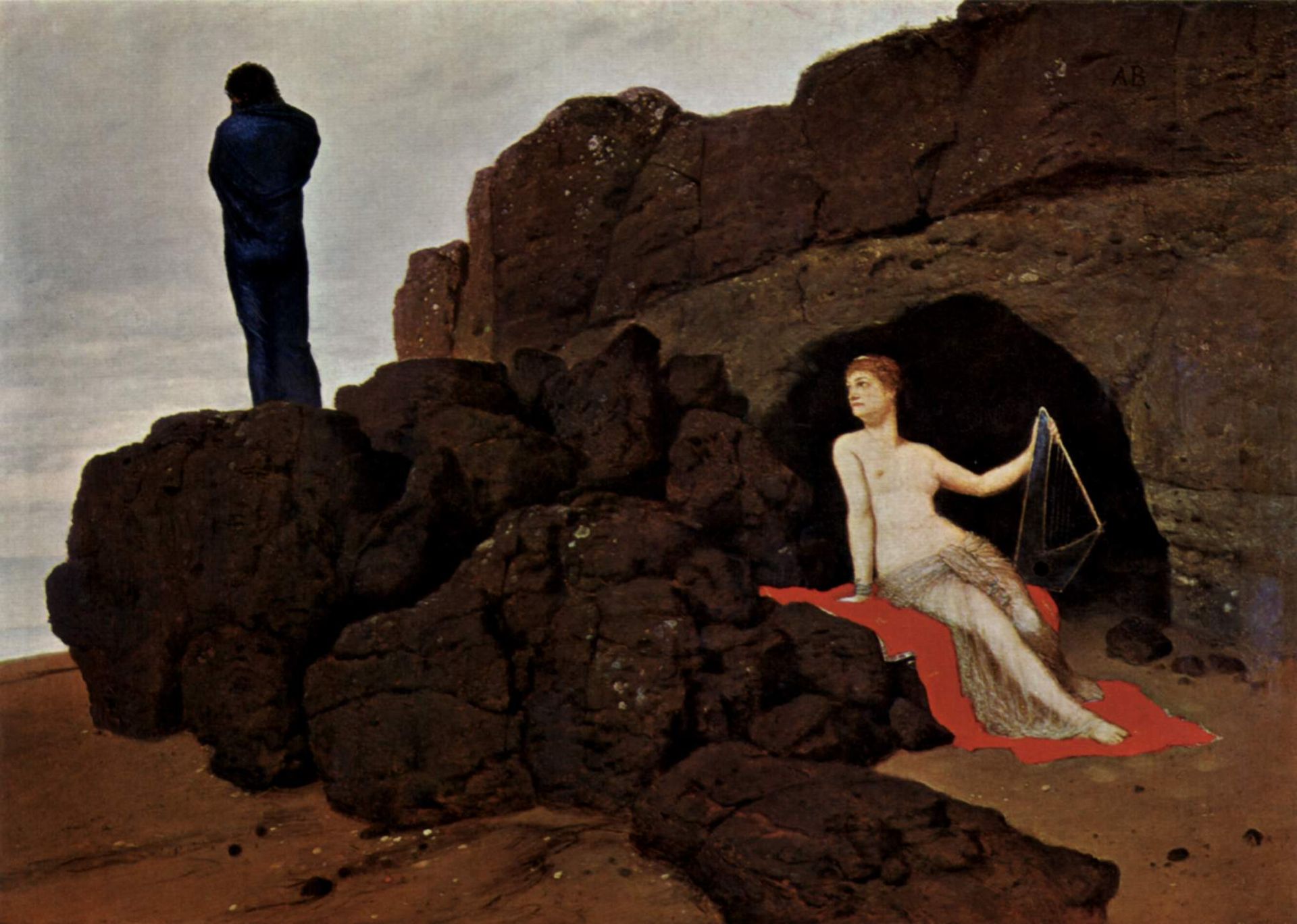
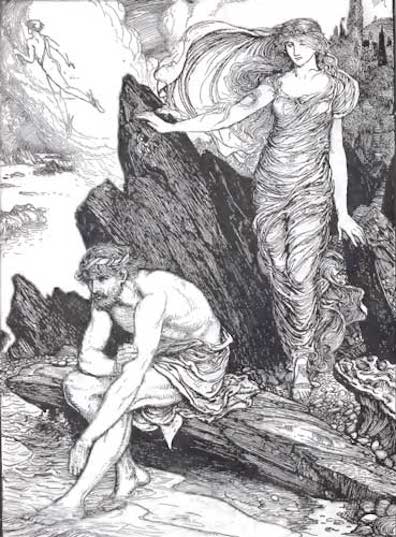
Athena tells Zeus that her protégé "lives and grieves upon
that island / in thralldom to the nymph." When the messenger
god Hermes arrives at Calypso's cave, bearing Zeus' command to
release her prisoner, Odysseus is not present. He is on the
seashore, sitting "apart, as a thousand times before":
The
sweet days of his lifetime
were running out in anguish over his exile,
for long ago the nymph had ceased to please.
Though he fought shy of her and her desire,
he lay with her each night, for she compelled him.
But when day came he sat on the rocky shore
and broke his own heart groaning, with eyes wet
scanning the bare horizon of the sea.
(5.150-57, Fitzgerald)
Molly plays the role of the captor in Calypso. She
orders her husband about with sharp commands, as he dutifully
labors to fulfill her needs and indulge her whims. She is also
the sexual partner who has "ceased to please," and here too
Joyce supplies a realistic analogue to Homer's story, though
he takes many chapters to supply the details. Since the death
of their second child, more than ten years earlier, the Blooms
have not enjoyed satisfying sexual intercourse, and the
disinterest is pretty clearly Bloom's.
Many other details link Molly with Calypso. Homer calls his
goddess "the softly-braided nymph," and Molly
lies in bed "counting the strands of her hair, smiling, braiding."
Over the Blooms' bed hangs a reproduction of a painting titled
The Bath
of the Nymph, which Bloom thinks is "Not unlike
her with her hair down: slimmer."
He remembers how it came to hang there: "She said it would
look nice over the bed." A passage in the Odyssey
describing the scented smoke
in Calypso's cave may have inspired Bloom's appreciation for
the scents of tea and cooking food in Molly's presence. And
the name Calypso means "Concealer." When Bloom delivers a
letter to his wife, she hides it under the pillow. It is from
the man that she will begin an affair with on this day—a great
concealment.
Molly does not bother to effectively conceal either the
hiding of the letter or the affair from her husband, but these
brazen actions express her alienation from him. Bloom too
feels alienated. He spends much of his day thinking about
other women, beginning in this chapter with the neighbors'
servant girl. Although he is not conducting any physical
affairs, he has visited prostitutes, and June 16 finds him
engaged in an epistolary affair. It is probably not his first.
His marked subservience to his wife coheres with a strongly masochistic tendency in
his sexuality, an excessive deference to other men that
suggests insufficient self-confidence, a willingness to
imagine other men having sex with his wife, and an interest in
Greek goddesses as immortal ideals of physical beauty who do
not have to live with physical frailty.
Bloom likes his place in the world, his home with Molly. The
"art" of the fourth chapter, according to Gilbert's schema, is
"economics," which in its original Greek sense means household
management, and this term describes Bloom's life as a
househusband as we see him puttering about in Calypso.
But the home, for him, is a place of entrapment as well as
self-fulfillment, and when the chapter ends he makes his way
out into the larger world. The travels that he undertakes on
June 16, thinking constantly of the sad state of his marriage,
push him out of his comfortable center and bring him back to
it at the end of the day. It is perhaps not too ingenious to
see in Boylan's letter an echo of Hermes' message from Zeus,
freeing Odysseus to leave. It will be a long time, actually
and textually, before this traveler returns.