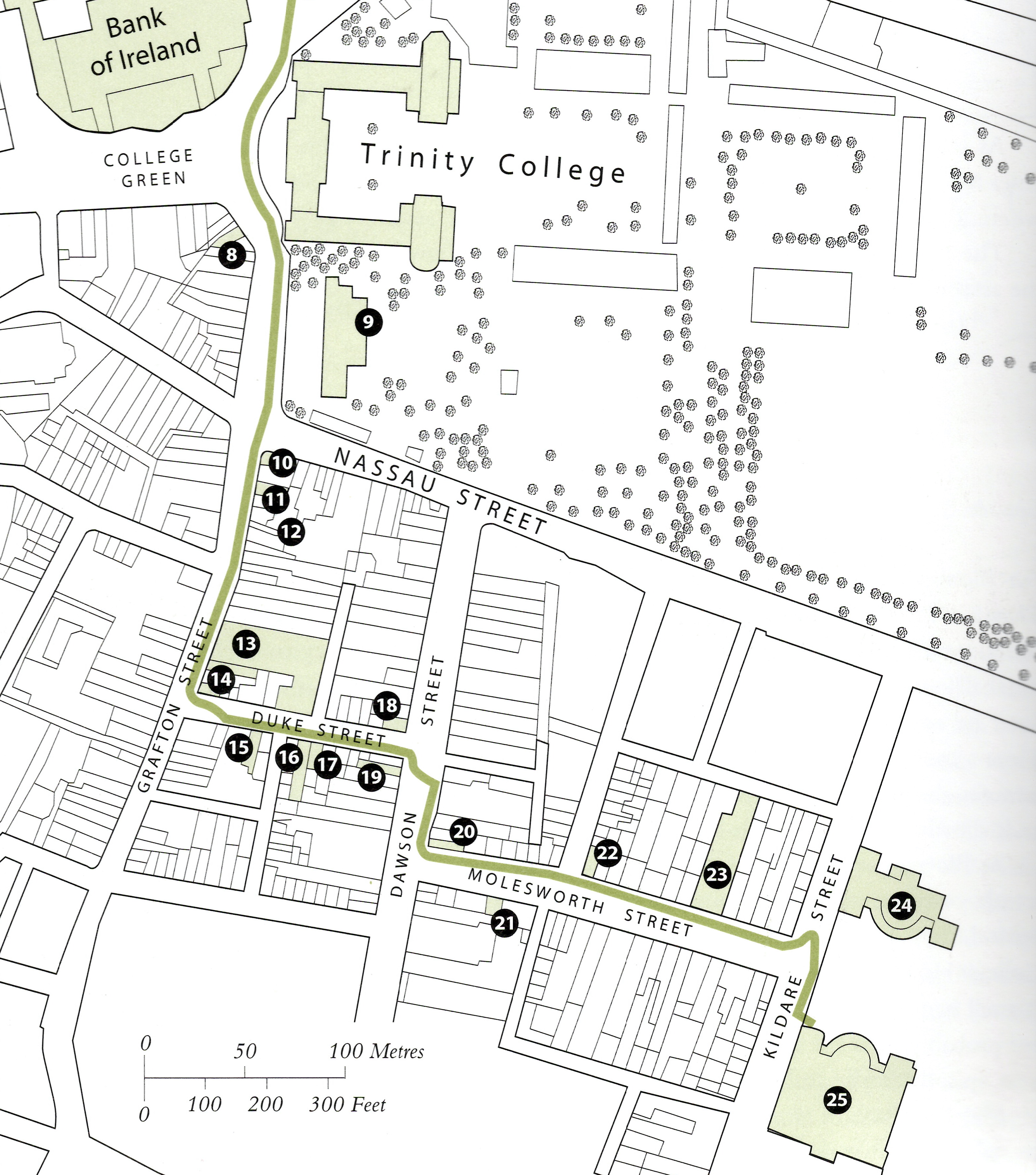
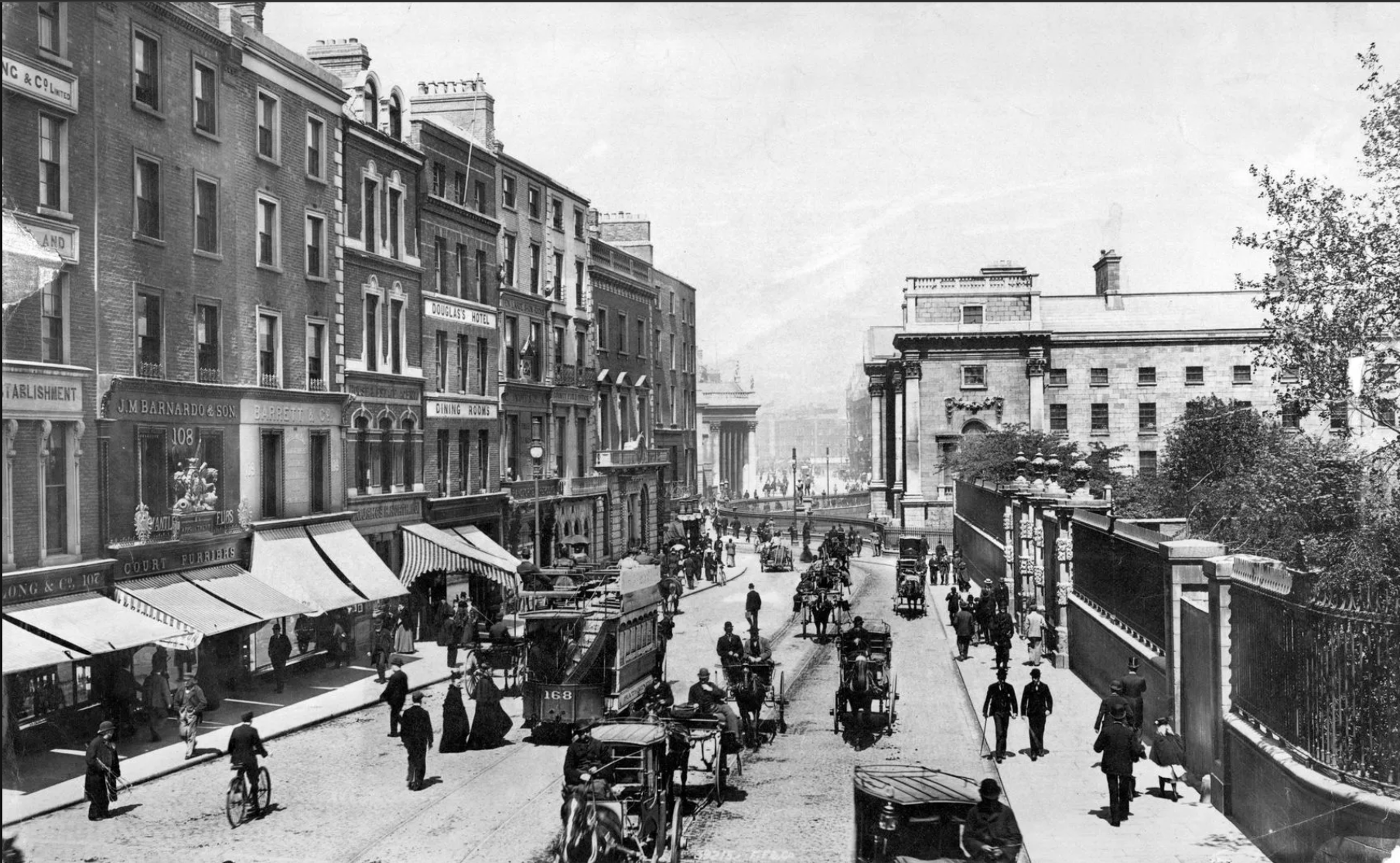
After crossing Nassau Street and standing in front of "Yeates and Son" looking back at
the Bank of Ireland, Bloom plunges into the fully enclosed
part of Grafton Street, a busy high-end shopping arcade. He
goes by "la maison Claire," listed in Thom's diretory
as "Court Dressmaker," and then sees Bob Doran heading into "the
Empire" pub at the entrance to the tiny alley called "Adam court." All around him,
"Grafton street gay with housed awnings" overwhelms his
senses, and he becomes entranced by displays in "the windows
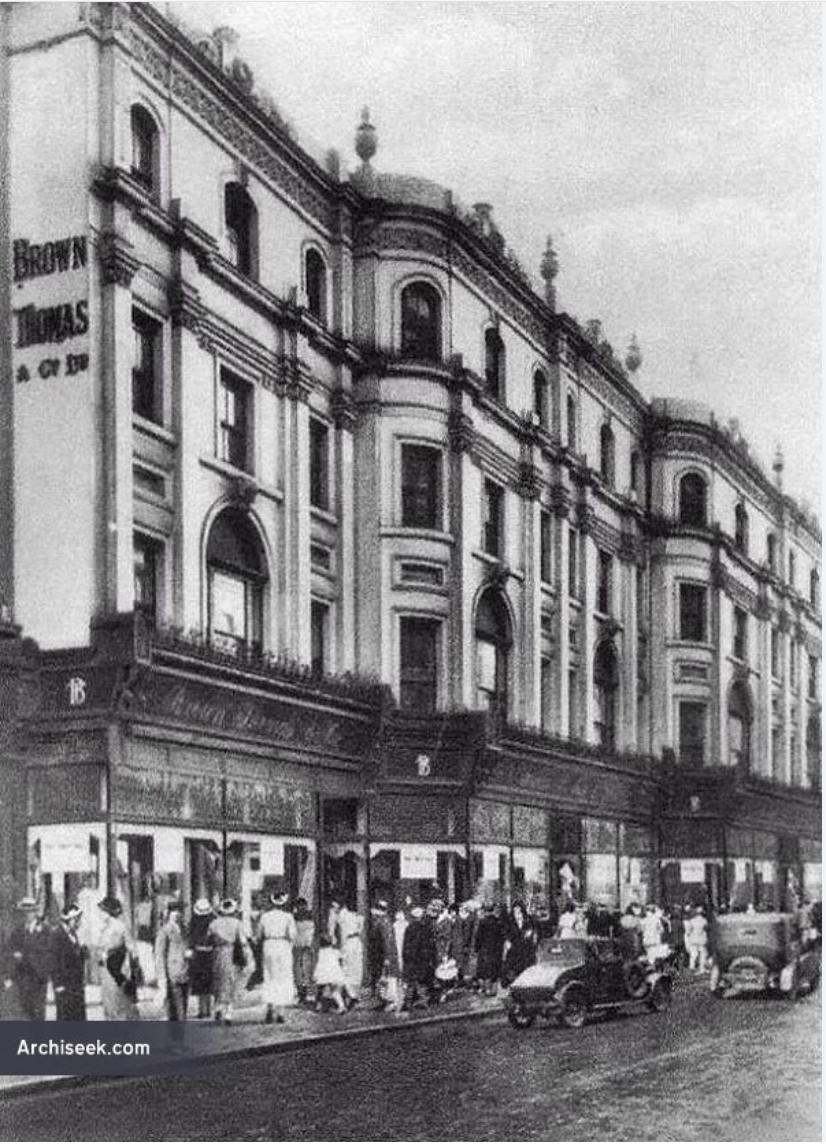
of Brown Thomas, silk mercers." This large apparel
store ("silk mercers, milliners, costumiers, mantle makers,
and general drapers"), with entrances on both Grafton Street
and Duke Street, was one of Dublin's most elegant stores.
After glutting his senses on the fabrics in the Grafton Street
windows, and having his desires stirred, he reaches "Duke
street. Here we are. Must eat. The Burton. Feel better
then."
Earlier in Lestrygonians Bloom had considered walking
a short distance southwest from Westmoreland Street to have
lunch at a pub called Rowe's: "He stood at Fleet street
crossing. Luncheon interval a sixpenny at Rowe's? Must
look up that ad in the national library. An eightpenny in
the Burton. Better. On my way." Since the library lies
in a different direction—southeast—he sets his sights instead
on the Burton Hotel in Duke Street, which is "On my way."
Finding himself now at the western end of Duke Street, he
turns left at "Combridge's corner," called that because
the building there housed Combridge and Co., "picture depot,
print sellers, and picture frame makers, artists and
colourmen." Duke Street is short, so food is close at hand.
But the sight of men ravenously shoveling food into their
mouths in "the Burton restaurant" at 18 Duke Street,
and the smells, turn Bloom's stomach. He leaves the Burton and
goes back a few steps to "Davy
Byrne's," a pub at number 21 where he can have a simpler
bite to eat in quieter surroundings. After a long lunch there
he leaves and walks east "towards Dawson street," the
larger thoroughfare where Duke Street ends. "At Duke lane,"
next to the Burton, he sees a dog regurgitating its meal, and
then he passes "the window of William Miller, plumber"
at number 17, thinking of the intestinal plumbing of the human
body. Nearing Dawson Street, Bloom looks left and sees a man
leaning "Against John Long's" pub on the corner. There
was another pub on the right-hand corner, with a Dawson Street
address, but Joyce mistakenly inferred from Thom's
that the last number on Duke Street occupied the corner: "Mr
Bloom turned at Gray's confectioner's window of
unbought tarts" (Katherine Gray, "confectioner," 13 Duke
Street).
To get to the library Bloom should cross busy Dawson Street
and take Molesworth Street eastward. He starts up Dawson,
contemplating "the reverend Thomas Connellan's bookstore"
just past the corner, and then spots a young blind man tapping
at the curb with his cane: "You're in Dawson street, Mr
Bloom said. Molesworth street is opposite. Do you want
to cross? There's nothing in the way." The "stripling"
hesitates, gesturing fearfully across the street with his cane
toward a van which is pulled up "before Drago's" hairdressing shop at 17
Dawson Street. Bloom supposes that the driver will be having a
drink in John Long's pub and assures the boy that it is safe
to cross the road. "Do you want to go to Molesworth Street?"
he asks. "— Yes, the stripling answered. South
Frederick street," referring to a street that connects
Molesworth and Nassau streets. "Come," Bloom says. He helps
the youth across Dawson and gives him directions: "First
turn to the left."
Walking "behind the eyeless feet," Bloom sees a "girl passing
the Stewart institution" on the other side of
Molesworth Street, just before the Frederick Street
intersection. This is the Stewart Institution for Imbecile
Children and Hospital for Mental Diseases. He sees the blind
man turn left: "There he goes into Frederick street.
Perhaps to Levenston's dancing academy piano." Thom's
records that three different Levenstons practiced musical
occupations at 35 South Frederick Street, and one of them,
"Miss K. Levenston," was a piano teacher. Readers learn in Sirens
that the blind stripling tunes pianos, but how would Bloom
know that? Nothing in the preceding paragraphs suggests that
he is even remotely acquainted with him. Joyce is clearly at
pains, here and in other chapters, to chart the piano tuner's
progress through Dublin on June 16, but he seems to be guilty
of another minor lapse in versimilitude at this point.
Bloom goes by "Doran's publichouse" on the corner of
South Frederick Street, and in the final long block of
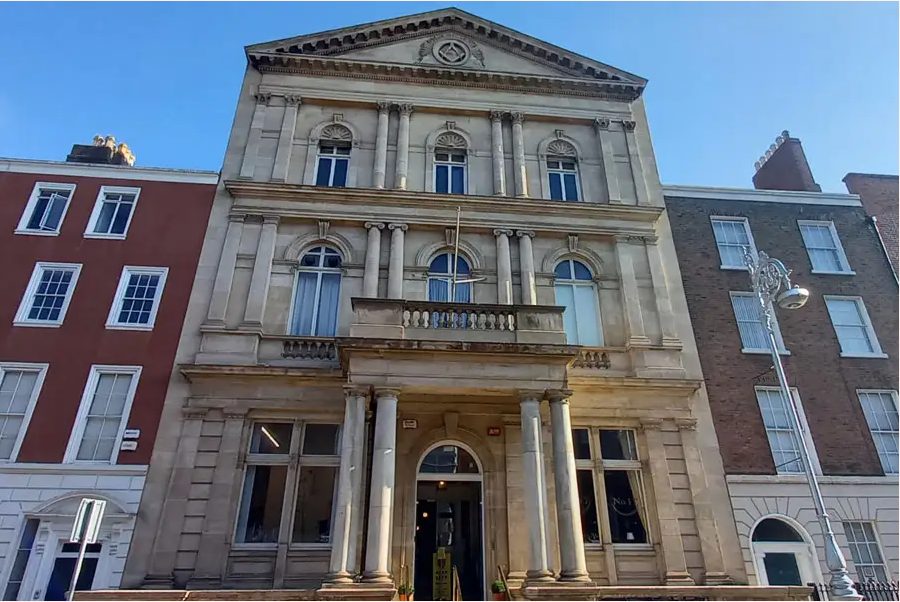
Molesworth Street he sees "Sir Frederick Falkiner going into the
freemasons' hall." Then he is at "Kildare street,"
but before he can turn left and enter the library he spots
Boylan coming toward him and veers in the opposite direction:
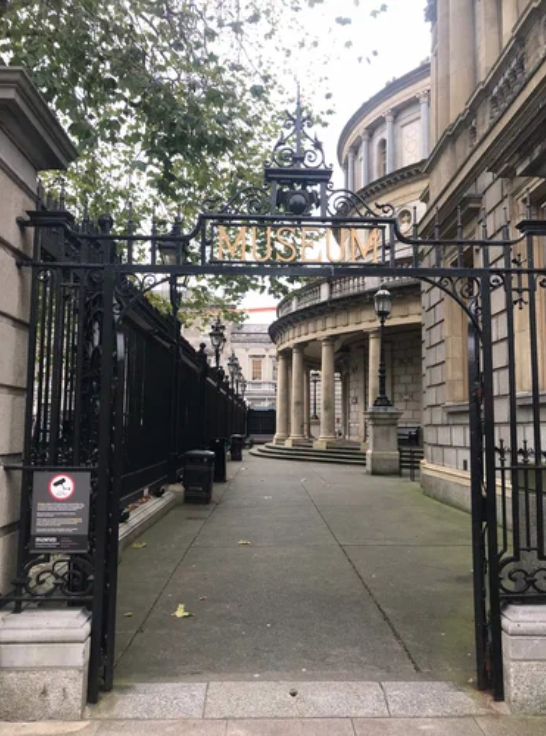
"His heart quopped softly. To the right. Museum.
Goddesses. He swerved to the right." Moving as quickly as he
decorously can, and glancing back to make sure Boylan is not
following him, he attains the safety of "the museum gate"
and goes in.