The first nine chapters of Ulysses were stunningly
avant-garde in 1922 and remain challenging today, but after
readers get used to the newness of what Joyce called the
"initial style" of his novel they can at least count on it
continuing. That rug is pulled out from under them in the last
nine chapters, which embark on a kaleidoscopic succession of
viewpoints and styles, changing the rules of narration each
time. Chapter 10, the first real departure from normalcy,
takes some cues from chapter 7, the first apparent one. Aeolus
violates the procedure of focusing intensely on either Stephen
(chapters 1-3 and 9) or Bloom (chapters 4-6 and 8). It begins
with an impersonal survey of Dublin's central business
district, and it makes the book's protagonists seem no more
important than anyone else. Language proliferates for its own
sake, obeying obscure rhetorical precepts, and the story is
broken up into sections announced by newspaper-like headlines.
But all of these innovations have an ephemeral quality, like
fog that burns away on closer inspection. Stephen and Bloom
both have productive goals in mind, unlike the other men seen
idly whiling away time in the newspaper office. The artful
linguistic effects of the prose amount to little more than
insignificant puffs of sound which the chapter analogizes to
unruly winds. And Joyce added the newspaper-like sections late
in the process of composing the chapter, imposing what may
seem like a radically new structure on a narrative whose sense
would not really be different if the headlines were removed.
The changes in Wandering Rocks are more substantial.
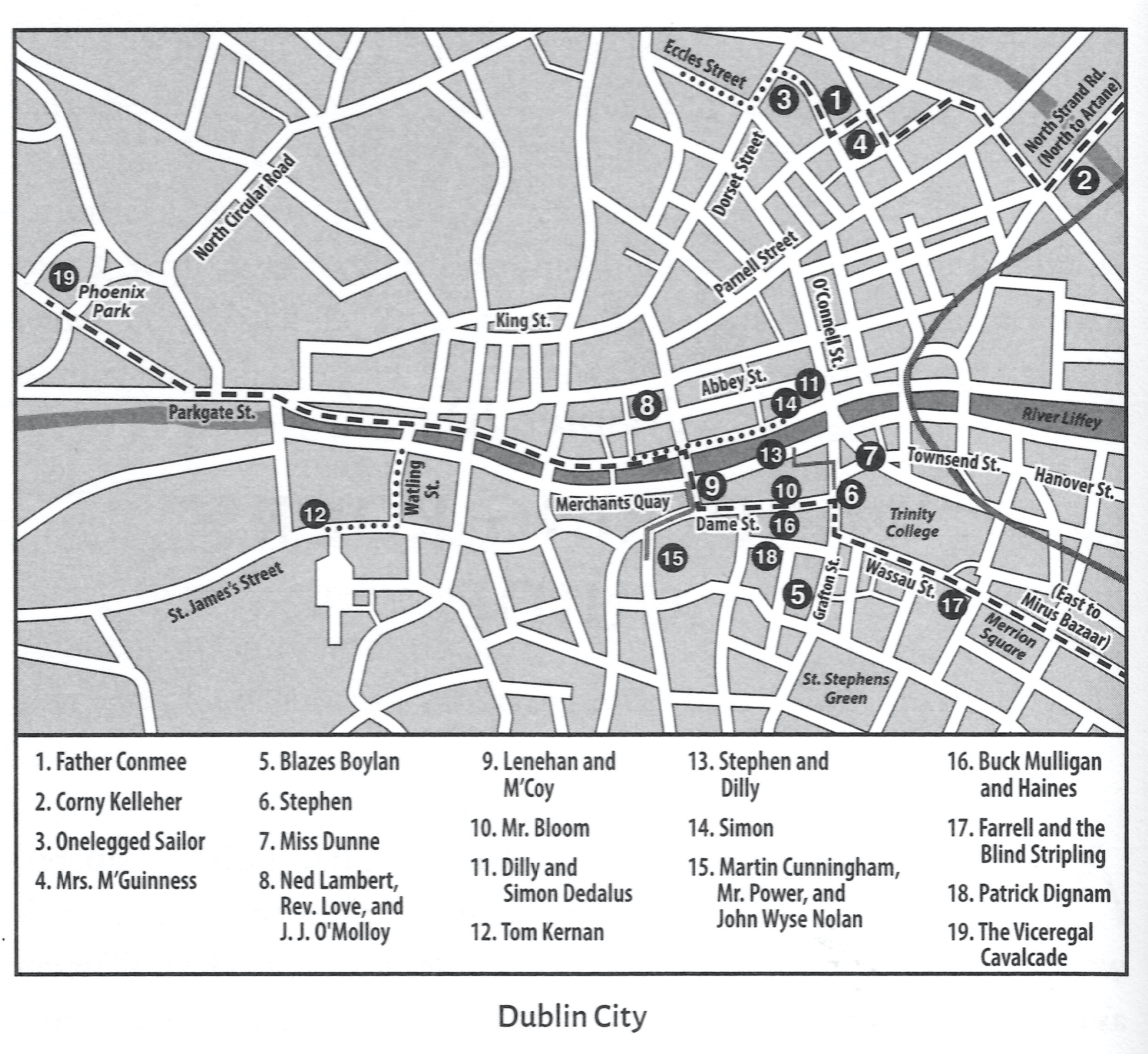
Instead of photographing just a block or two of Sackville
Street, the narrative pans out to look at much of Dublin,
assembling a collective portrait from vignettes snapped in
many different locations. Stephen and Bloom become just two of
many figures crawling over the surface of the city, and
several minor characters—Father
Conmee, Tom Kernan, Patsy Dignam—are
dignified with free indirect narration and interior monologue.
Also, for perhaps the first time in the novel, making sense of
the physical locations of streets and buildings seems as
pressing a concern for readers as making sense of the
psychological conditions of people. The nineteen sections are
truly discontinuous stories, though their actions often
intersect––as seems appropriate to a busy urban center humming
on a weekday afternoon. The language is less showily
artificial than that of Aeolus, but it is cunning,
introducing ambiguities and coincidental connections that
complicate readers' responses.
After the intense literariness and braininess of episode 9,
where writers in a library listen to an account of
Shakespeare's dramatic genius that offers keys to
understanding Ulysses itself, books play a much
smaller role in Wandering Rocks. Both Stephen and
Bloom peruse them at bookstalls, Haines is happy to have found
his copy of Douglas Hyde's poems, and Dilly Dedalus is
guiltily thrilled to have purchased a French primer. But these
are small moments, devoid of much intellectual interest and
outweighed by a world of people going about their daily
business: eating food, procuring it, seeing others, being
seen, helping others, not helping them, working, pretending to
work, looking for ways to obtain money, dodging creditors,
questioning life, cursing it, consuming alcohol, playing
chess, betting on horses, running a business, and so on.
Threads of money, wealth, and poverty run throughout the
chapter.
The relative indifference to literature extends to the
Homeric analogues that structure Ulysses. While those
intertextual conversations seem more substantial in some
chapters than in others, only this one dares to make something
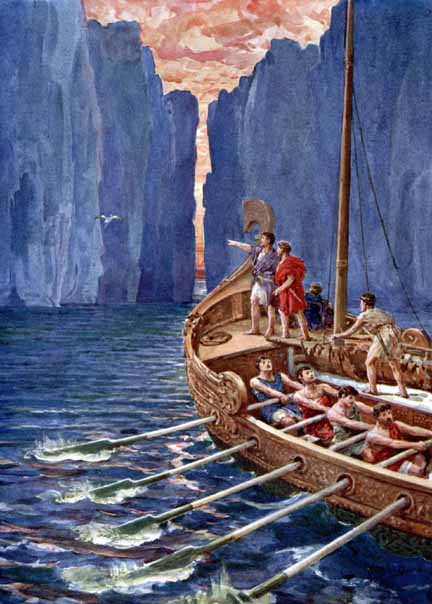
of nothing. In book 12 of the Odyssey Circe tells
Odysseus that he can either risk the channel between Scylla
and Charybdis or attempt a passage that has only been survived
once:
The blessed gods call these the Wandering Rocks.
No birds can fly through safe, not even doves,
who bring ambrosia to Zeus. One dove
is always lost in that sheer gulf of stone
and Zeus must send another to restore
the number of the flock. No human ship
has ever passed there. When one tries to enter,
the waves and raging gusts of fire engulf
ship timbers and the bodies of the men.
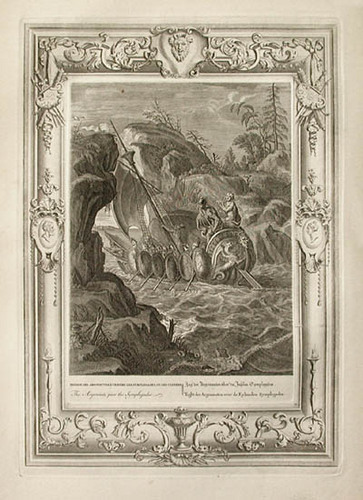
Only the famous Argo sailed through there
returning from the visit with Aeetes.
(Wilson)
These terrors are usually identified as the Symplegades, two
rocks in the Bosporus strait that were said to crash against
one another. (The name is compounded from words meaning "to
dash together.") Odysseus decides to risk Scylla and Charybdis
rather than follow Jason through this gauntlet, and the poem
never visits the Wandering Rocks.
But Joyce wanted to evoke the voyage that Homer merely
alludes to. In the schema that he gave to Valery
Larbaud late in 1921, and subsequently to several other men,
he noted that the River Liffey plays the part of the
"Bosporus," the Viceroy is the "European Bank" of that strait,
Father Conmee is the "Asiatic Bank," and the Symplegades are
"Groups of Citizens." The Liffey indeed plays a central role
in this episode. After starting in the northern parts of
Dublin in sections 1-4, most of the remaining sections take
place not far from the river. Sections 7-15 in particular
all take place on the quays or within a couple of blocks of
them, jumping back and forth repeatedly between the north and
south banks.
The other schema, given to Carlo Linati in 1920, identifies
the Persons of the chapter as "Objects, Places, Forces,
Ulysses," the Sense as "The Hostile Environment," the Art as
"Mechanics," and the Technic as "Labyrinth moving between two
banks." In that prior schema Joyce also listed the Organ as
"Blood"––a stream in which things crash against each other.
Among several examples of Symbol he named "Christ and Caesar,"
suggesting that Conmee's long journey in section 1 and the
viceroy's long journey in section 19 are meant to evoke
structures of Church and State that bracket Dubliners'
journeys through life.
These symbolic suggestions are worth attending to, but before
readers can do much with them they must first make sense of
where the actions of the chapter are taking place, and when.
In Proteus Stephen mused that he was walking in "A very short
space of time through very short times of space." It
is easy to imagine this gnomic sentence triggering the
composition of Wandering Rocks. The chapter charts the
paths traced by numerous pedestrians (as well as a few people
riding in vehicles), and it also appears to track the passage
of time involved in those journeys, meticulously connecting
the two in an intricate spatiotemporal matrix.
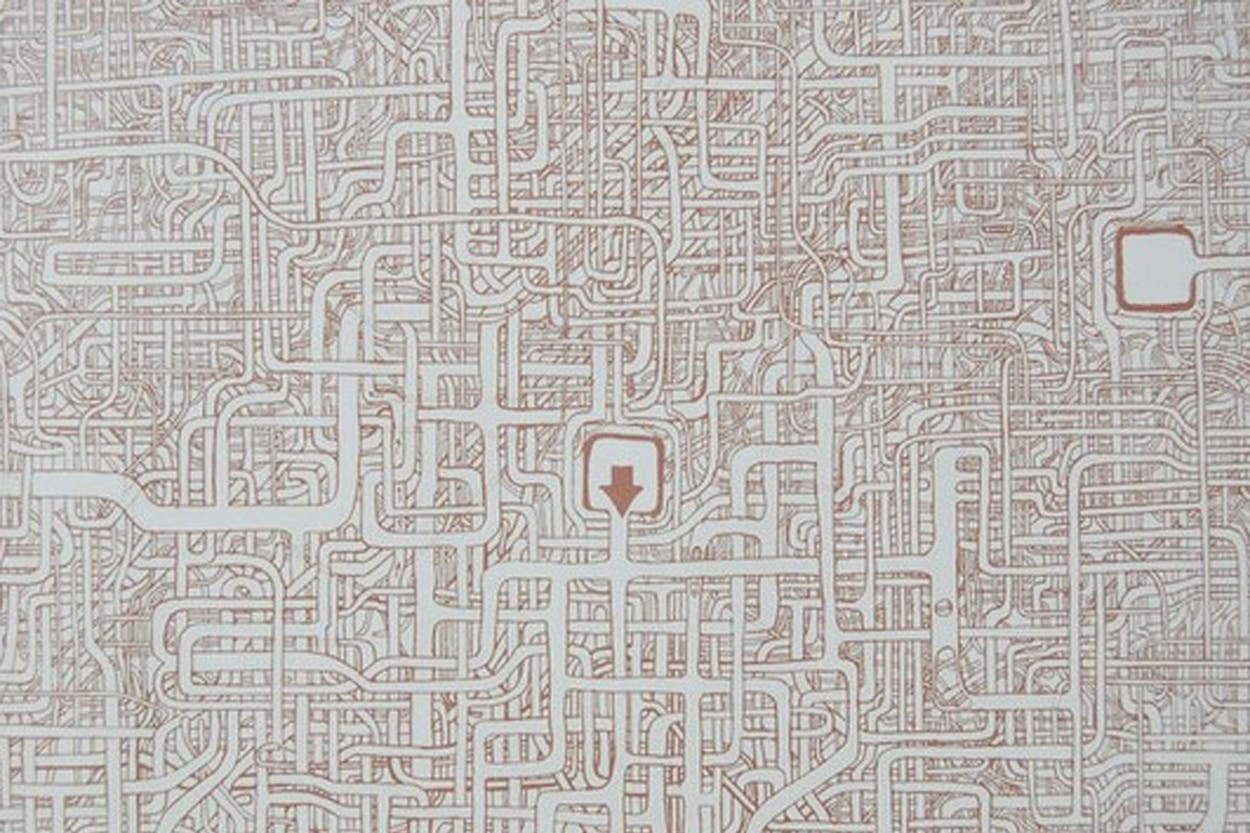
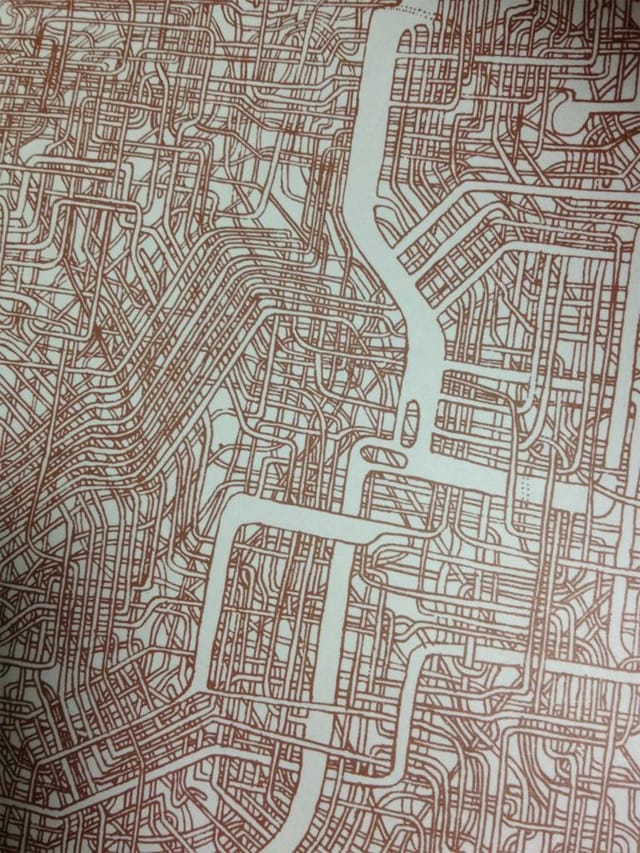
In James Joyce and the Making of Ulysses, Frank
Budgen wrote that "Joyce wrote the Wandering Rocks
with a map of Dublin before him on which were traced in red
ink the paths of the Earl of Dudley and Father Conmee. He
calculated to a minute the time necessary for his characters
to cover a given distance of the city.... While working on Wandering
Rocks Joyce bought at Franz Karl Weber's on the
Bahnhofstrasse a game called 'Labyrinth', which he played
every evening for a time with his daughter Lucia. As a result
of winning or losing at the game he was enabled to catalogue
six main errors of judgment into which one might fall in
choosing a right, left or centre way out of the maze"
(122-23). Readers of the chapter must play a similar game in
most sections.
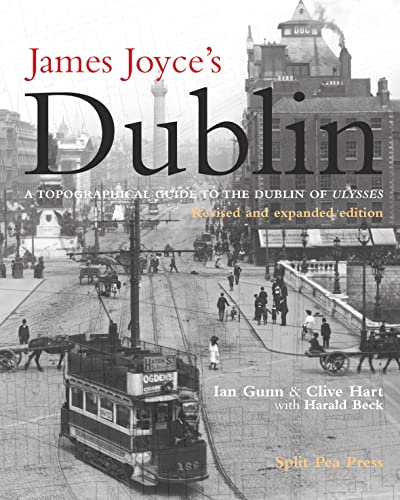
The critic who has done most to chart the dizzyingly complex
calculations involved is Clive Hart, notably in an essay on Wandering
Rocks published in 1974 in James Joyce's Ulysses:
Critical Essays, then in 1975 and 1976 with Leo Knuth in
A Topographical Guide to Ulysses, and finally in 2004
with Ian Gunn in James Joyce's Dublin: A Topographical
Guide to the Dublin of Ulysses, which also incorporates
insights offered by Harald Beck and Leo Knuth. My notes on the
chapter's nineteen sections draw on the work of Hart and his
collaborators and sometimes reproduce parts of Gunn's maps in
James Joyce's Dublin. I frequently cite and add to
Hart's insights, infrequently take issue with him, and
occasionally note work that he has done for which there is no
place in my notes.
Most of the places represented in Wandering Rocks can
be certainly and precisely identified, and even the ones that
cannot (the Dedalus home, the Dedalus girls' school, Miss
Dunne's office, Lynam's bookmaking operation, Bloom's
bookshop) can be inferred with some confidence. I repeat what
Hart and others have discovered on these questions, but I
reproduce only a little of what he says about the walking
paths of characters before or after their appearances in this
chapter. Readers who want to know more about this should look
for a copy of James Joyce's Dublin.
On matters of time, too, I refer to Hart's work selectively.
In his 1974 essay and in his 2004 book he published an
ambitious chart of times which, taking a cue from Joyce
calculating "to a minute the time necessary for his characters
to cover a given distance," attempts to identify exactly when
most of the chapter's actions take place. The schemas identify
the hour as 3-4 PM, the chapter starts with Father Conmee
consulting his watch at 2:55, and a passage in Penelope
reveals that the Dedalus girls pass Molly's house at 3:15, but
these teasing details are the only ones that Joyce gives his
readers. (The teasing is quite real. He shows characters
consulting watches or clocks three more times but does not
document what they learn.) Hart's response was to identify all
the paths and walk them repeatedly at reasonable paces,
measuring the times, averaging the results, and correlating
actions in different sections. I admire his scrupulousness but
I do not understand all the principles by which he correlated
disparate actions, and I question how valuable his elaborate
chart may actually be for making sense of the chapter as one
reads.
My notes explore some other questions about time. As a
general principle, Joyce creates an impression of forward
temporal progression from section to section by showing
successive actions performed in them, whether in the main
blocks of text or in interpolations. (In sections 3 and 4, for
example, we see Katey and Boody on the sidewalk and then at
their home. Similar examples can be found in 1-3-16, 3-9, 5-7,
6-17-19, and 9-10.) The arrow of time does not always move
neatly forward, however. Section 2 occurs at a moment that
must be earlier than the end of section 1. Another general
principle, articulated by Hart and repeated by many other
scholars, is that the interpolations show temporal
simultaneity across spatial distance. But, again, there are
exceptions. Interpolations in sections 9 and 10 show things
happening around the Four Courts building that seem to
correlate to actions represented in section 19, but in fact
both of them are happening a bit earlier. Here the principle
of moving forward in time from section to section is
preserved, but the principle of interpolations marking
simultaneous occurrences is not.
Joyce also challenges his readers by thwarting the
expectations he creates about interpolations. Some sections
contain as many as three or four, while several (6, 17, 18,
19) lack them entirely. Some sections (2, 5, 9, 14, 15)
contain sentences that appear to be interpolations but really
are not, or not quite. Some contain interpolations (the bike
race in 11, the crumpled paper floating down the Liffey in 4,
12, and 16) that do not refer to any action represented
narratively in another section. One (in section 5) jumps not
only to an earlier section (1) but to a still earlier action
that the principal character there may be remembering. The
first and third interpolations about the throwaway show it
floating "eastward," but the second shows it moving
cryptically "westward," a little after another interpolation
in section 12 shows Denis Breen moving in the
opposite direction from when he was last seen. Readers
must constantly be alert to such tricks, which are a good
reminder that for all his maniacal love of systematic order
Joyce was never content to reduce things to a system. Artistic
freedom and whimsy invariably prevail.
In his 1974 essay, Hart notes another kind of devious
patterning: the thematic burden of the interpolations, which
not only play with space and time but also imply similarities
or differences with the people represented in the surrounding
section. Usually suggestive indications of linkage can be
found, Hart suggests, in sentences immediately before or after
the interpolation. Pursuing these, he reproduces each
interpolation of the chapter along with some nearby text and
identifies what he sees as linking elements. In three cases he
admits that he has come up empty, but his honesty about those
rare exceptions only strengthens his overall claim. I pursue
these leads, often adding to Hart's observations. In two of
the three instances where he confesses himself stumped (in
sections 14 and 16), I offer possible thematic links.
I follow Hart's lead too in noting instances of still another
kind of patterning that Joyce worked into his text: misleading
linguistic constructions. As he observes, the chapter's first
words, "The superior, the very reverend John Conmee,"
refer to the priest's title, a noun, but manage to suggest
adjectivally that he regards himself as one of the
elite––which he does. When Conmee thinks a bit later that Mrs.
M'Guinness has a "fine carriage" he is referring to her
manner of holding herself, but a reader may be forgiven for
supposing (not unreasonably, given the aristocratic tenor of
the priest's thoughts) that she owns a grand vehicle. Other
statements are simply false: in the final section, the
observation that "The viceroy was most cordially greeted on
his way through the metropolis" is not borne out by many
of the examples cited later.
Similar misleading ambiguities arise with names. In section 8
"Mary's abbey" is mentioned twice, but does that refer
to the abbey chapterhouse or to the nearby street? (Yes.) Are
"Jimmy Henry" and "Henry Clay" somehow related
in section 15? (No.) Is the "Lewis Werner" in section
17 the "Louis Werner" mentioned in Hades? (No.) Do "Mr
Bloom's dental windows" in section 17 have anything to
do with the novel's protagonist? (No.) In much the same way
that readers of this chapter must continually struggle to
understand where in Dublin they are, with whom, at what time,
and why bits of unrelated action keep flashing into their
field of view, simply making sense of words and phrases can
require keen navigational skills.