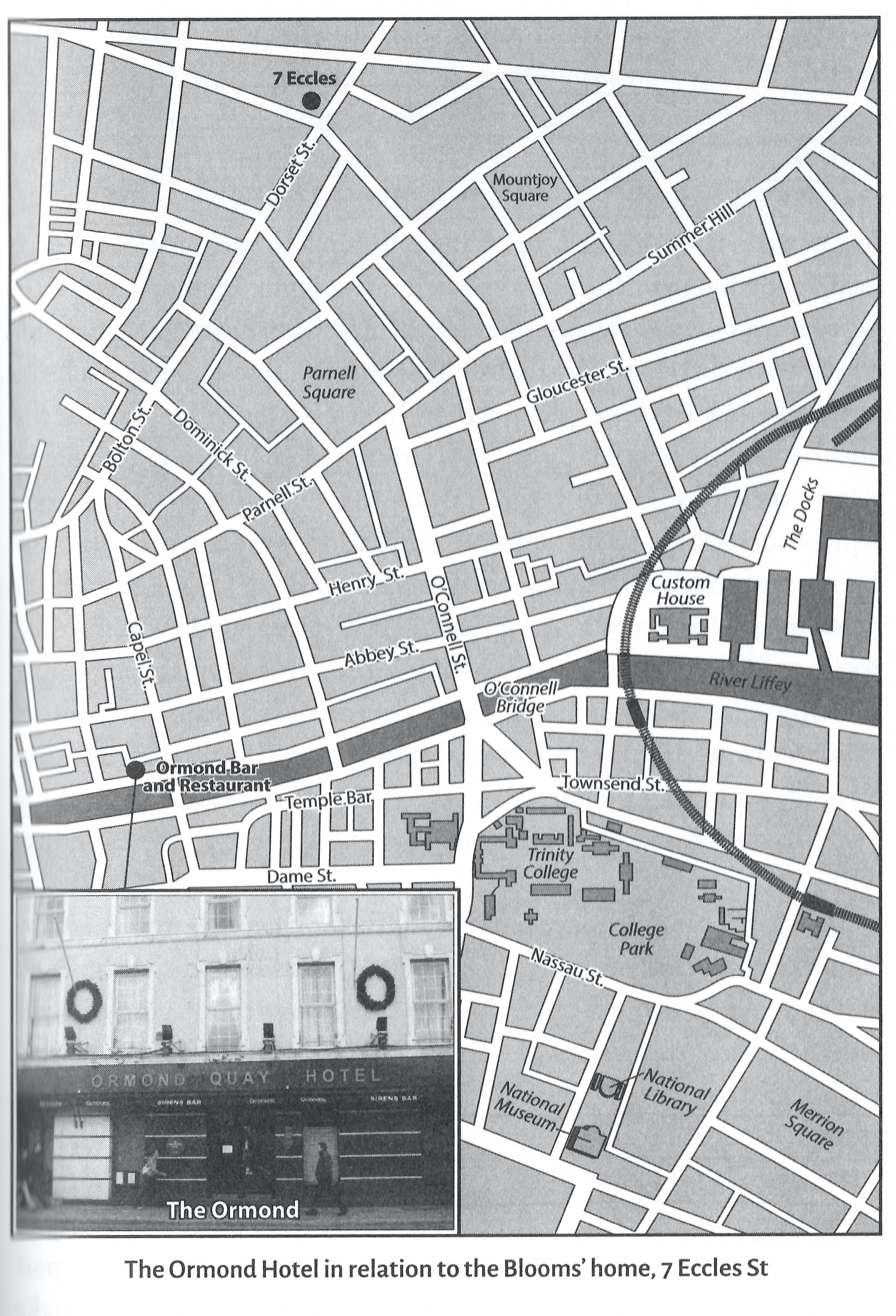
Episode 11, "Sirens," takes place between 4 and 5
PM, most of the action happening in the bar, restaurant, and
"saloon" (a small concert space) of a
hotel on the northern quays
where Bloom sees Blazes Boylan depart for his assignation with
Molly. From passages in book 12 of the
Odyssey, Joyce
conceived some key narrative elements: two beautiful and
seductive young women, some emotionally compelling songs, a man
listening from afar, threats of destruction. He made this a
chapter about music, just as
Hades is about death,
Aeolus
about rhetoric, and
Lestrygonians about eating. In
addition to representing the performance of several actual songs
(nearly every word of
one
appears in the text),
Sirens is composed of words that
aspire to the condition of music. Through repetition,
onomatopoeia, alliteration, assonance, fragmentation, rhythmic
organization, and other devices, words are freed from rigidly
sematic contexts and converted into quasi-musical motifs. Joyce
was deluded in his pretentious claim to have created the
equivalent of a baroque fugue, but he beautifully succeeded in
blurring the boundary between literature and music.
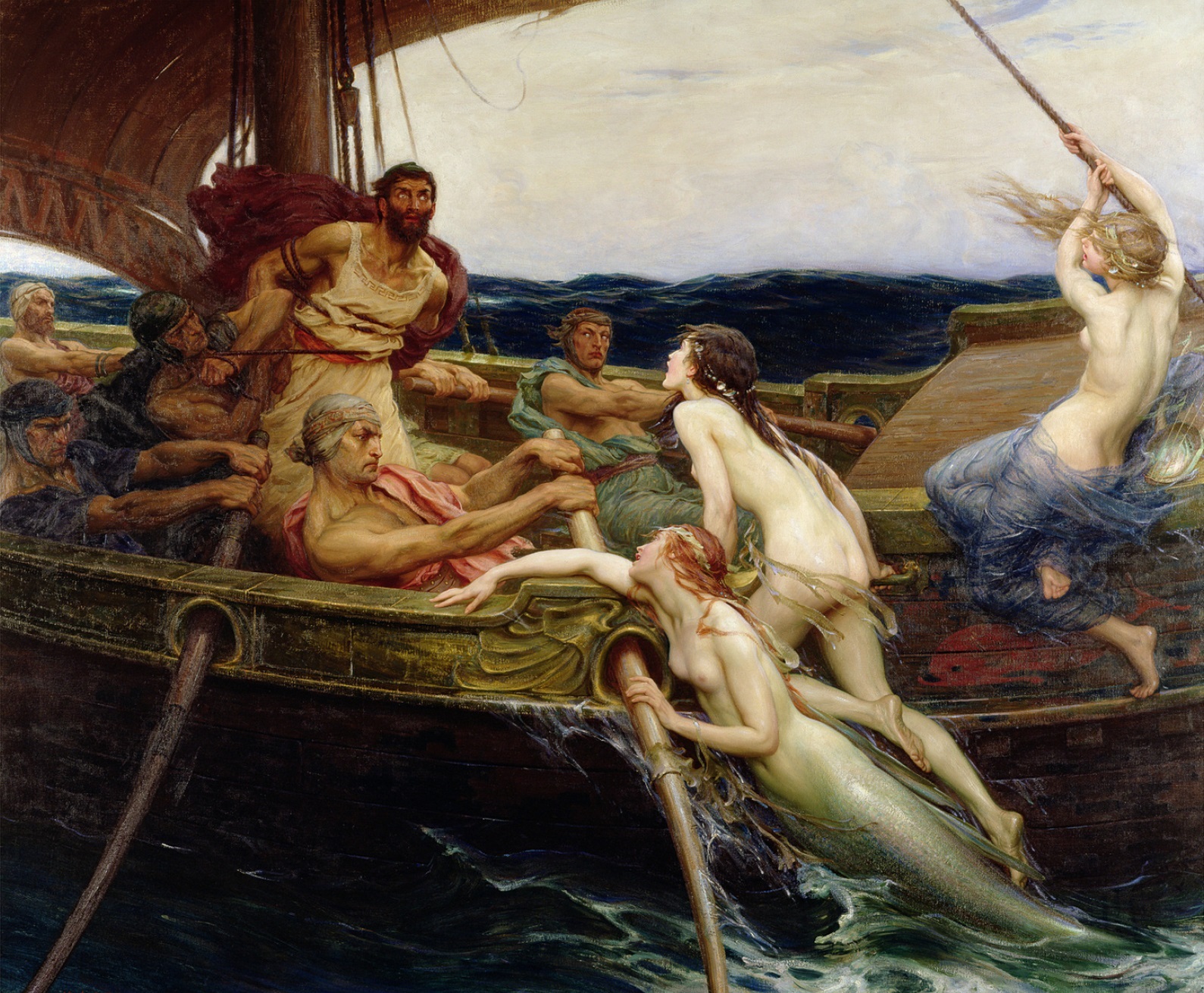
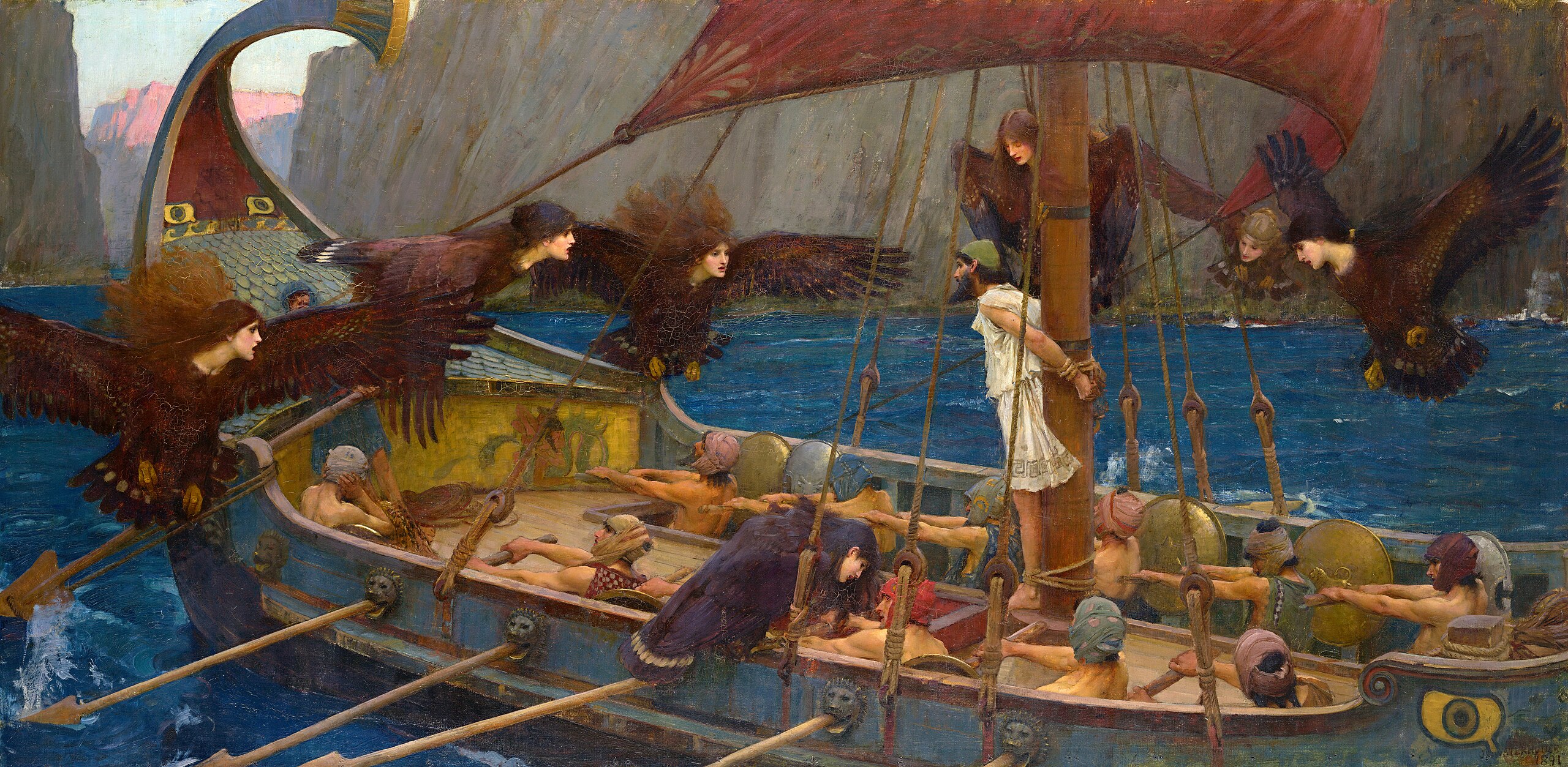
In one passage of book 12, Circe tells Odysseus how to
listen to the seductive song of some sea nymphs without being
destroyed. In another part of the same book, the hero follows
her advice. The Greek mythological figures called Sirens do
not appear in any existing classical literature before the Odyssey,
and Homer does not describe, number, or name them. Only three
things are certain: they are female, they inhabit a coastal
plain, and they lure sailors to destruction by singing
"piercing songs. Around about them lie / great heaps of men,
flesh rotting from their bones, / their skin all shriveled up"
(12.45-47, trans. Wilson). Circe tells Odysseus that when his
ship passes by this coast he should plug his men's ears with
wax and have them bind him tightly to the ship's mast so that
he can hear the beautiful music without succumbing to its
seductive lure. The hero exactly follows her advice, gaining a
rich experience while bypassing a mortal peril.
As in many other chapters in Ulysses, a short but
imaginatively rich incident generates a wealth of imagistic
details. Two attractive young women work behind a bar
described as a "reef of counter," in "cool dim
seagreen sliding depth of shadow." One of them has just
returned from a seaside vacation, "Lying out on the strand
all day.... Tempting poor simple males," and she
has brought back a lovely seashell, a "spiked and winding
seahorn" (probably a conch) that makes haunting sounds when
held to the ear. Darting to the window to see a young man in
the viceregal cavalcade who is turning to look at her, she
laughs through "wet lips" and tells her companion that "He's
killed looking back.... Aren't men frightful idiots?"
Other men enter the bar and flirt with the women, and
eventually three of them perform well-known songs to piano
accompaniment, in front of "a dusty seascape" depicting "A
headland, a ship, a sail upon the billows.... A
lovely girl, her veil awave upon the wind upon the headland,
wind around her." From his perch in the dining room next
to the bar, Leopold Bloom listens to the songs, watches the
women listening to them and to the seashell, and thinks of "lovely
seaside girls." Unwinding an "elastic band," he weaves
it around his fingers in some kind of cat's cradle, leaving
them "gyved...fast" like Odysseus to his mast.
Aeolus, fabricated from imagistic reminders of
Homer's story about the winds and the rhetorical devices that
are their everyday equivalent, quotes from three actual
speeches exemplifying Aristotle's three kinds of rhetoric. In
Sirens the imagery suggestive of Homer's seductive
nymphs is complemented by three actual songs of "Love and
War." As Bloom listens to them, emotion wells up in
him—understandably, since Molly has told him that Boylan will
be coming to see her "at four" (the hour when the chapter
begins) and Boylan makes an appearance at the Ormond Hotel bar
on his way to Eccles Street. Bloom becomes an Odysseus figure
both by being susceptible to these rushes of strong emotion
and by distancing himself from them. He thinks about music
with critical detachment, musing in his wry layman's way on
its calculating devices and mysterious powers.
Joyce too was thinking abstractly about music as he wrote the
chapter, and more ambitiously, though it seems likely that his
knowledge of musical theory was little better than Bloom's.
Ellmann records remarks that he made to Georges Borach on 18
June 1919: “I finished the Sirens chapter during the last few
days. A big job. I wrote this chapter with the technical
resources of music. It is a fugue with all musical notations:
piano, forte, rallentando, and so on. A quintet occurs
in it, too, as in Die Meistersinger, my favorite
Wagnerian opera…. Since exploring the resources and artifices
of music and employing them in this chapter, I haven’t cared
for music any more. I, the great friend of music, can no
longer listen to it. I see through all the tricks and can’t
enjoy it any more” (459). The disenchantment was probably
temporary, but the grandiose affectation was only too
enduring. Ellmann goes on to remark that Joyce later went with
Ottocaro Weiss to see Wagner's Die Walküre, and at the
intermission he asked his friend, "Don't you find the musical
effects of my Sirens better than Wagner's?" When Weiss
said no, "Joyce turned on his heel and did not show up for the
rest of the opera, as if he could not bear not being
preferred" (460).
Sirens displays many impressive quasi-musical effects,
but Joyce's efforts to treat it as a genuine musical
masterpiece seem pretentious and defensive. Whatever he may
mean by a "quintet"—probably the moment when "Lidwell, Si
Dedalus, Bob Cowley, Kernan and big Ben Dollard," "true men"
all, lift glasses—it can hardly be equivalent to what Wagner
does. Effects like piano (quiet), forte
(loud), and rallentando (gently slowing down) are so
laughably basic as to demean anyone who prides himself on
using such "technical resources." Most pretentious of all is
the claim to have written a fugue. In both schemas Joyce
identified the Technic as "Fuga per canonem," and in a letter
he told Harriet Shaw Weaver that the chapter had "all the
eight regular parts of a fuga per canonem" (Letters
1.129). Notwithstanding the fact that this is not a commonly
recognized term in musical theory ("fugue" is, but per
canonem?), literary critics have been all to willing to
hear in this authorial boast an indication that Sirens
possesses some dauntingly intricate structure. Many have
labored to explain how the prose exemplifies it, prompting
many others to mindlessly repeat the critical mantra: fuga
per canonem....
This whole critical endeavor has the feel of a snark hunt.
Literary texts, which move forward one word at a time, simply
cannot reproduce the contrapuntal effects of a fugue, in which
multiple melodic lines sound simultaneously, pursuing separate
horizontal paths but coinciding vertically in harmonious
intervals. Poetry and prose fiction can certainly accomplish a
complex interweaving of themes, and they can be contrapuntal
in the loose sense of having different voices answer one
another successively, but they cannot do so
simultaneously. To achieve true contrapuntal polyphony in the
medium of language, speakers would have to perform separate
texts at the same time—a kind of supra-literary vocal
performance art which Sirens does not attempt.
One might argue that Joyce's per canonem implies
something simpler. A "canon," or "round," is a more basic
contrapuntal form in which a melody is repeated unchanged over
and over again. Such songs (Three Blind Mice, "Row,
row, row your boat," Frère Jacques) are far less
complicated than the fugues written by Bach and other Baroque
composers, but they too are impossible to replicate in a
literary medium. And Joyce's strange reference to the "eight
regular parts" of a fugue suggests that he was thinking of
something decidedly un-simple.
Susan Brown has offered to dispel the air of grandiosity in
Joyce's self-advertisements, and to undermine the critical
hunt for intricate contrapuntal structure in Sirens, in
an article titled "The Mystery of the Fuga Per Canonem
Solved," published first in Genetic Joyce Studies 7
(2007) and then in European Joyce Studies 22 (2013):
173-93. As a result of scrutinizing one page in a long-lost
trove of Joyce's manuscripts and notes, Brown reports that
Joyce's notion of a fugue in eight "regular parts"—a
theoretical entity that no musician has ever heard of—came
from superficial impressionistic reading of an article by
Ralph Vaughan Williams in the second edition of Grove's
Encyclopedia of Music, published from 1904 to 1910. On
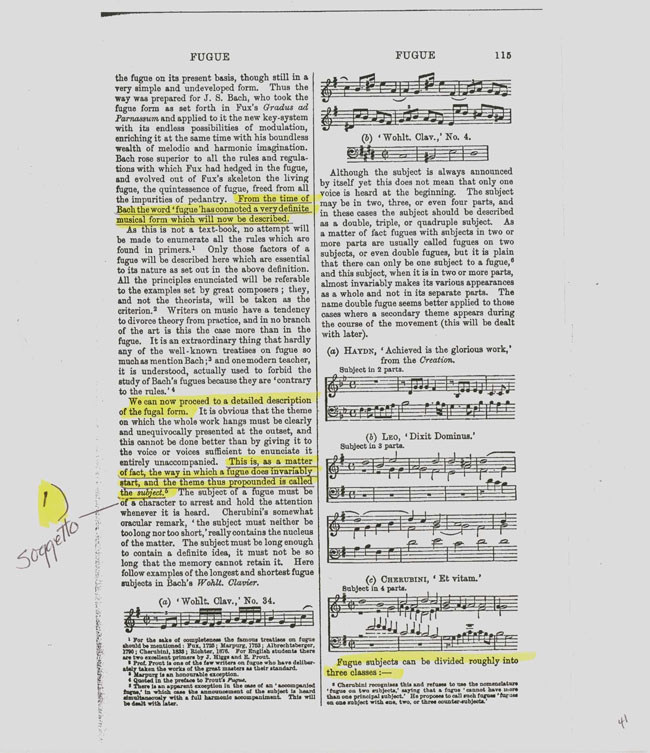
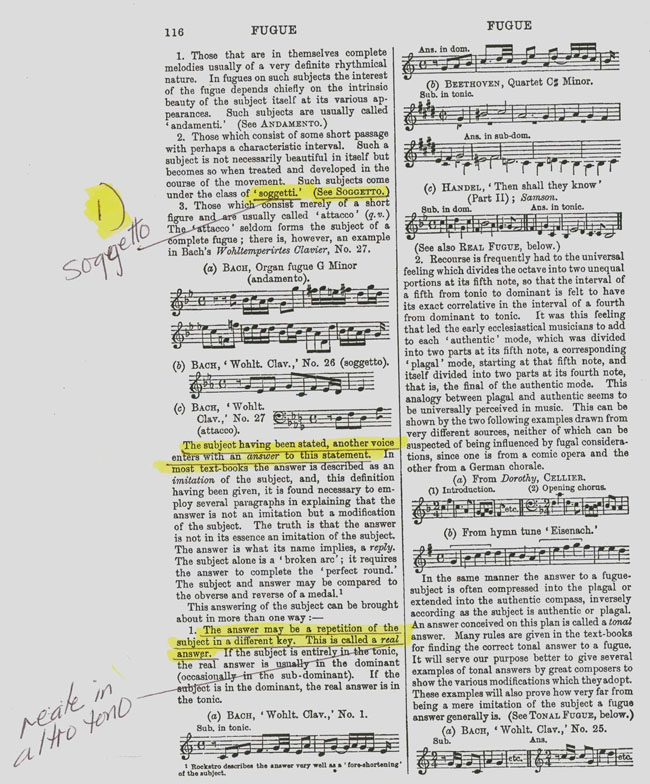
the inside cover of a copybook Joyce listed, in Italian, eight
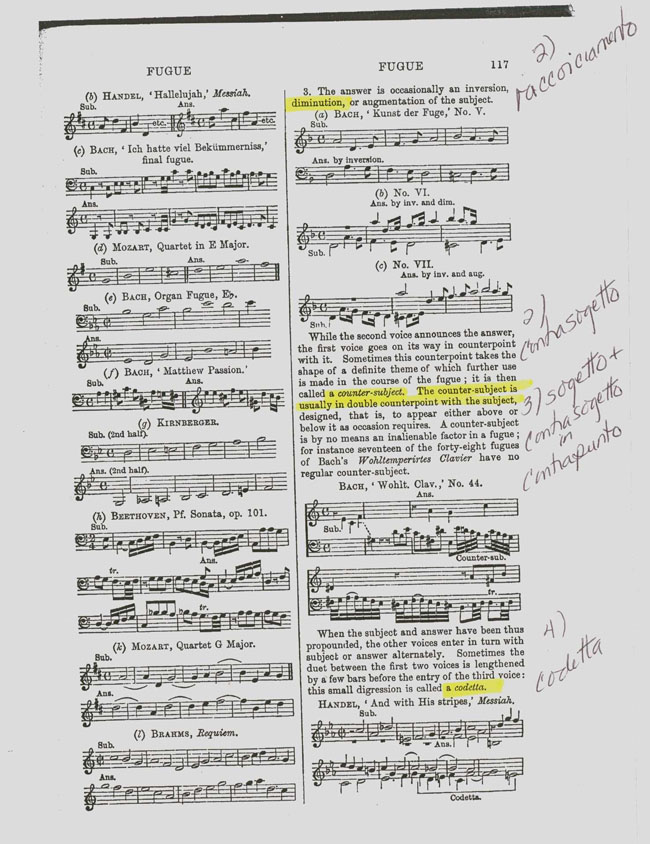
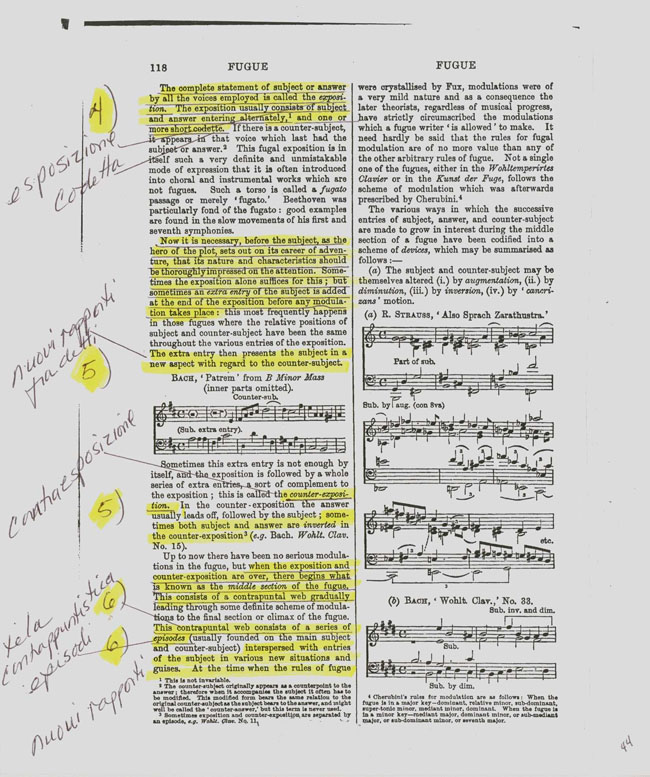
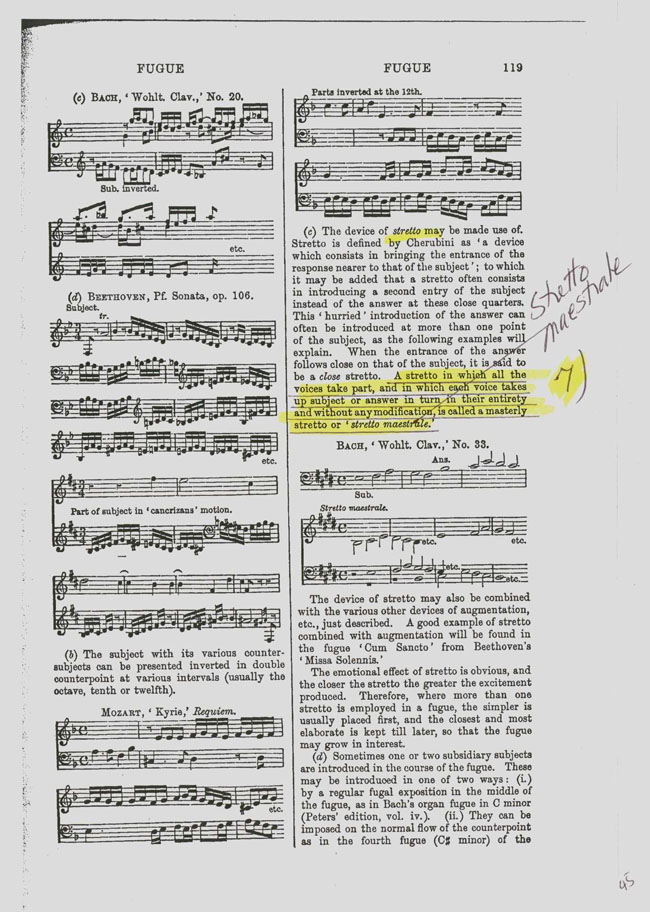
elements of a "Fuga per canonem"—terms like "subject,"
"answer," and "countersubject"—that he apparently intended to
graft onto the chapter that he had begun working on.
Joyce was a magpie and a skimmer of texts, but when dealing
with things like literature and philosophy he had an uncanny
facility for pulling out details that would establish a rich
intertextual dialogue with his own writing. Brown argues that
his engagement with the Grove encyclopedia entry, by contrast,
represents "pure cribbing." "Fuga per canonem" reflects his
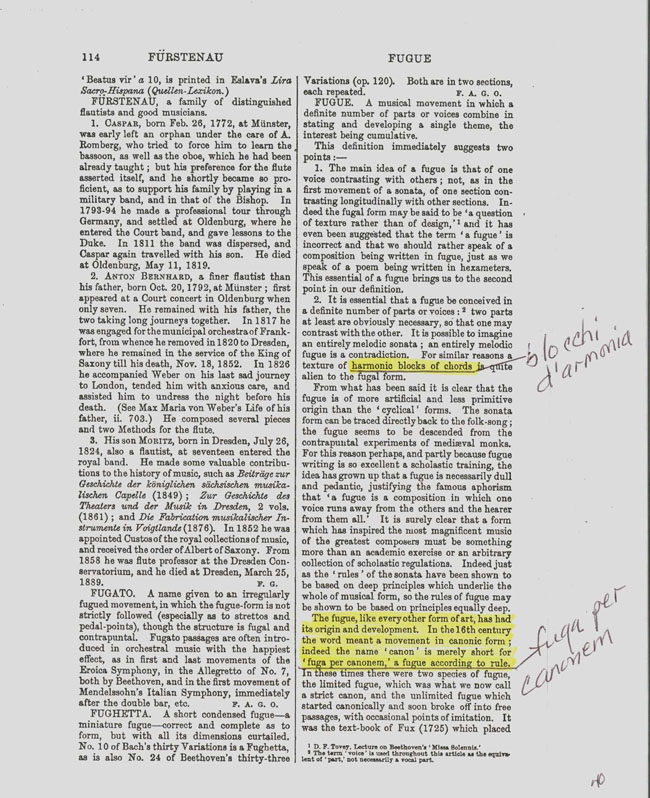
misunderstanding of Vaughan Williams's observations early in
the article (on the first page reproduced here) that "a form
which has inspired the most magnificent music of the greatest
composers" (i.e., works by Bach and others) began much more
simply: "In the 16th century the word meant a movement in
canonic form; indeed the name 'canon' is merely short for
'fuga per canonem', a fugue according to rule." Some people in
that era practiced the "limited fugue" or "strict
canon"—simple rounds of the Frère Jacques variety.
Others played with freer forms that ultimately led to the
splendid complexity of the Baroque era. Joyce got it exactly
backwards, then: canonem refers to the simple
precursors from which fugues later evolved, not to a
hyper-complicated structure.
Brown attempts to puzzle out what Joyce wrote down about the
eight elements of a complicated fugue and what he meant by
them. Her specific findings do not bear repeating here, but
her assessment of their overall significance does. Vaughan
Williams, she notes, was describing possible elements
that a fugue might feature, not "regular parts," and Joyce
grasped very little of their complex musical significance. His
purported mastery of fugue theory was "bogus to none," and he
used the terms he cribbed from Grove's as "an
inspiration—not a template" to start playing with language in
new ways in Sirens. Even his reference to a quintet in
Die Meistersinger appears to come from the same essay
in the encyclopedia. None of this means that he was not
thinking of his eight terms as he introduced different
characters and themes into his chapter—probably he was—but it
does mean that readers need not search for some fiendishly
intricate theory to make sense of the verbal patternings in Sirens.
Probably only one structure in Sirens could not have
been conceived without the example of a musical structure. The
chapter begins with a list of verbal motifs divorced
from any narrative framework. After nearly five dozen
fragmentary non-paragraphs, ending with "Done," someone says,
"Begin!" and a recognizable narrative commences. All of these
clusters of words eventually appear in the narrative, and much
of the pleasure of reading it consists in retrospectively
learning what events they reference. This structure may well
be unprecedented in literature, but every operagoer will
recognize what is happening. Operas often begin with an
instrumental overture in which musical themes that will appear
later in the work's arias, duets, and choruses sound before
anything happens on stage. People who already know the work
can take pleasure in being reminded of what is to come. People
who are new to it can be introduced to themes that they will
soon hear developed more fully.
Mozart, Rossini, Bizet, and Verdi all practiced this kind of
musical foreshadowing, but the composer through whose writing
it gained a technical name (though he did not himself use the
term) was Wagner—the artist of whom Joyce spoke to Borach and
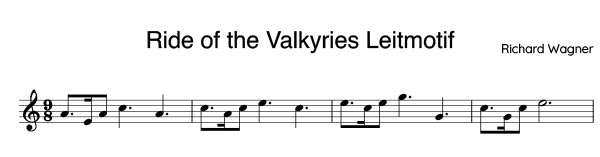
Weiss. The Wagnerian leitmotif is a melodic theme
that, instead of belonging to one musical number, becomes
recurrently associated with a character, situation, object, or
idea. Some even recur throughout the Ring cycle. Sirens
develops very comparable aural motifs associated with
characters, objects, and states of mind. Every careful reader
learns to recognize and enjoy the "tap tap tap" of the blind
piano tuner's cane, the "jingle" of Boylan's carriage bells,
the "blue" notes of Bloom's sadness, the "chips" of Simon's
fingernails, the "black deepsounding chords" of The Croppy
Boy, the distinctive rumblings of Bloom's intestines.
These are real aesthetic accomplishments of the chapter, not
mere pretensions to parity with great musicians. A few
ingenious critics may affect to hear the play of fugal
subjects and countersubjects in various sentences, but every
attentive reader will quickly learn to recognize these simple
aural themes and appreciate the lovely music that Joyce makes
from them.
Both schemas
list the Art of Sirens, unsurprisingly, as Music, and
its bodily Organ as the Ear. The Gilbert schema lists the
Symbol as Barmaids, and the Linati schema lists the Sense
(Meaning) as The Sweet Deception.