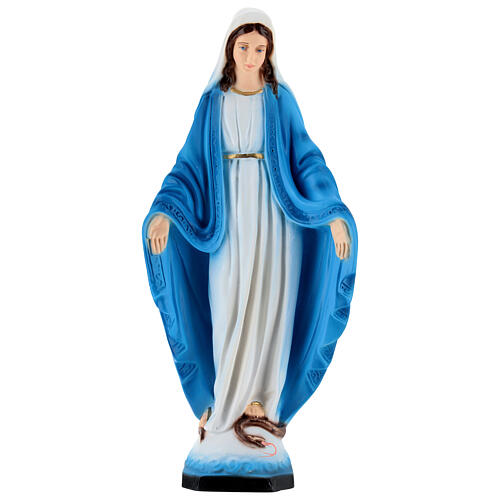
Countless works of religious art depict Jesus's mother in a blue
robe—a
motif which Joyce deploys
repeatedly in
Nausicaa. One other color is usually
involved, typically in the dress worn under the robe. This
second color is occasionally red, but more often white. "
Bassi's
blessed virgins" conform to the iconographic pattern: "
Bluerobed,
white under." About a page later in the text, and only a
few feet farther up the street, "
Ceppi's blessed virgins,
bright of their oils" presumably do so as well. The white
color seen "under" Mary's outer garment may appear to be only an
empirical observation. It proves to be something much more
disturbing.
Believers in Ireland, as in many other Catholic countries, keep
Virgin icons in their domestic spaces as perpetual reminders
that God's mercy to sinners, symbolized in a mother's selfless
love, is inexhaustible. The cultus of the Blessed Virgin arose
in the later Middle Ages as a popular antidote to harsher images
depicting God as a righteous and vengeful judge of human
frailty. Mother Mary acts as an intercessor between this angry
heavenly father and his incorrigible offspring. Beckoning
sinners with maternal love, she assures them that if they
confess their crimes, show contrition, and resolve to sin no
more, no transgression can exceed God's capacity for
forgiveness.
Stephen Dedalus was raised in this culture of venerating the
heavenly mother, but as an adult he scorns it. In
Scylla and
Charybdis, as elsewhere, he meditates on the
Trinitarian theology of Father
and Son as the true essence of Christian faith: "On that mystery
and
not on the madonna which the cunning Italian intellect
flung to the mob of Europe the church is founded." Mary is
a saint in the Catholic religion—the most blessed of human
beings, closest to God of all heaven's inhabitants—but she is
not divine. Bloom gets this wrong: "
God they believe she is:
or goddess." But it is a distinction that nonbelievers may
understandably fail to grasp, given the ardor with which
Catholics embrace their holy icon. Protestants call the devotion
mariolatry, "worship of Mary," and the freethinking Bloom jumps
to the same conclusion.
As an atheist skeptical of all religious doctrines, he takes
little interest in what the goddess statues might imply about
sin, atonement, forgiveness, or reconciliation. Instead he sees
simply a beautiful female figure, someone that a man might like
to fuck. In
Lestrygonians his distinctly
anal eroticism led him to
inspect one of the statues of Greek goddesses in the National
Museum to determine whether the sculptor provided her with an
anus, and now he recalls how his plan was thwarted when someone
spoke to him: "
Those today. I could not see. That fellow
spoke. A student. After with Dedalus' son. He might be
Mulligan."
If statues of Greek goddesses are capable of exciting erotic
interest, then why not Christian ones? Never mind the
puritanical piety of Christians as contrasted with Greek delight
in the naked human form. And never mind the clothes. Bloom lives
in a culture with strong taboos against the display of female
flesh, resulting in fetishization of undergarments. He suffers
from a bad case of underwear-lust, as Molly thinks in
Penelope:
"of course hes mad on the subject of drawers thats plain to be
seen always skeezing at those brazenfaced things on the bicycles
with their skirts blowing up to their navels even when Milly and
I were out with him at the open air fete that one in the cream
muslin standing right against the sun so he could see every atom
she had on...drawers drawers the whole blessed time."
Seen through this particular lens, the statues in Bassi's and
Ceppi's shop windows acquire a most unorthodox kind of
significance: "
All comely virgins. That brings those rakes of
fellows in: her white." Comely virgins exist to be
deflowered, and the body language of this one says "
come to
me." Is it any wonder, then, that licentious young men
("rakes") may be carnally attracted to a young woman whose white
"
under"-garments are all too visible? Even today, no
commentators seem to notice this staggeringly blasphemous little
detail in
Sirens. If any of the censors in Joyce's day
had been good enough readers to spot it, perhaps his novel would
never have made it onto English, American, and (especially!)
Irish shores.