Book 5 of Homer's poem tells how Odysseus, who has gained his
release from Calypso's island, sails for many days and then is
shipwrecked by Poseidon. He washes up on an unknown beach
battered, exhausted, and naked, crawls under some bushes, and
falls asleep. Book 6 tells how, the next morning, the lovely
young princess of the Phaeacians who rule this island drives a
wagon loaded with clothes down to the water to wash them,
because she hopes to find a husband and must look her best.
She and her slaves do the laundry, bathe, rub oil into their
bodies, eat, and then throw a ball to each other. Nausicaa is
good at the play, but one of her companions fails to catch the
ball, which rolls into an eddy. Odysseus is waked by the sound
of women shrieking. He emerges naked, covered only with a
leafy branch, to the terror of the slave girls, but Nausicaa
stands her ground.
He wondered, should he touch her knees, or keep
some distance and use charming words, to beg
the pretty girl to show him to the town,
and give him clothes. At last he thought it best
to keep some distance and use words to beg her.
The girl might be alarmed at being touched.
His words were calculated flattery.
(6.142-48, trans. Wilson)
Addressing the young woman as if she might be a goddess, he
says, "that man will be luckiest by far, / who takes you home
with dowry, as his bride. / I have seen no one like you. Never,
no one. My eyes are dazzled when I look at you" (158-61).
Relating his ordeal, he begs her to give him some clothes and
show him the way to town: "So may the gods grant all your
heart's desires, / a home and husband, somebody like-minded"
(181-81). Nausicaa agrees, and after Odysseus washes the salt
from his hair and rubs his skin with oil, Athena makes him too
appear godlike: "his handsomeness was dazzling. The girl was
shocked.... Before, he looked so poor and unrefined; / now he is
like a god that lives in heaven. I hope I get a man like this as
husband" (238-39, 243-45). She tells him how to get to her
father's house but declines to accompany him, because people
would talk: "So they will shame me. I myself would blame / a
girl who got too intimate with men / before her marriage"
(284-86).
Joyce mimics every major element of this scene. Like
Nausicaa, Gerty MacDowell (for that is the maiden's name, dear
reader) prides herself on her clothes and longs to be married.
She goes to the seaside with some female companions to whom
she feels superior, not to wash clothes but to tend children.
The boys play with a ball and it finds its way to Bloom. He
throws it back and it lands at the feet of Gerty, who (less
athletic than Nausicaa, for reasons revealed later) attempts
to kick it back to the boys but misses. The interaction draws
her attention to the man, and his sad face moves her. Sounds
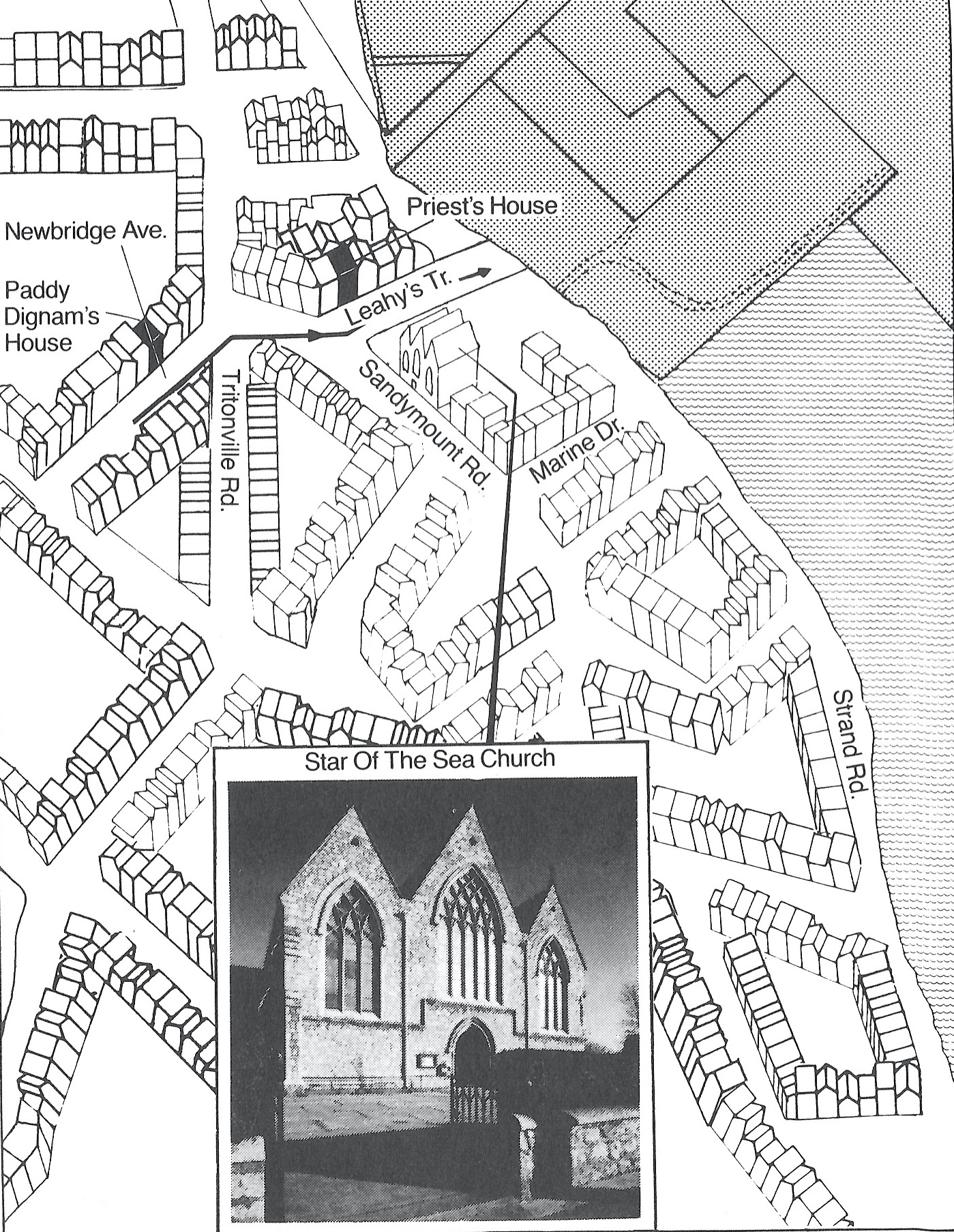
waft out of the Star of the Sea church, imploring the protectress of sailors, and as
the gazing progresses the foreigner's sad face becomes
phenomenally handsome, "the image of the photo she had of
Martin Harvey, the matinee idol."
All of these actions have clear analogues in the Odyssey.
Somewhat less obvious are the ways that Joyce responds to the
differing perspectives of a young woman and a more experienced
older man in Homer's poem. Nausicaa thinks she may have found
a husband, but Odysseus is only using "calculated flattery" to
effect a rescue. Similarly, Gerty decides that this is her
"dreamhusband" and quickly allows herself to develop fantasies
of a married life with him, but Bloom takes advantage of the
romantic transport to gratify needs more immediate and less
lasting than matrimony. Nausicaa is attracted to the stranger
but also cautious. Gerty more brazenly skirts the limits of
maiden modesty, allowing Bloom to feast his eyes on her but
feeling that "He was eying her as a snake eyes its prey. Her
woman's instinct told her that she had raised the devil in
him." Homer's inspired idea of introducing a naked man into a
group of young women finds hilarious new expressions in Nausicaa.
When Cissy goes over to Bloom to ask him for the time, "she
could see him take his hand out of his pocket, getting
nervous." Gerty sees him as "a man of inflexible honour to his
fingertips. His hands and face were working."
Joyce critics seldom notice how extensively Nausicaa
echoes Homer's action, probably because the echoes of a more
obvious literary model tend to drown it out. By the technique
of free indirect narration
used elsewhere to foreground the sensibilities of Bloom and
Stephen, more than half of this chapter hovers close to
Gerty's thoughts, parodying the style of books that a woman
like her would read. Romance novels of the 19th century tended
to privilege feeling over thought, frequently making a
positive virtue of sentimentality. Joyce's prose here, an
extension of the parodic principle introduced in Cyclops,
is a master class in cloying sentimentality, preciosity,
cliché, confessional intimacy, and beauty tips. In a 1920
letter to his friend Frank Budgen, Joyce said that it is
"written in a namby-pamby jammy marmalady drawersy (alto là!)
style with effects of incense, mariolatry, masturbation,
stewed cockles, painter's palette, chitchat, circumlocutions,
etc., etc."
He chose one work in particular to mock. American writer
Maria Cummins's novel The Lamplighter (1854) was
immensely popular: in the first five months it sold more than
65,000 copies, and there were numerous subsequent editions. It
tells the story of Gerty Flint, an impoverished young woman
who undergoes a moral education, becomes a model of pious
self-sacrifice, and is rewarded with marriage and money.
Gifford offers a succinct plot summary: Gerty "begins life
'neglected and abused...a little outcast', sweet, as expected,
but vengeful and vindictive, capable of 'exhibiting a very hot
temper'. She rapidly comes into possession of 'complete
self-control' and then of a sentimental religiosity that,
combined with considerable coincidence, rewards her with the
good life of self-sacrifice (and of affluence in her marriage
to Willie, the love of her childhood, who has himself made it
from rags to riches)." The model of the parody is acknowledged
when Gerty thinks of having "that book The Lamplighter
by Miss Cummins, author of Mabel Vaughan and other
tales." (Mabel Vaughan, another novel, was published in
1857.)
Like the Gerty of The Lamplighter, Gerty MacDowell is
pious. She comes from a lower-middle-class family where money
is tight, but she dresses elegantly and considers herself born
for better things: "Had kind fate but willed her to be born a
gentlewoman of high degree in her own right and had she only
received the benefit of a good education Gerty MacDowell might
easily have held her own beside any lady in the land and have
seen herself exquisitely gowned with jewels on her brow and
patrician suitors at her feet vying with one another to pay
their devoirs to her." She dreams of marrying her childhood
love Reggy Wylie (the name recalls Gerty Flint's Willie),
whose family is Protestant and better-off, and she imagines
how she will be regarded when they are married: "in the
fashionable intelligence Mrs Gertrude Wylie was wearing a
sumptuous confection of grey trimmed with expensive blue fox."
Gerty also inherits some of her namesake's nasty pettiness.
She entertains catty rivalrous thoughts about her friends. Edy
Boardman, who is inclined to make fun of her (pure jealousy,
in Gerty's view), is "squinty Edy," an "Irritable little
gnat," "puny little Edy." She prides herself on being "very petite
but she never had a foot like Gerty MacDowell, a five." The
highspirited and humorous Cissy Caffrey offers no offense but
still comes in for some scorn. Gerty watches her "tossing her
hair behind her which had a good enough colour if there had
been more of it." Energetically wrangling two small boys on
the sand, she becomes unladylike, "the flimsy blouse she
bought only a fortnight before like a rag on her back and a
bit of her petticoat hanging like a caricature." Nor does
Gerty feel tender toward the children: "Little monkeys common
as ditchwater. Someone ought to take them and give them a good
hiding for themselves to keep them in their places, the both
of them."
While she does not (yet) have much Christian kindness, Gerty
MacDowell does have a strong instinct for heterosexual
flirtation. Nothing in the narrative shows that she feels the
kind of frankly lustful desires that compel Bloom to spank the
monkey in his pants, and she protects herself against such
desire by imagining that men are brutes and women victims.
Nevertheless, she manifests unconscious complicity in his
lustful fantasy by leaning far back in a posture that not only
shows him her underwear but also mimes a sexual swoon. Both
Gerty's unspoken aggression and her unacted sexuality make her
an immature version of the Molly of Penelope, and for
both her and Bloom the seaside gazing feels like a precursor
to a real sexual relationship, however unlikely that may be.
Joyce here takes one final cue from Homer, whose hero is a
married man trying to get back to his wife but who is not
averse to some opportune flirtation. For Bloom the object is
not gaining an introduction to the king of Scheria, but
finding some relief from his present defeated condition:
"Goodbye, dear. Thanks. Made me feel so young."
As for the question of why he is on this beach in the first
place, that is slowly answered as the chapter proceeds. At
several points Gerty mentions "Mr Dignam and Mrs and Patsy and
Freddy Dignam," whose Sandymount house is quite nearby, and
Bloom later thinks of "coming out of Dignam's." Still later he
thinks, "Off colour after Kiernan's, Dignam's. For this relief
much thanks." Cyclops showed him going to Barney
Kiernan's pub to meet Martin Cunningham about the collection
for Dignam's widow, and now it becomes clear that they have
paid her a visit. Confrontations with a violent nationalist in
a dark pub and a grieving widow in a house of mourning have
left him "Off colour," and sexual satisfaction goes a long way
toward restoring his peace of mind.
Cyclops ends at about 6 PM and Nausicaa begins
at about 8. Although some distance separates the pub near
Capel Street and the house in Sandymount, traversing it would
take nothing like two hours. Much of this time must have been
spent in the Dignams' house, but Joyce chooses not to
represent the scene. In a novel structured around successive
hours of one day, why might he have chosen to create this
two-hour gap? Various explanations seem possible, but Don
Gifford's may be the best: true acts of charity do not call
attention to themselves. According to Matthew 6:3, the right
hand should not know what the left is doing. Bloom does not
come off altogether well from the narration in Nausicaa,
but an action that is not narrated goes some way toward
balancing the account.