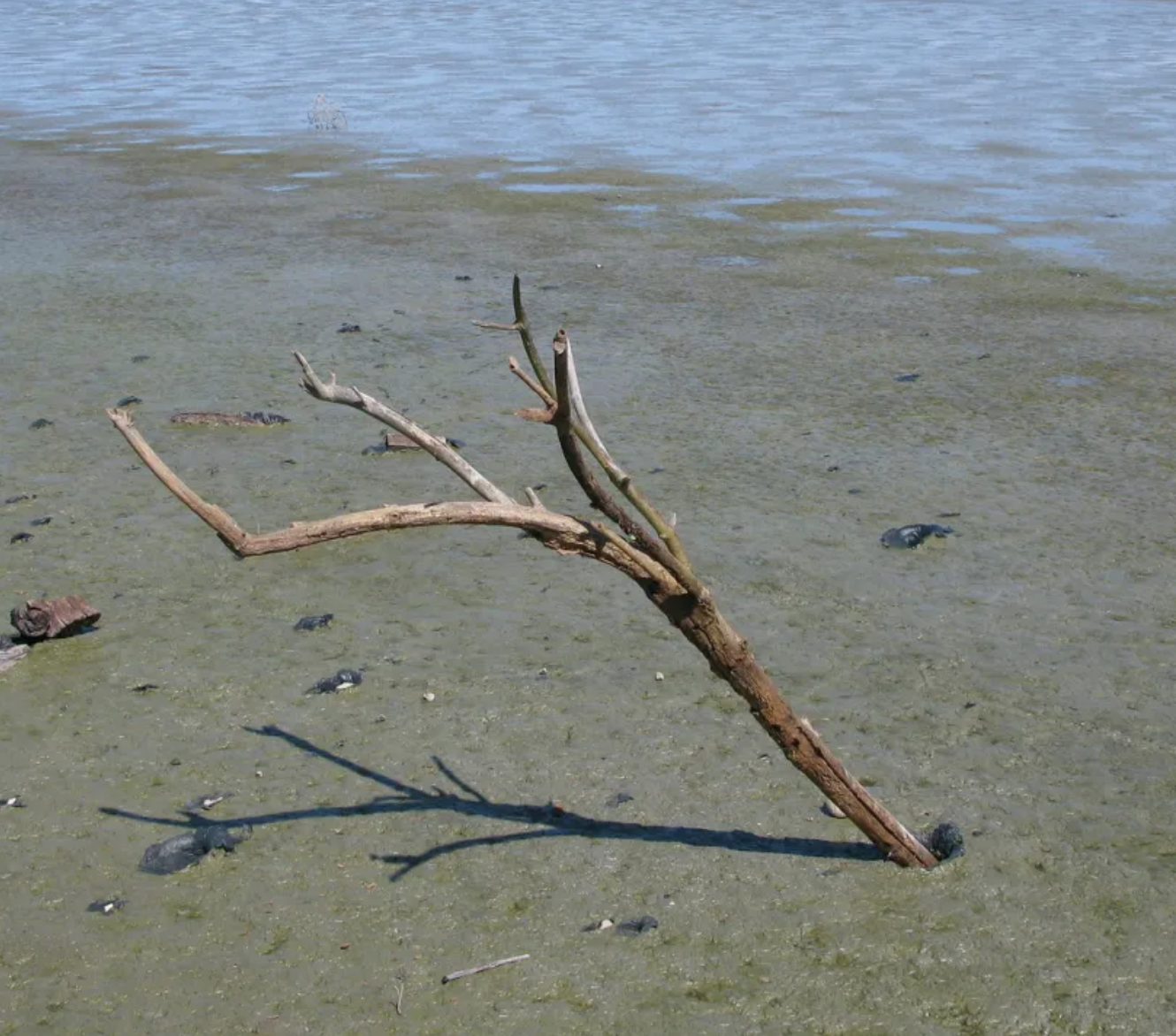
Walking along the wet beach at the end of Nausicaa,
Bloom sees a stick and evidently picks it up, because soon
this "wooden pen" is writing out a message to Gerty: "I... AM.
A." The sentence remains unfinished, leaving readers to
imagine what Bloom may have wanted to say. Symbolically, the
capitalized letters could promise some grand message informed
by the Bible, but the cuckoo clock that is heard soon
afterward offers a much humbler, and more credible,
alternative. The stick itself supplies a second unflattering
answer when, flung away, it improbably embeds itself
vertically in the sand.
Bloom comes across the stick while thinking about messages in
bottles and other human impulses to commit things to the
waves: "Bottle with story of a treasure in it, thrown from a
wreck. Parcels post. Children always want to throw things in
the sea. Trust? Bread cast on the waters. What's this? Bit of
stick." He wonders whether Gerty (or he) will come back to the
same spot tomorrow and then, despite the futility of the
gesture, thinks of sending her a message: "Mr Bloom with his
stick gently vexed the thick sand at his foot. Write a message
for her. Might remain. What? / I. / Some flatfoot
tramp on it in the morning. Useless. Washed away. Tide comes
here." Useless or not, he keeps writing until a rock or some
other object gets in the way: "AM. A. / No room. Let
it go. / Mr Bloom effaced the letters with his slow boot.
Hopeless thing sand." He gives up: "He flung his wooden pen
away. The stick fell in silted sand, stuck. Now if you were
trying to do that for a week on end you couldn't. Chance.
We'll never meet again. But it was lovely."
Judging by the way he corresponds with Martha Clifford, Bloom may be
planning to write something enticingly pathetic like "I am a
lonely man" (romantic, spurned, more sinned against than
sinning)—or, in keeping with the prose in the first half of
this chapter, something extravagantly complimentary like "I am
a worshiper" (at your shrine, dear one). Symbolic readings
outside the scope of Bloom's thoughts are also possible: a
capitalized "I AM" is God's self-description in Exodus 3:14,
and in Revelation 22:13 the same deity says, "I am A(lpha and
Omega)." But any such biblical reading makes less obvious
sense of the incomplete sentence than the cries of the little
cuckoobird several paragraphs later. "I am a cuckold"
aptly describes the mental state of a man desperately
masturbating on a beach to a total stranger while his wife
waits at home. Nausicaa ends with another incomplete
sentence encouraging this inference: "she noticed at once that
that foreign gentleman that was sitting on the rocks looking was
/ Cuckoo.
/ Cuckoo.
/
Cuckoo."
Comically, the narrative offers a second unflattering way of
finishing the I AM thought. If the stick is doing the writing
(inanimate things do stranger things in Circe), then
it identifies itself by piercing the muck, standing upright,
and thereby finishing the sentence: "I am a stick in the mud."
This description also applies to Bloom. In Circe Molly
appears in exotic Turkish costume and teasingly mocks him: "O
Poldy, Poldy, you are a poor old stick in the mud! Go
and see life. See the wide world." Bloom evidently feels
this to be painfully true, though he blames it on his
marriage. In Eumaeus he laments that "the man in the
street...for the matter of a couple of paltry pounds was
debarred from seeing more of the world they lived in instead
of being always and ever cooped up since my old
stick-in-the-mud took me for a wife." As with "I am a
cuckold," this completion of the sentence comments gloomily on
Bloom's situation. He is deep in a rut.
Just before he picks up the stick, Bloom has bent down and
"turned over a piece of paper on the strand. He brought it
near his eyes and peered. Letter? No. Can't read. Better go.
Better. I'm tired to move. Page of an old copybook. All those
holes and pebbles. Who could count them? Never know what you
find." The beach is full of unread, lost messages, as Stephen
has thought in Proteus: "These heavy sands are
language tide and wind have silted here." The message that
Bloom writes in the sand is one more unfinished effort to
communicate something lasting about human experience in a
medium of ceaseless flux. It may imply aspirations to divine
permanence and omnipresence, but more clearly it confesses
human futility.