A reader's impression that D. B. Murphy may somehow be the Odysseus of Eumaeus
grows when, like Odysseus regaling the Phaeacians with stories
of the Lestrygonians and Cyclops, he tells the men in the
shelter about monstrous cannibals in faraway lands: "And I
seen maneaters in Peru that eats corpses and the livers of
horses. Look here. Here they are." But the evidence he
offers—a commonly available postcard of South American natives
doing nothing like eating human flesh—could hardly be less
convincing, and his fumbling talk quickly dispels any thoughts
of heroic adventure. Instead of opening onto a broad highway
of Homeric signification, this scene dives into a rabbit hole
of palpably false reports.
The Odyssean echoes begin when Murphy tells the people in the
shelter that he has a wife waiting for him in the south of
Ireland that "I haven't seen for seven years now, sailing
about." (Later he mentions a son, also a seaman, who'd "be
about eighteen now, way I figure it"—a Telemachus figure to
round out the household.) The story of wandering the world far
from family makes Bloom think of Ben
Bolt and Enoch Arden,
two literary heroes who left loved ones behind to undertake
long voyages at sea, as well as the landlocked but similar
stories of Rip Van Winkle
and Caoc O'Leary. The
keeper of the shelter says, "You must have seen a fair share
of the world," and Murphy mentions spots all over the globe,
with very few experiential details. Prompted by another
listener to recount "queer sights," he comes up with an
unimpressive anecdote of a crocodile biting an anchor, and
then thinks of cannibals:
And I seen maneaters in Peru that eats corpses
and the livers of horses. Look here. Here they are. A
friend of mine sent me.
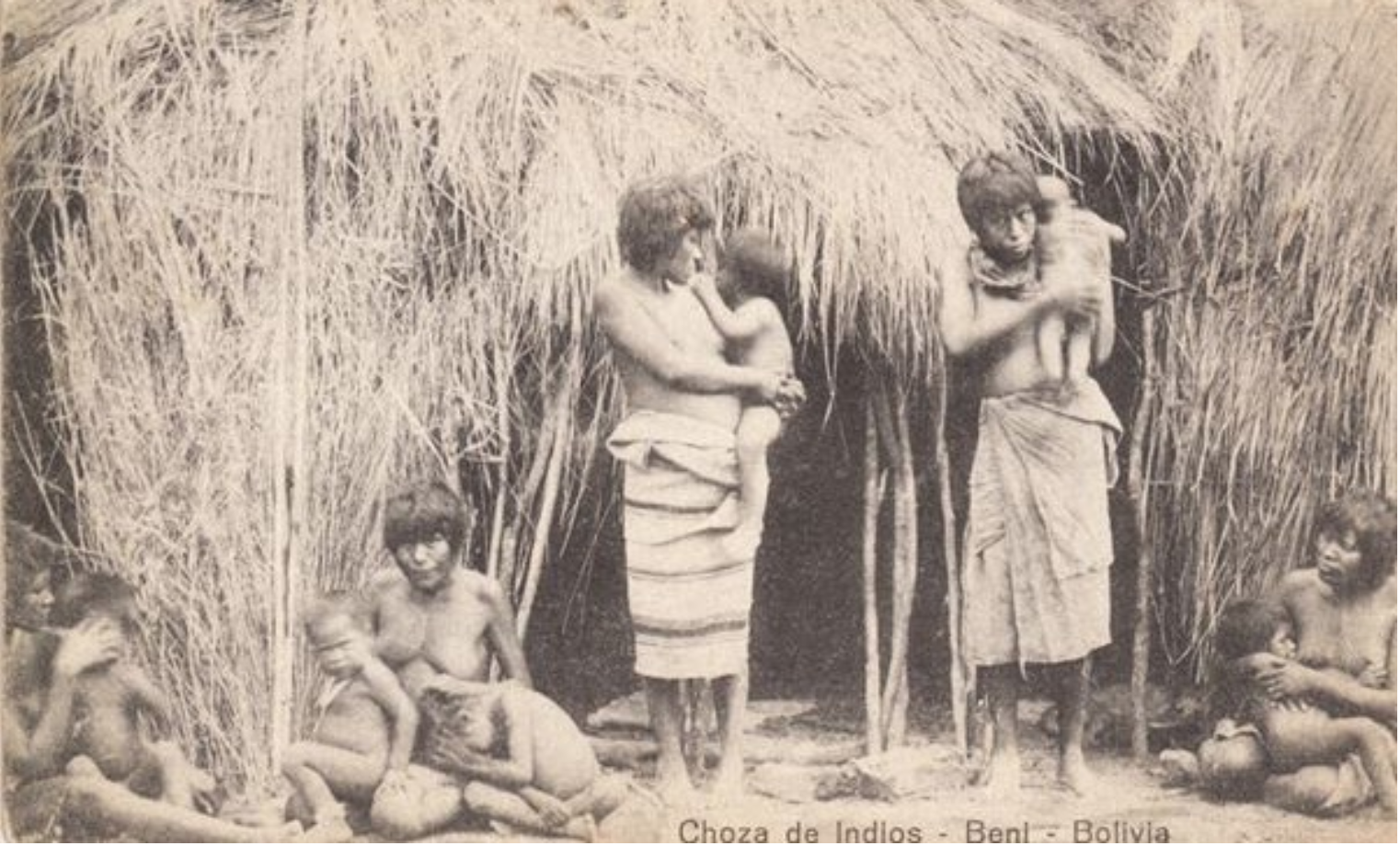
He fumbled out a picture postcard
from his inside pocket which seemed to be in its way a species
of repository and pushed it along the table. The printed
matter on it stated: Choza de Indios. Beni, Bolivia.
All focussed their attention at the
scene exhibited, a group of savage women in striped
loincloths, squatted, blinking, suckling, frowning, sleeping
amid a swarm of infants (there must have been quite a score of
them) outside some primitive shanties of osier.
— Chews coca all day, the
communicative tarpaulin added. Stomachs like breadgraters.
Cuts off their diddies when they can't bear no more children.
See them sitting there stark ballocknaked eating a dead
horse's liver raw.
Murphy hardly makes his report more credible by adding that
the Peruvian cannibals are (still more horrifyingly) ghoul-like corpse-eaters and
(bathetically) consumers of horse liver. The blundering
continues when he pulls out a photograph whose Spanish caption
sets it in Bolivia, not Peru, and which shows only some women
and children gathered outside their houses. The narrative
description does not mention any chewing of coca leaf,
grotesque mutilation of stomachs and breasts, or consumption
of raw horse parts.
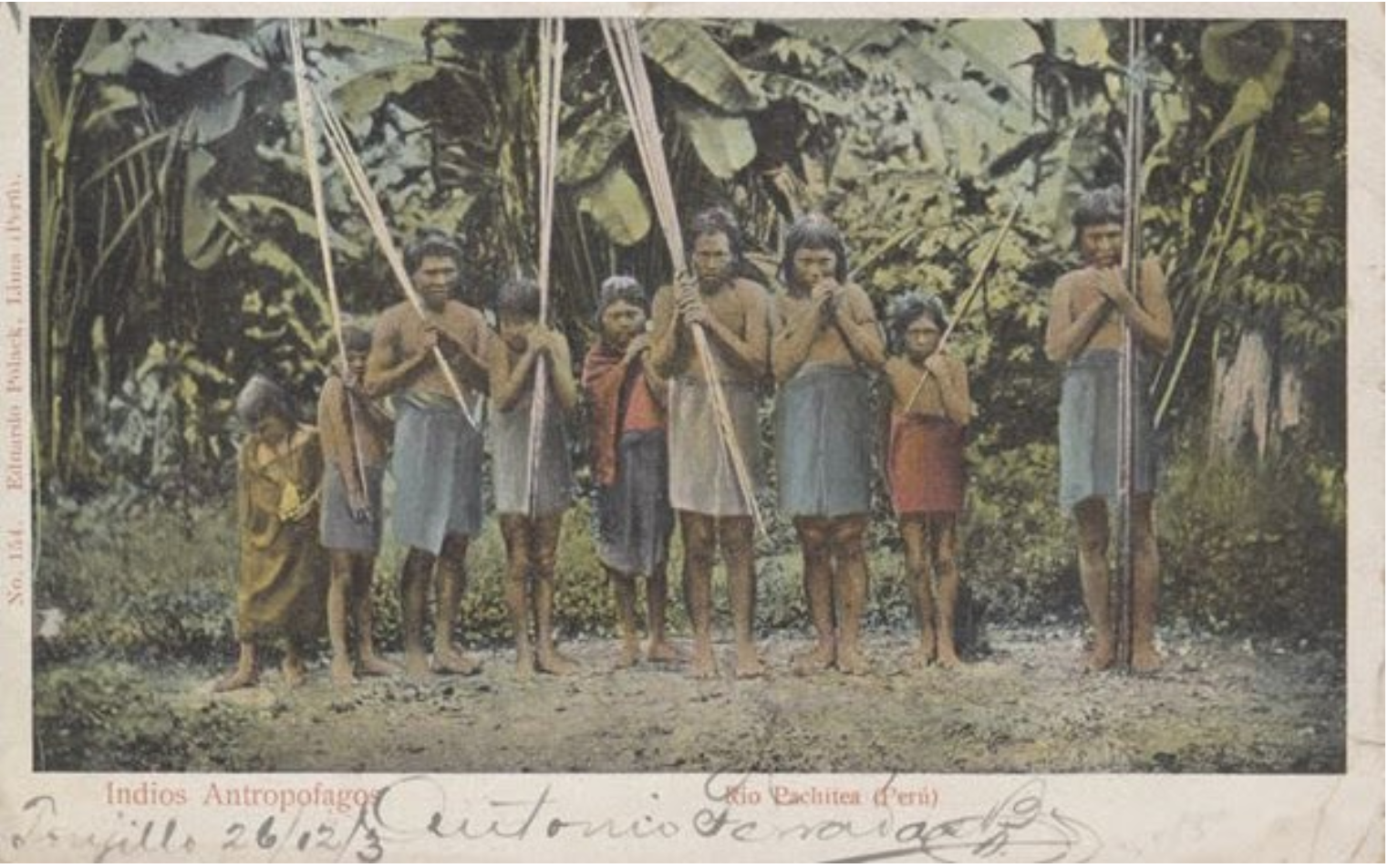
In a JJON article, Aida Yared has reproduced some
contemporary postcards from South America suggesting that
Joyce was thinking of real photographic originals. One of her
images shows some native men standing against a backdrop of
jungle vegetation, holding what may be weapons, over a caption
that reads, "Indios Antropofagos of Rio Pachitea (Perú)."
The men in this postcard or a similar one—Othello attests
that stories of exotic "Anthropophagi" had been circulating
for centuries—must be the maneaters of Peru to which Murphy
refers. The other postcard shows a scene nearly identical to
the one described in the novel, over the caption "Choza de
Indios" ("Hut of Indians"). Its women, children, and
"primitive shanties of osier" conform to the narrative
description very precisely, but it lacks all the details that
Murphy says can be seen in it.
Why pull out a postcard to demonstrate things it lacks? One
might suppose that Murphy has two postcards in his jacket and
takes out the wrong one due to drunkenness or bad eyesight.
But his reference to breastless Amazons (another ancient
staple of popular mythology) shows that he knows he is handing
around the picture of nursing mothers. Or perhaps the answer
is that he owns only the Bolivian postcard but has seen the
one of Peruvian maneaters and figures that one picture will do
as well as another to give a sense of Amazonian natives. But
Murphy speaks as if the picture demonstrates precisely the
things he has claimed: "Look here. Here they are.... See them
sitting there." The best explanation may be simply that the
man is an idiot doing his poor best to sound impressive—the
very opposite of Homer's clever liar.
Whatever the reason for the mixup, Murphy's credibility is
doubtful on other grounds. Owning a postcard is no evidence
that one has seen the things captured in it, and it seems
highly unlikely that an ordinary seaman's travels would have
taken him into the rainforest. Beni is a remote region in
northeastern Bolivia, on the other side of high mountains far
from the seacoast, and the Rio Pachitea of the other postcard
is one of the headwaters of the Amazon, likewise well east of
the Andes. The Bolivian postcard could possibly have been
purchased in that country: Yared notes that the first "Choza
de Indios" shown here was produced by the Arnó Hermanos
publishing house in La Paz. But Bolivia's capital is in the
mountains, not the jungle, and by Murphy's own testimony
someone else purchased the card: "A friend of mine
sent me."
The postmark on the back side of the card indicates that it
was mailed to an address in Chile,
introducing one more remove from firsthand experience: from
the jungle where cannibals dwell, to photographic
reproductions in nearby capitals, to a remote continental
capital. Murphy may never have set foot in Peru, or nearby
Bolivia. Indeed, given the trade in postcards, he may never
have even visited South America. Yared notes that the era
before World War I experienced "a craze in postcard-sending
and collecting. In 1903, it is estimated than more than 600
million postcards were handled by the postal system of Great
Britain, and an estimated billion in Germany."
John Hunt 2025
Postcard of "Indios Antropofagos" (Maneating
Indians) in Peru. Source: www.jjon.org.
Postcard of "Choza de Indios" (Hut of Indians)
in Bolivia. Source: www.jjon.org.
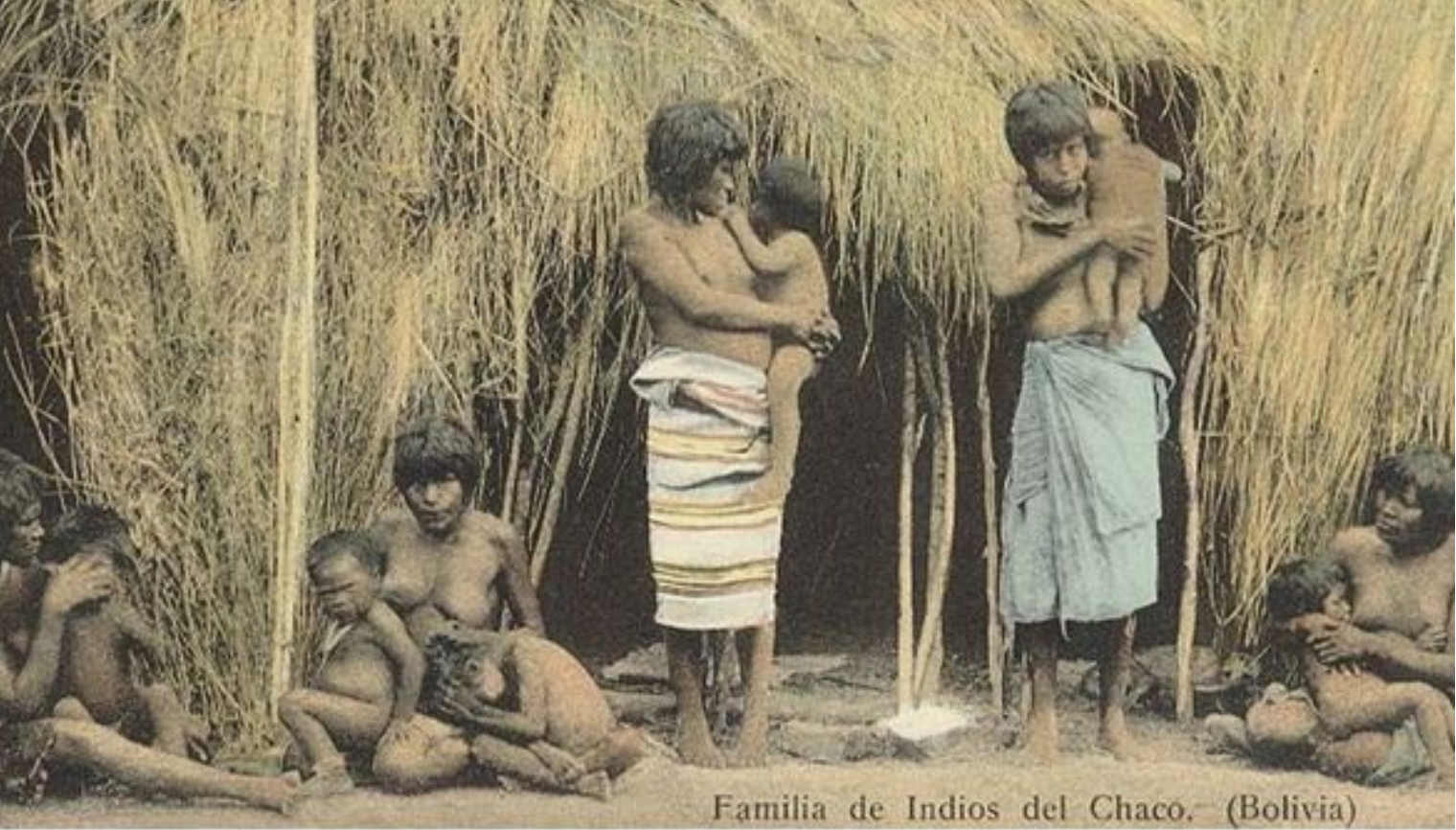
Colorized lithograph version of the second
postcard, bearing the caption "Familia de Indios del Chaco,
Bolivia” (Family of Indians of the Gran Chaco tribe). Source:
www.jjon.org.