Molly's reference
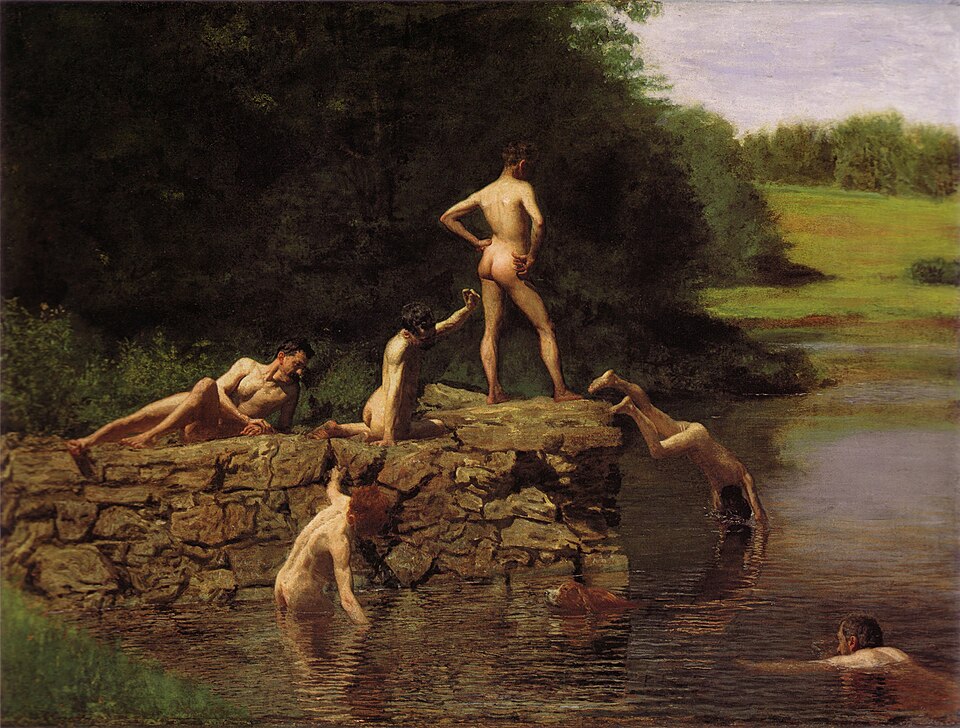
to "the side of the rock" might conceivably be taken as
referring to the eroded cliff walls near the English Margate,
but nothing in the novel suggests that she has ever been there.
Gifford assumes that her vision of male beauty came from her
early days in Gibraltar, and Slote, Mamigonian, and Turner agree
with him. Gifford says of the Margate Strand in Gibraltar, "At
specified hours it was a for-men-only bathing place; but there
was also a bandstand on the strand, and it was a place of public
resort on summer evenings." This dual use might account for a
young woman catching sight of naked men.
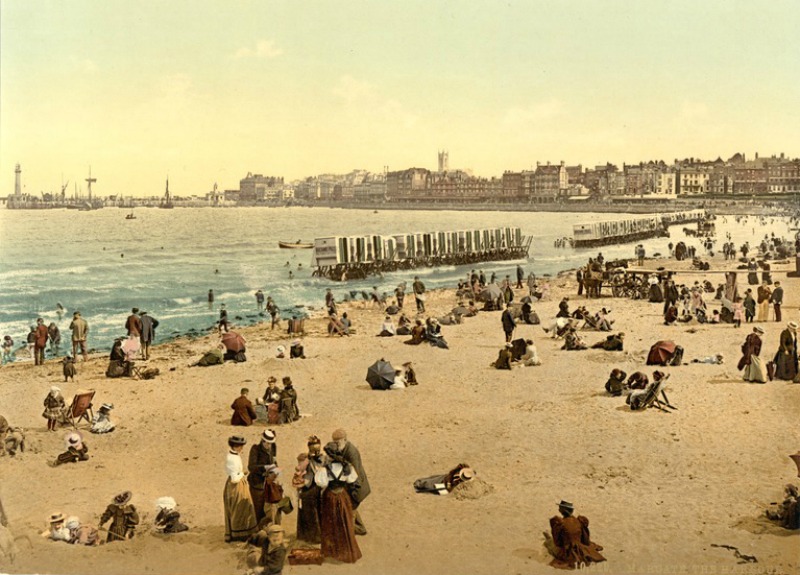
But the other Margate too had a reputation for daring displays.
It is the beach where
"Those
Lovely Seaside Girls" is set: "Down at Margate looking
very charming you are sure to meet / Those girls, dear girls,
those lovely seaside girls." The song describes young men gazing
on "silks and lace," and "bloomers smart," as girls parade in a
modish seaside style of dress that was more revealing than
street clothes, but the beach provided still better
opportunities for voyeurism: both men and women swam there, and
in close proximity. Victorian public opinion held that
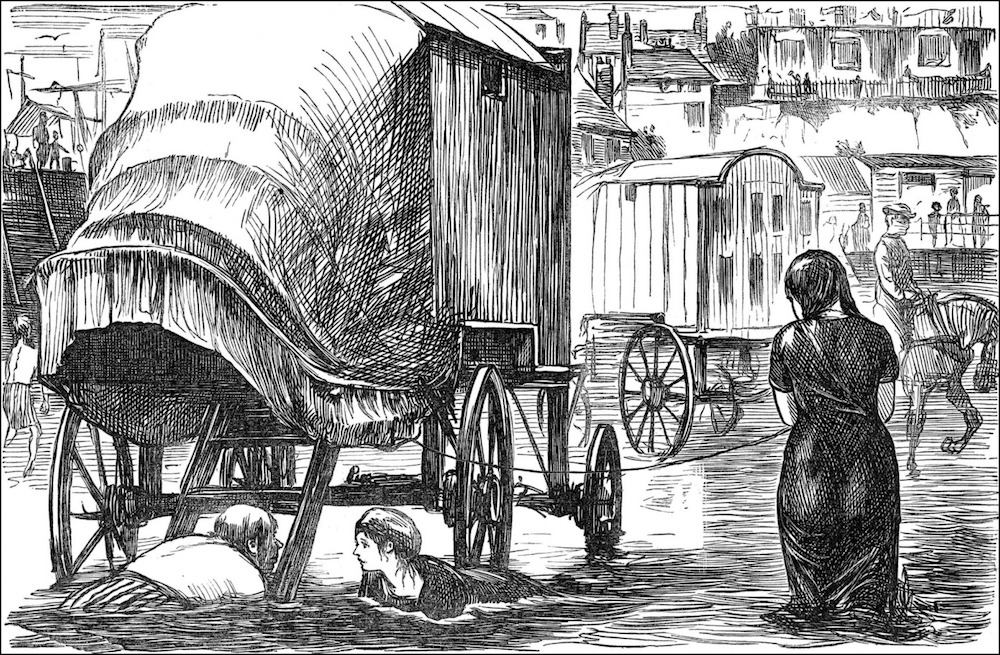
"promiscuous bathing" was a great danger. Seaside resorts like
Margate provided horse-drawn "bathing machines" that enabled
people to enter fully clothed on the beach, change into their
swimwear while the vehicle was being pushed out into the waves,
and then modestly enter the water down some back steps that were
covered with fabric, giving swimmers some shelter from the sight
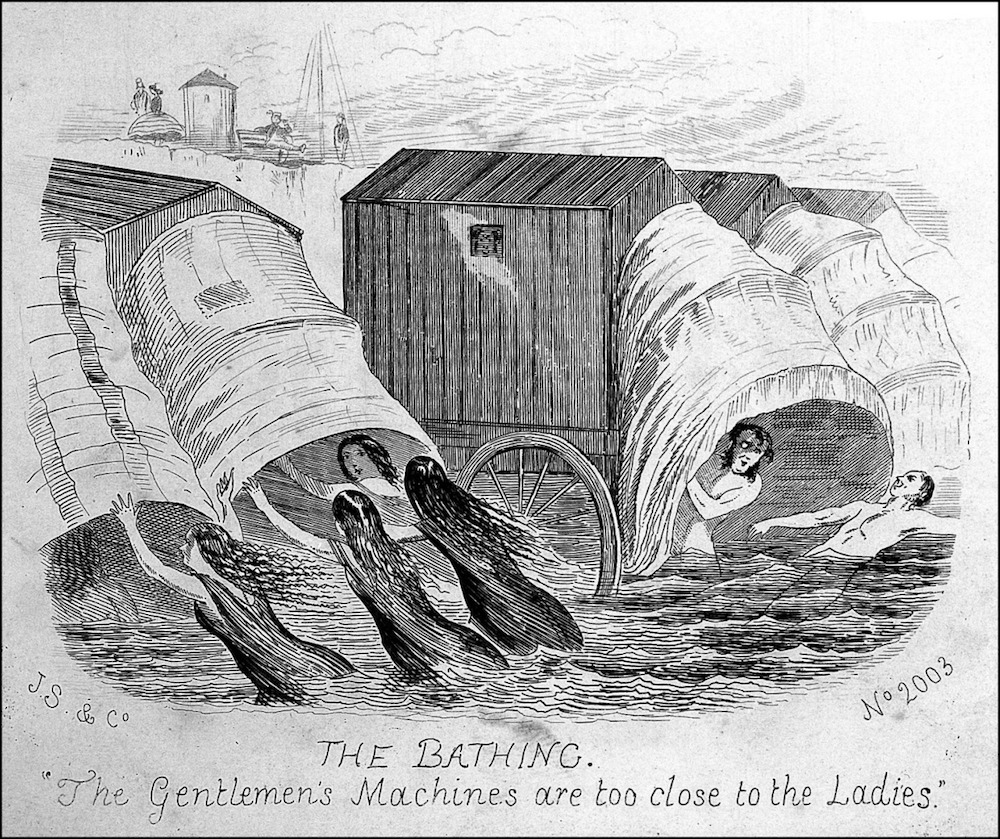
of people on the beach. At some resorts the men's and women's
bathing machines were kept far apart, but Margate apparently was
not one of them.
Not only were the bathing machines at Margate placed close
together, but evidently some men were in the habit of emerging
with no suits on. Mimi Matthews observes on her blog site,
mimimatthews.com, that some gentlemen "emerged from their
bathing machines in what the 2 September 1854 edition of
the
Leeds Times describes as an 'entirely
primitive state'. Once in the water, these naked gentlemen had
no compunction about approaching the female bathers nearby." The
chats and splashing contests that ensued attracted audiences on
the beach, "some of whom employed telescopes to get a better
view of the indecency. Of this 1854 incident, the reporter
noted that 'The beach was thronged with admiring spectators, and
many of them with glasses, although they were not required, as
the bathers, from the high tide, were close to the shore'.”
In the 1860s, "crowds at Margate" were still using telescopes
"to get a better view of the 'nude groups and sportive syrens'
in the water." A 23 July 1865 article in the
Era, a
London newspaper, reported that "these 'magnifying mediums' were
as likely to be used by ladies as by gentlemen." This was pretty
strong stuff in mid-Victorian England, and some saw it as a
threat to public morals. The writer of the article
observed, "There must be something morally infectious in the
atmosphere of this popular watering place that induces men and
women to do that at Margate which they would blush even to be
thought capable of doing in any other locality—namely,
disregarding all those social observances which are usually
called decency in men, and modesty in women.... The bathers of
both sexes romp, laugh, and perform all kinds of antics in which
the actual nudity of the men is infinitely less offensive to our
sense of decency than the modest immodesty of the clinging
gossamer vestment in which the females cover, without hiding,
their forms." This "chronic evil," the writer argued, corrupted
not only the bathers but also those watching from the sand.
In other parts of the UK, police actions were sometimes taken
against men who strayed within 200 yards of the spots reserved
for women. Such laws against promiscuous bathing were of a piece
with the obscenity laws that kept Joyce's works from being
published, and it seems likely that he took an interest in
Margate because it represented another form of resistance to the
enforcers of public morality. A transgressive exchange in
Circe
highlights the transcendent scandalousness of what Bloom, in
Eumaeus, calls "
Margate with mixed bathing." After
political candidate Bloom panders to his constituency by
promising "Free money, free rent, free love and a free lay
church in a free lay state," O'Madden Burke parries, "Free fox
in a free henroost." Bloom comes back with the still more
radical proposal of "Mixed races and mixed marriages," prompting
the comedian Lenehan to utter the crowning blasphemy: "
What
about mixed bathing?"