Throughout the novel, familiar scriptural phrases find new
life in secular contexts as whimsical jokes. Stephen and
Mulligan do this casually, with no particiular satirical edge.
In Telemachus Mulligan goes forth from the tower
"with grave words and gait," saying, “And going forth
he met Butterly”—an echo of Matthew 26:75, where
Peter recognizes that he has denied Jesus three times “And
going forth, he wept bitterly." In Proteus Stephen
uses the words of the Gloria
Patri, a doxology praising the eternity of the
Holy Trinity, when he thinks of Aristotle's belief that the
physical universe is eternal: "See now. There all the time
without you: and ever shall be, world without end."
Other characters employ such echoes more daringly. In Hades
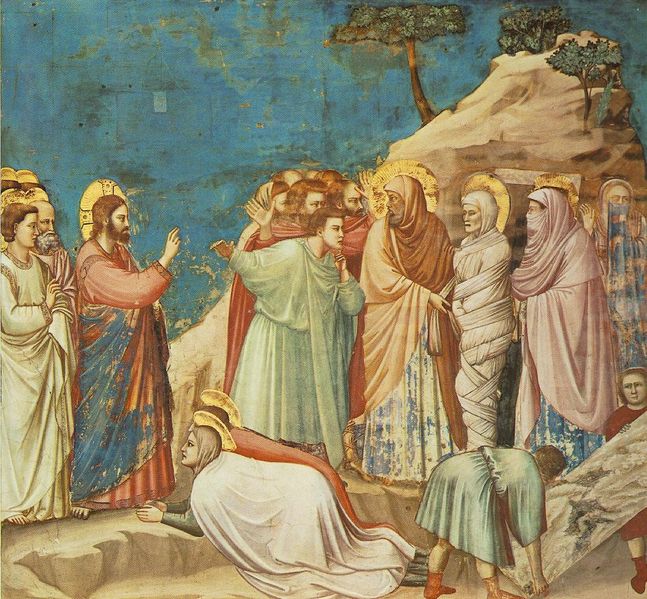
Bloom recalls a joke that Dubliners make about Jesus raising
Lazarus from the dead in John 11:43: “Come forth,
Lazarus! And he came fifth and lost the job.” In Wandering
Rocks Jesus's words to
Mary Magdalene in John 20:17 about his resurrected body
describe someone who won't agree to contribute to a charitable
fund: "— Boyd? Martin Cunningham said shortly. Touch me
not." The shortest verse in the Bible, John 11:35, where
Jesus learns of the death of Lazarus, animates Simon Dedalus's
scornful contempt for his in-laws in Proteus: "Jesus
wept. And no wonder, by Christ!"
In Hades the freethinking Bloom keeps his spirits up
in the cemetery with a steady string of irreverent thoughts
not suitable for public airing, but the good Catholics in
attendance seem no less inclined to leaven funereal solemnity
with humor. Ned Lambert says he has been down in Cork recently
and seen a man that Simon Dedalus used to know there. "And how
is Dick, the solid man?" asks Simon jovially. "Nothing
between himself and heaven," says Ned. But Dick has
not gone to meet his Maker, as Simon is quick to perceive: "—
By the holy Paul! Mr Dedalus said in subdued wonder. Dick
Tivy bald?"
The best joke of the chapter, one of the best in the novel
really, is told by John O'Connell, the caretaker of the
cemetery:
They tell the story, he said, that two drunks came
out here one foggy evening to look for the grave of a friend
of theirs. They asked for Mulcahy from the Coombe and were
told where he was buried. After traipsing about in the fog
they found the grave sure enough. One of the drunks spelt out
the name: Terence Mulcahy. The other drunk was blinking up at
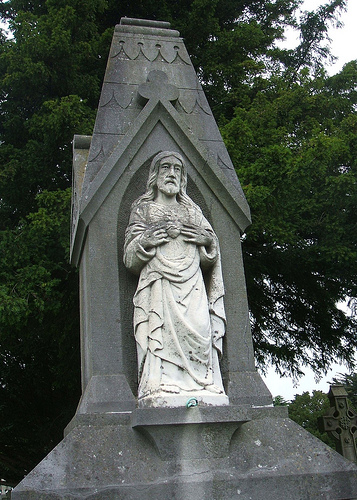
a statue of Our Saviour the widow had got put up.... And,
after blinking up at the sacred figure, Not a bloody
bit like the man, says he. That's
not Mulcahy, says he, whoever done
it.
The joke is hilarious but harmless, and the listeners credit
O'Connell with humane motives: "— That's all done with a
purpose, Martin Cunningham explained to Hynes. / — I
know, Hynes said. I know that. / — To cheer a fellow up,
Martin Cunningham said. It's pure goodheartedness: damn the
thing else." Comedy involving sacred icons always runs some
risk of irreverence, though. Slote, Mamigonian, and Turner
note that Patricia O'Connell, in a published article called
"My Family Connections in Ulysses," reports that the
joke told in her family often contained a second punch line:
"the other drunk, slightly less inebriated, retorts scornfully
'That's not Mulcahy, that's Our Saviour' and his friend
snaps 'Not a bloody bit like Him, either!"
These sayings tesfity to a lively oral culture that was never
entirely overwritten by the humorless pieties of Rome. Joyce
uses the conversation of ordinary Catholics—invariably men,
invariably drinkers—to insinuate an easygoing secularity into
contexts that might normally be expected to elicit a
respectful hush. He also makes his country's religion funny by
viewing it through the naively skeptical eyes of an outsider.
Although nominally Catholic, Bloom is ignorant of most
Christian teachings, baffled by most church ritual, and
disinclined to give himself over to an alien form of
indoctrination. This results in some very funny
defamiliarizations of familiar things.
Bloom sees the aspergilium from which the priest sprinkles holy water in Hades
as "a stick with a knob at the end of it." He wonders
about the psychology of the women taking Communion in Lotus
Eaters: "Good idea the Latin. Stupefies them first....
Then feel all like one family party, same in the theatre, all
in the same swim. They do. I'm sure of that. Not so lonely."
The cunning men who run the show elicit his admiration for
savvy marketing practices, as if they have worked out a
superior business model:
Wine. Makes it more aristocratic than for example if
he drank what they are used to Guinness's porter.... Doesn't
give them any of it: shew wine: only the other. Cold comfort.
Pious fraud but quite right: otherwise they'd have one old
booser worse than another coming along, cadging for a drink.
Queer the whole atmosphere of the. Quite right. Perfectly
right that is.
Wonderful organisation certainly, goes like clockwork.
Confession. Everyone wants to. Then I will tell you all.
Penance. Punish me, please. Great weapon in their hands.
More than doctor or solicitor. Woman dying to.
Squareheaded chaps those must be in Rome: they work the
whole show. And don't they rake in the money too?
Bequests also: to the P.P. for the time being in his
absolute discretion. Masses for the repose of my soul to be
said publicly with open doors.... The doctors of the church:
they mapped out the whole theology of it.