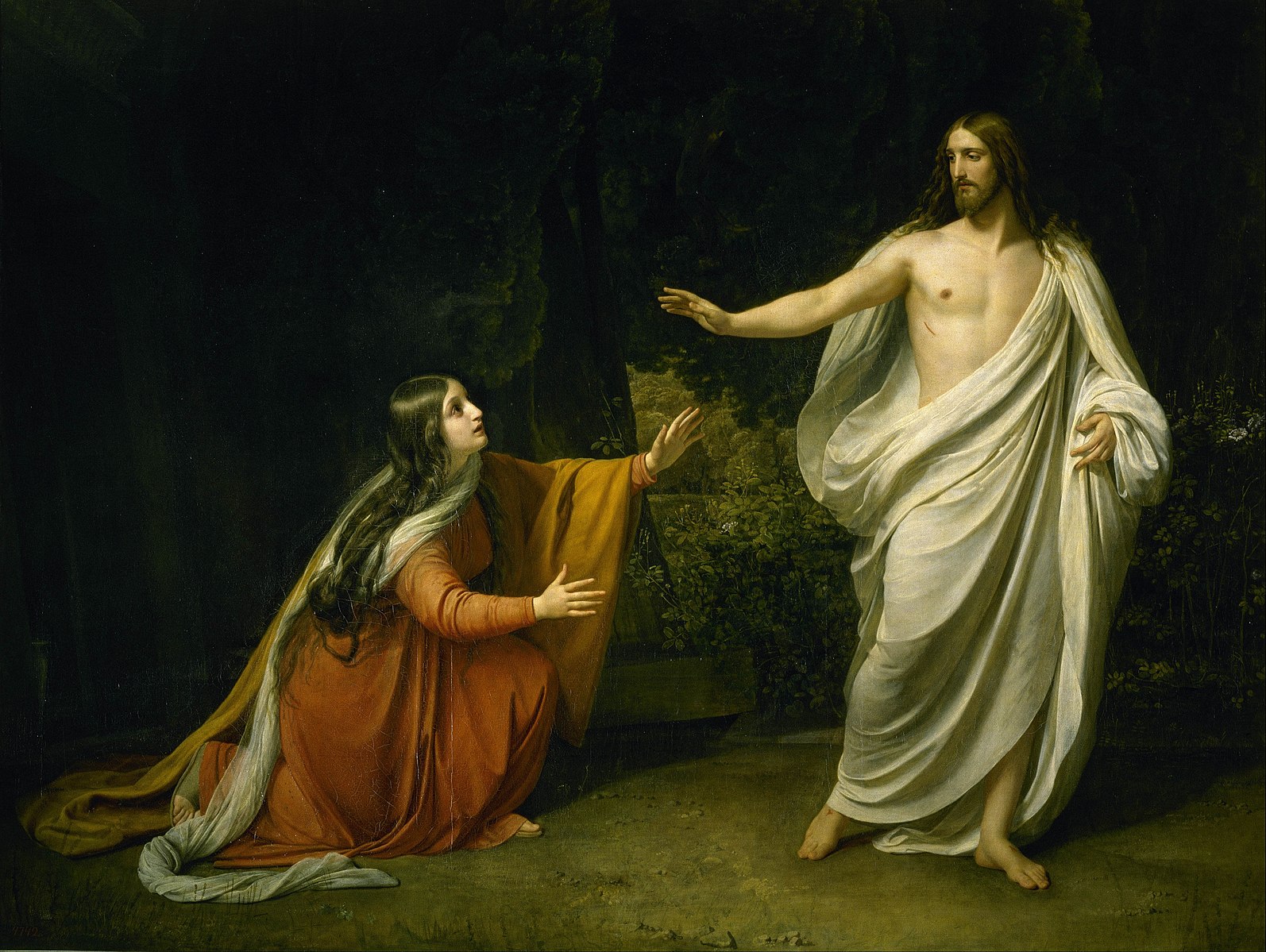
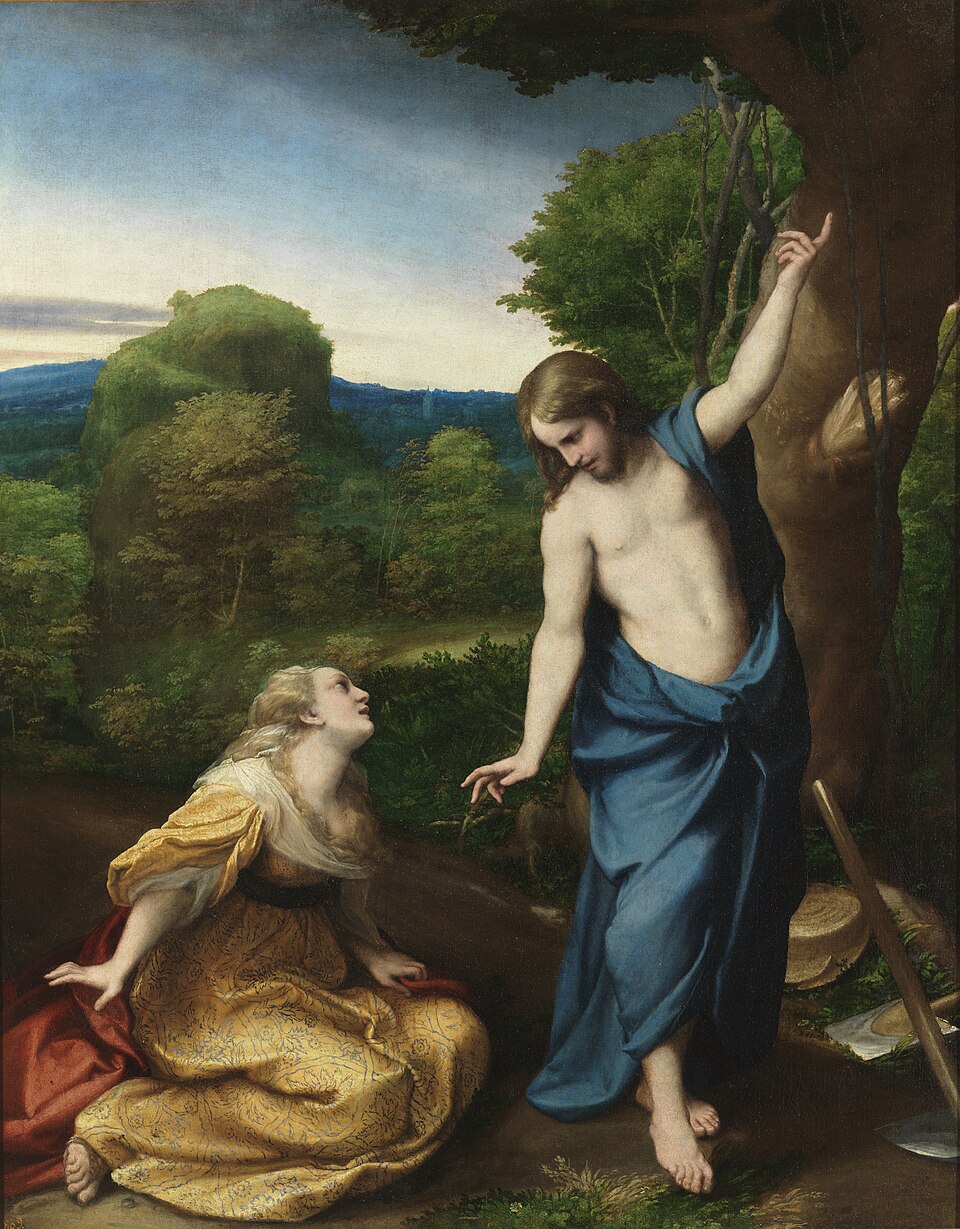
In John's gospel Mary Magdalene sees Jesus after he has risen
from the dead. He tells her, "Touch me not; for I am not
yet ascended to my Father" (20:17). One possible
interpretation of this cryptic passage is that Jesus does not
want to be embraced tearfully as a loved one who has come back
to life, but instead awaited faithfully as the redeemed Savior
of all mankind. The original Koine Greek, Me mou haptou,
which means "Don't cling to me" or "Don't hold on to me,"
supports this reading: Christ is now not a man of this world
but a god of the other one. In the Latin Bible of the Catholic
church, though, Noli me tangere means "Don't touch
me," and in common English parlance to "touch" someone is to
hit them up for money. Assuming that Boyd will say no to a
request for money, Cunningham uses Christ's spooky alterity as
a metaphor for the man's cold disinterest.
Power's reference to "our friend" just as he and Cunningham
leave their workplace suggests that Boyd too works in the
Castle, and Vivien Igoe has identified just such a man. John
Boyd (1867-1932) worked in the State Solicitor's Office in
Dublin Castle for 41 years. He was a colleague of Matthew Kane, the model
for Martin Cunningham, and a friend of John Stanislaus
Joyce. The three men "were a familiar threesome at various
funerals in Dublin," and Boyd was a member of the Kane Family
Fund Committee established to help Kane's family after he
drowned in July 1904. It would seem, then, that Joyce retained
multiple vestiges of the real-life Boyd—his name, his
government work, his association with schemes to charitably
assist surviving family members—but for some reason made him
seem unlikely to support Dignam's family.
What that reason may have been is a matter for speculation,
but one possible explanation is sectarian difference. There
are many Boyds in Ireland—it is a Gaelic name—but most are
descended from western Scots who settled in Ulster in the Plantation years of the 16th
and 17th centuries. John Boyd worked at the Castle for 41
years, but according to Igoe he was actually born in Scotland.
A Scot who emigrated to Ireland in the later 19th century
would most likely have been Protestant, as would someone who
worked in the bastion of British state power in Dublin.
Cunningham and Power are Catholics, but they would have rubbed
shoulders at work with many people of the opposite persuasion.
In Surface and Symbol, published in 1967, Robert
Martin Adams identified the Boyd of Wandering Rocks as
William A. Boyd, a man who was pretty clearly Protestant.
Igoe's research suggests that he was mistaken, but his comment
on "Touch me not" still makes good sense. Adams reasons that
the allusion "may imply either financial closeness or a
holier-than-thou attitude in Boyd, or a suspicious horror of
him in the speaker" (11). Scotsmen are notoriously tight with
money, and a Scottish Protestant might be even less likely to
make a charitable contribution if he knew it was going to an
Irish Catholic family. And even if those things were not true,
an Irish Catholic might suppose them to be true and decline
even to make the request. Christ's spectral touch-me-not
distance from Mary offers a good figure for the unbridgeable gulf between
prudent capitalistic Protestants and Catholics who don't waste
time brooding on nest eggs—alienated populations who see each
other as living in separate worlds, even when Christian
charity is involved.