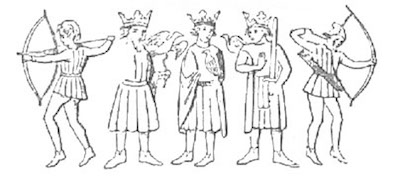
In Nestor Mr. Deasy tries to paper over the gap
between his Protestant unionism and Stephen's Catholic
nationalism: "We are all Irish, all kings' sons." The saying
is proverbial, reflecting the fact that there were many
independent kingdoms in pre-Norman Ireland. Given the great
number of kings in Irish history, the intricate kinship
relationships within clans, and the modest population of the
island, many modern Irish people probably could claim descent
from some ancient ruling family. But numerous ironies attend
Deasy's resort to the patriotic bromide. First, he is a West
Briton loyal to the English crown, so identifying himself with
symbols of fierce Irish independence is ludicrous. Second, his
real-life model was an Ulster Scot,
and Stephen thinks of him as
Scottish in Proteus, so any Irishness he has may
be limited to the last few centuries. Finally, if some of his
ancestors do belong to an ancient Irish bloodline, his name
threatens to negate the claim of royalty.
There are a few families named Deasy in Scotland, but it is
largely an Irish name found in County Waterford, County Cork,
and County Mayo. Joyce may have chosen it for his headmaster
because of its etymological associations. Slote, Mamigonian,
and Turner note that "The Irish name Déisi (whence
Deasy is derived) was specifically associated with the subject
peoples who pay 'vassal tribute' (deisis) to their
rulers," so the Deasy family "would be an exception" to the
proverbial commonplace. This detail adds one more layer of
scathing irony to the ridiculous circumstance of an Ulster
Scot making common cause with an Irish Catholic—and dismissing
his aspirations to national independence—by suggesting that
they are both "kings' sons."
For Stephen, the notion that the imperially subjugated Irish
are royalty manqué is a black joke born of the futility of
perpetual disempowerment. In Proteus he thinks about
the many "pretenders" who
aspired to control all of Ireland as High King, or to
establish Ireland's independence from English overlords, or to
establish a claim to the throne of England itself through some
fabricated genealogy: "All kings' sons. Paradise of
pretenders then and now." This long dismal history is
not simply a saga of individual ambitious men. It is a
national compensatory fantasy.
Joyce lightens the black joke in Cyclops, when Bloom
briefly becomes a warlike "O'Bloom" akin to the Gaelic
O'More lords of Counties Laois and Kildare, Alf Bergan
becomes "the
young chief of the O'Bergans," and Paddy Dignam becomes
"O'Dignam, sun of our morning." All are participating in a
Victorian-era enthusiasm for recapturing national dignity by
restoring the lost "Ó" that means "grandson or descendant of."