The chamberpot that the Blooms keep under their bed for
nighttime emergencies, and which Molly uses under just such
conditions at the end of the novel, is described as
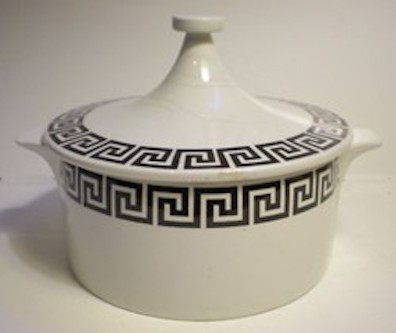
"orangekeyed." This cryptic adjective probably refers to the
labyrinthine design sometimes called a Greek key, and various
details suggest that Joyce means it to evoke Homeric times.
Readers also learn in Calypso that the bedroom
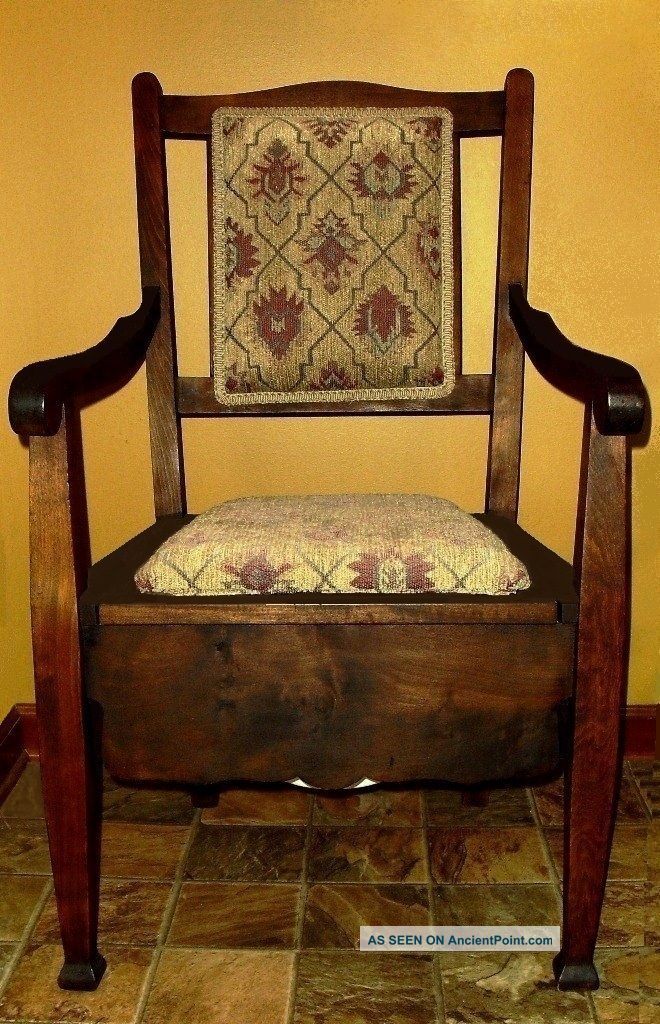
contains a "broken commode," which Ithaca describes
more exactly as "A commode, one leg fractured, totally covered
by square cretonne cutting, apple design." This is a wooden
chair, beautified by a fabric covering and concealing a
ceramic pot beneath its seat—a much more commodious appliance
for doing one's business. The commode long ago broke when
Molly was sitting on it, so the Blooms use the chamberpot,
purchased as one part of a matching set of ceramic items.
In Circe Bloom refers to "That antiquated commode.
It wasn’t her weight. She scaled just eleven stone nine. She
put on nine pounds after weaning. It was a crack and want of
glue. Eh? And that absurd orangekeyed utensil which
has only one handle." In Penelope Molly too recalls
breaking the commode. The realization that her period is
starting sends her looking for the pot: "wait O Jesus wait yes
that thing has come on me yes now wouldnt that afflict you...O
patience above its pouring out of me like the sea...I dont
want to ruin the clean sheets the clean linen I wore brought
it on too damn it damn it...wheres the chamber gone
easy Ive a holy horror of its breaking under me after that
old commode." Ithaca notes that the pot is one
part of a set: "Orangekeyed ware, bought of
Henry Price, basket, fancy goods, chinaware and ironmongery
manufacturer, 21, 22, 23 Moore
street, disposed irregularly on the washstand and floor
and consisting of basin, soapdish and brushtray (on the
washstand, together), pitcher and night article (on
the floor, separate)."
In his critical study Ulysses, Hugh Kenner argues
that "orangekeyed" must refer to an orange border in the kind
of continuous pattern called a key pattern, key meander, Greek
fret, or Greek key, implying multiple links to Homeric Greece.
The OED's first documented use of "key" as a kind of
graphic pattern "is dated 1876, in the first decade of Homeric
archaeology." The figure "characterised much Greek pottery of
the Geometric Period, the ninth to seventh centuries BC:
pottery of the lifetime (if he lived) of Homer" (144). Joyce
emphasizes the connection by coining his word in "the way
Homer formed many epithets, of which the most celebrated is rhododaktylos,
'rosyfingered,' by joining an attribute of colour or
brightness with a name." (Other such epithets include "wine-dark,"
"bronzed-armored," "grey-eyed"
or "shining-eyed," "white-armed," "red-haired,"
"flaming-haired," and "silver-footed.") Finally, although
Kenner does not mention it, much ancient Greek pottery was
thrown from iron-rich Attic clay and fired in oxygen-rich
environments that turned any unpainted surfaces intensely
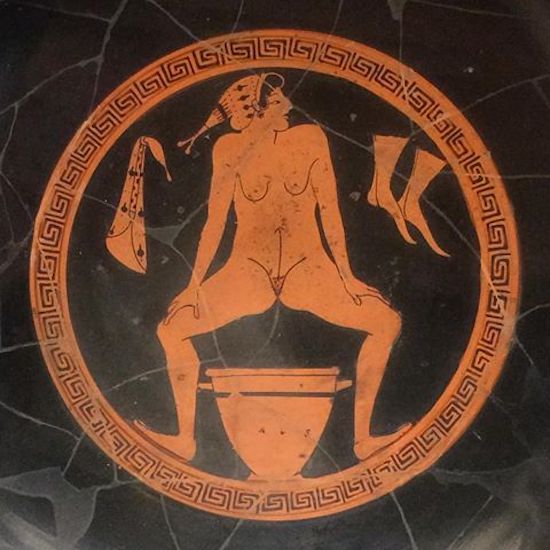
orange. The 5th century cup shown here combines orange color,
a key pattern, and a woman using a chamberpot.
If this humble pot serving the Blooms' baser bodily needs is
meant to recall the Homeric age, the ironic audacity of the
connection would not have escaped Joyce's notice. In Telemachus
Mulligan says to Stephen, "The mockery of it!...
Your absurd name, an ancient Greek!" But Stephen's name
is far from meaningless:
both words contain ancient Greek meanings that figure in the
novel's symbolic structures. Soon Mulligan, who is well
schooled in Greek, is hearing Homeric echoes in his own name:
"My name is absurd too: Malachi Mulligan, two dactyls. But it has a Hellenic
ring, hasn't it? Tripping and sunny like the buck himself. We
must go to Athens." In these two instances, the word "absurd"
performs a kind of feint, suggesting that any hunt for
significance is illogical or inappropriate. When Bloom speaks
of "that absurd orangekeyed utensil" in Circe,
the adjective performs the same trick once more. Linking a
chamberpot to a great heroic era may seem discordant and
irrelevant, a mere mockery.
In fact it is a small arresting reminder that in human
experience some things stay eternally the same.