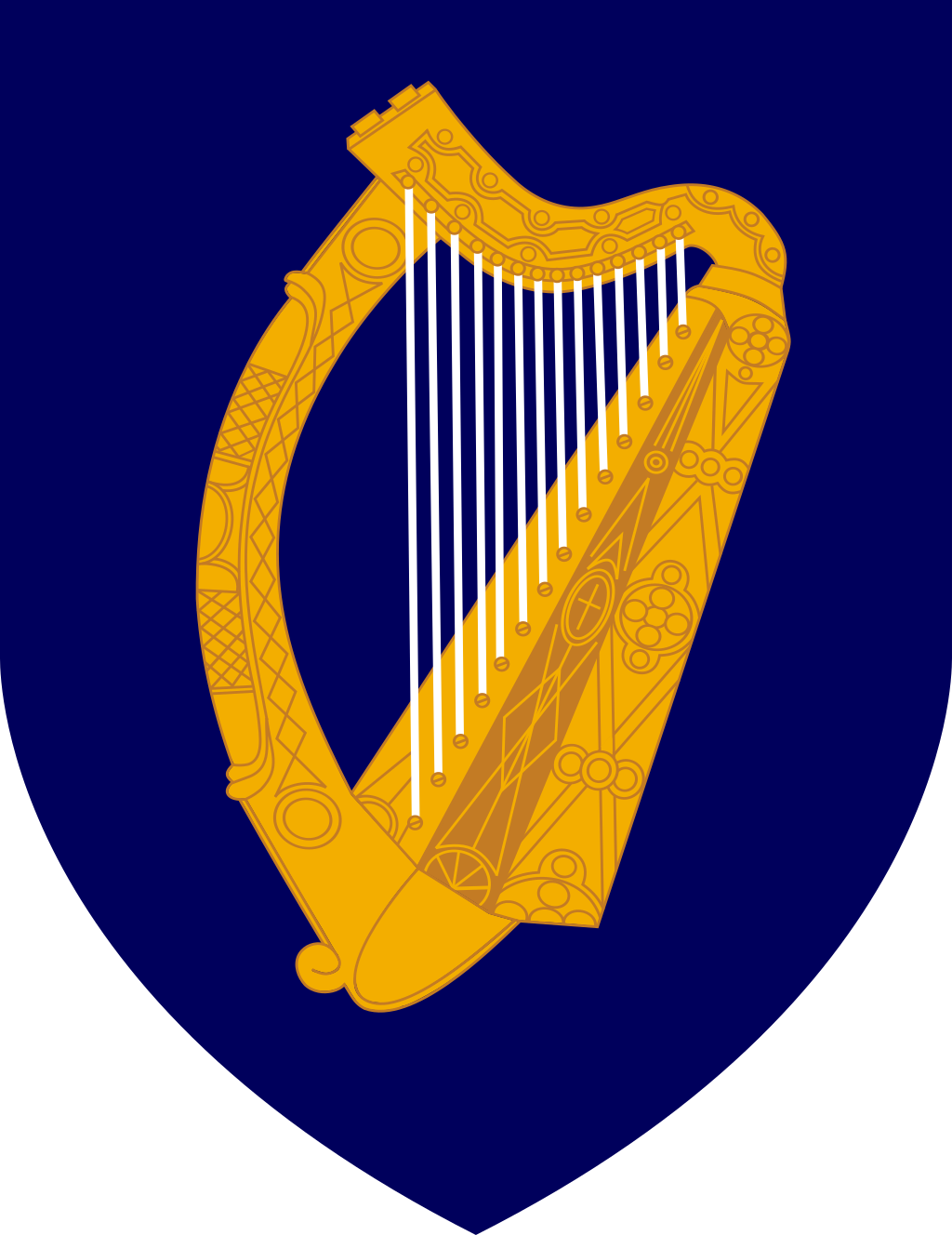
Published in the first volume of Irish Melodies
(1808) and set to a tune by Dublin composer John Stevenson,
Moore's poem imagines harp music sounding on the hill of Tara,
traditional home of Ireland's High Kings:
The harp that once through Tara's halls
The soul of music shed,
Now hangs as mute on Tara's walls,
As if that soul were fled.
So sleeps the pride of former days,
So glory's thrill is o'er,
And hearts, that once beat high for praise,
Now feel that pulse no more.
No more to chiefs and ladies bright
The harp of Tara swells;
The chord alone, that breaks at night,
Its tale of ruin tells.
Thus Freedom now so seldom wakes,
The only throb she gives,
Is when some heart indignant breaks,
To show that still she lives.
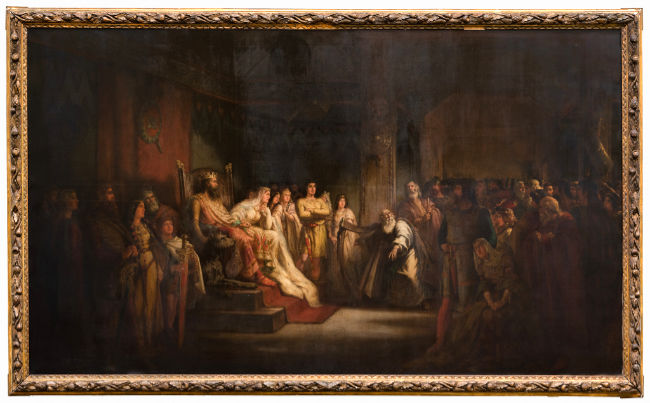
In about 1900 William Magrath, an artist born in Cork who lived
his adult life in America, began painting a massive canvas
inspired by Moore's lines. In 1904 it was exhibited in Ireland
to enthusiastic response. Joyce too seems to have responded
strongly to the poem as a young man. In "Two Gallants," Lenehan
and Corley hear some "mournful music" in the streets:
They walked along Nassau Street and then turned into
Kildare Street. Not far from the porch of the club a harpist
stood in the roadway, playing to a little ring of listeners.
He plucked at the wires heedlessly, glancing quickly from time
to time at the face of each new-comer and from time to time,
wearily also, at the sky. His harp, too, heedless that her
coverings had fallen about her knees, seemed weary alike of
the eyes of strangers and of her master’s hands. One hand
played in the bass the melody of Silent, O Moyle,
while the other hand careered in the treble after each group
of notes. The notes of the air sounded deep and full.
Joyce imagines the harp as a woman whose clothes have been
stripped off and who wearily, apathetically forbears people
gazing at her body and a man's hands playing on her. The
connection to Corley's preying on
a compliant servant girl is unmistakable. The pound coin
that he gets from the poor girl, a "sovereign," suggests
England's colonial domination of Ireland, and similar echoes
sound in the harpist playing his sad music in the street by
the Kildare Street Club,
headquarters of the ruling Anglo-Irish caste. These symbolic
details are Joyce's own, but they strongly suggest the
influence of Moore's poem, in which a harp that once stirred
proud emotions now sings a "tale of ruin."
Bloom's thoughts display no such patriotic fervor. In Lestrygonians,
preoccupied with eating, he thinks of a joke once delivered at
the Harp Musical Hall: "The harp that once did starve us
all." But he does have a feeling for harp music, and in
Sirens it figures in his erotic reveries. Thinking with
distaste of various kinds of instrumental music he has
listened to in concert halls, he makes an exception for one
instrument:
Only the harp. Lovely. Gold glowering light. Girl
touched it. Poop of a lovely. Gravy's rather good fit for a.
Golden ship. Erin. The harp that once or twice. Cool
hands. Ben Howth, the rhododendrons. We are their harps. I.
He. Old. Young.
The associations here shift rapidly and obscurely. The gold
color of the harp makes Bloom think of the girl playing it,
and then of Cleopatra's barge ("The poop was beaten gold," Antony
and Cleopatra 2.2.192). Gifford suggests, and Slote and
his collaborators concur, that "Erin" refers to the Erin's King, the
sightseeing vessel that Bloom once went on with Milly. This
seems a stretch, as the old tub was neither golden nor lovely,
but it was a ship, so possibly it bridges the gap in Bloom's
thoughts between Cleopatra's ship and the ancient nation of
Erin that the harp symbolizes. But Bloom is not thinking of
national greatness. He is thinking of the kinship of music and sex, of
Molly laying hands on him on Howth Head, and of her now
turning her love to Boylan. "Once or twice" evokes the long
interruption of sexual activity that has plagued his marriage.
The ancient Irish harp figures prominently in at least one
other poem by Moore, "The
Minstrel Boy," and in Circe a line from this
song recalls the association that Sirens made between
love and harps. Bloom is transmogrified into a troubadour,
plucking lute strings as he warbles songs of love. Then he
becomes the minstrel boy: "Steered by his rapier, he glides
to the door, his wild harp slung behind him."