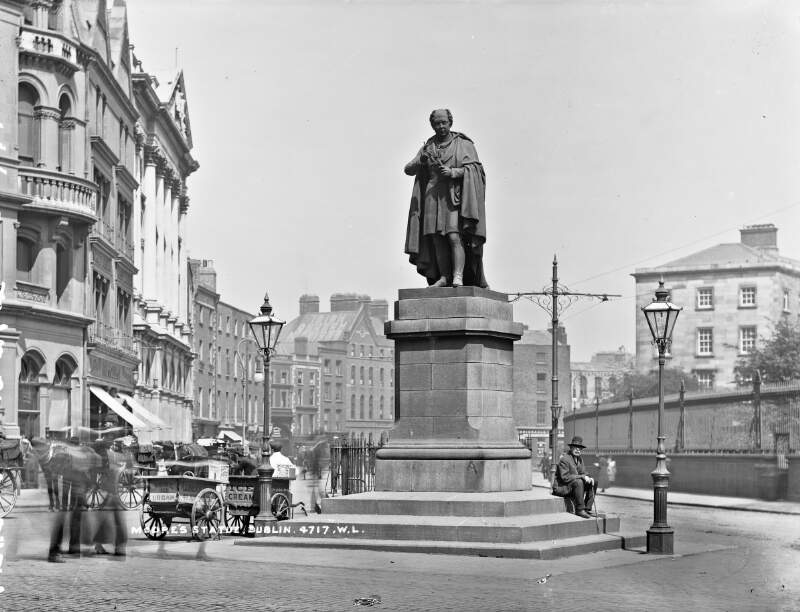
Walking southward toward Trinity College in Lestrygonians,
Bloom steps off the sidewalk where Westmoreland Street meets
College Street and crosses the intersection in front of
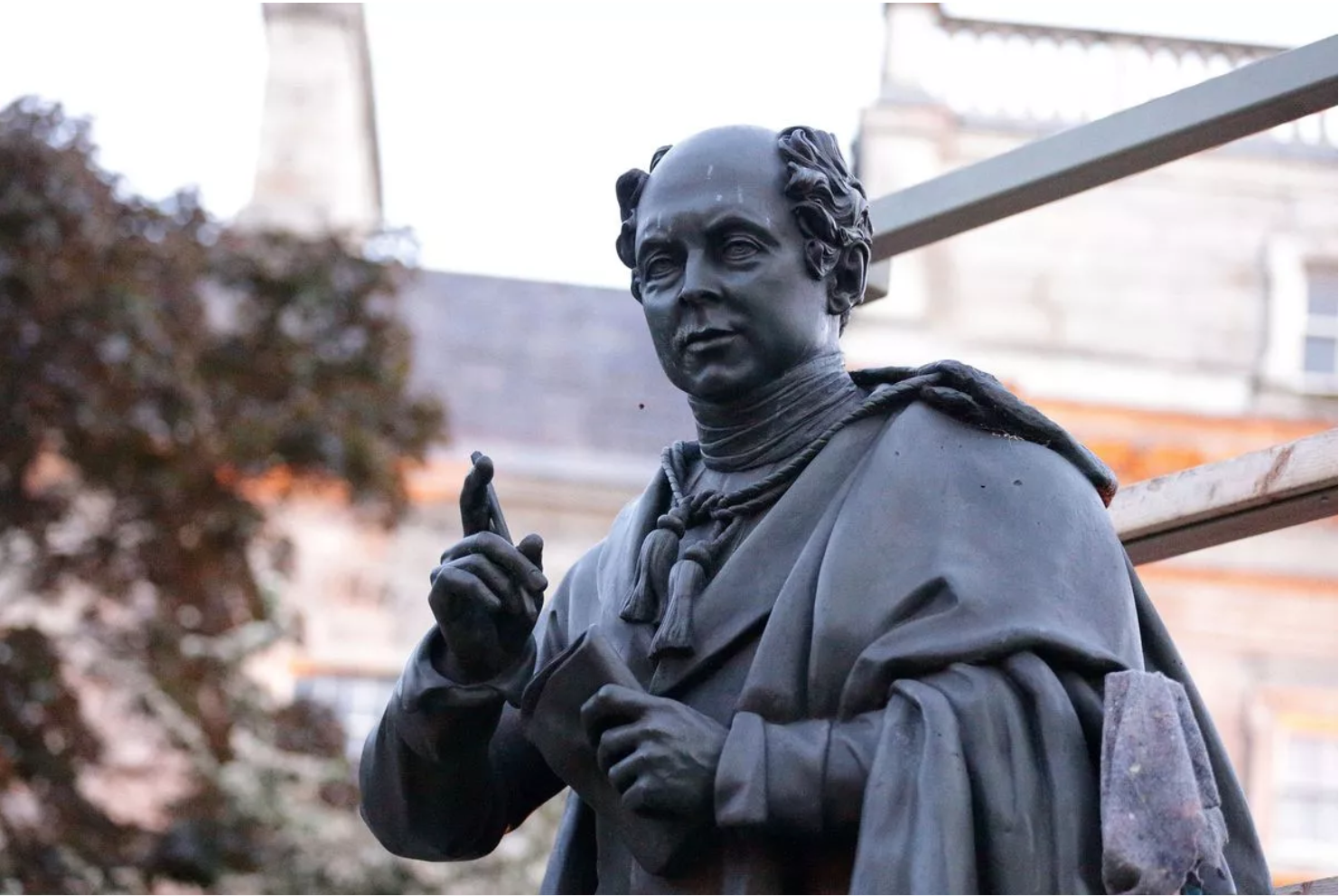
a statue, passing "under Tommy Moore's roguish finger." He
thinks, "They did right to put him up over a urinal." This and
another irreverent allusion to "Tommy Moore" in Cyclops
are the novel's only mentions of Thomas Moore, a major
romantic poet in the manner of Robert Burns, but his songs
pervade Ulysses. The capacious index to Gifford's
annotations lists no fewer than 18, many of which appear in
multiple chapters. In only a handful of chapters (Telemachus,
Nestor, Calypso, Hades, Ithaca) does no character think
of lines from one of these highly popular lyrics.
Dubliner Thomas Moore (1779-1852) was one of the first
Catholics to attend Trinity College—hence the location of his
statue—and his romantic celebrations of Irish experience
endeared him to people on both sides of the sectarian divide.
In ten separate volumes from 1808 to 1834 he published Irish
Melodies: poems set to old Irish tunes. Within his
lifetime he became known as Ireland's national Bard, much like
Scotland's beloved Robert ("Rabbie") Burns, who was a
generation older and whose choice to set eloquent original
verses to traditional Scottish melodies must have given him
inspiration and a model. This musical strategy made both men
something more than simply poets. Their lyrics take up
uncommonly powerful residence in memory because people can
sing them, hear them, feel them.
Moore was a nationalist. As a young man he sympathized with
the 1798 Rebellion and opposed Union
with Great Britain, and the poems that he published
starting in his late 20s praised ancient Irish culture and
lamented its suppression by English conquerors. Countless
Dublin households owned copies of the Melodies and
performed them in their parlors, and Moore's emotionally
charged vision of Irish nationhood inspired generations of
anti-imperial feeling. But their author was no revolutionary.
He left Ireland in 1798 and became an accomplished man of
letters in the Whig circles of 19th century London. Gifford
remarks, probably too harshly but with some justice, that "His
laments for 'poor old Ireland' were, therefore, not vital
Irish rebellion but sentimental complaints acceptable to English ears."
Joyce's many echoes of the Melodies in Ulysses
suggest that he responded warmly to their lyrical beauty, but
his references to the author convey a certain acidity that can
perhaps be read as criticism of Moore's temporizing softness.
Bloom thinks of the greenhouse
near Moore's statue because of a "Great song" published
in the 1808 Melodies and set to the traditional air
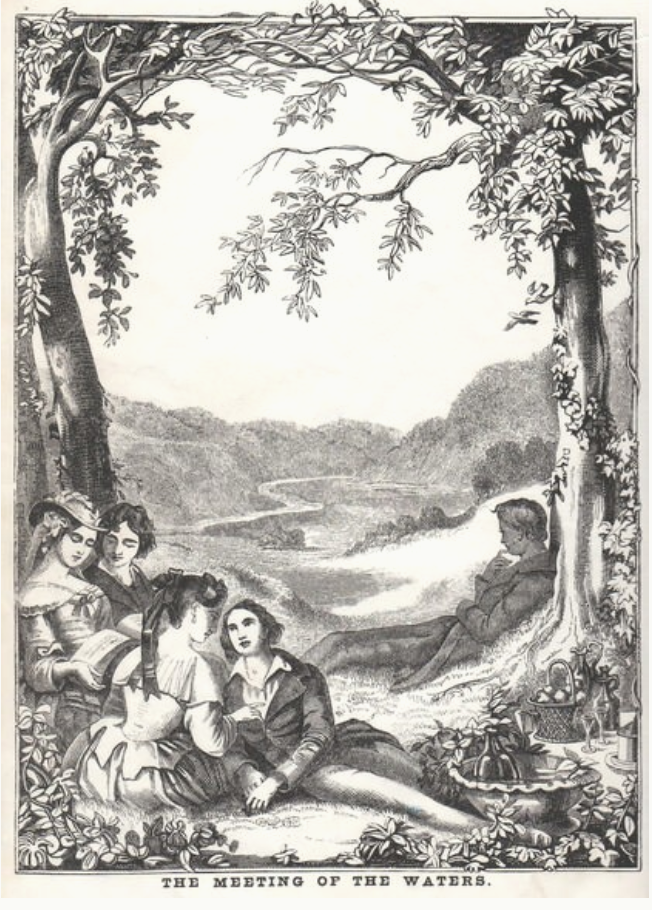
"The Old Head of Dennis." This lyric celebrates a place in
County Wicklow called the Meeting of the Waters where the
Avonmore and the Avonbeg join to form the River Avoca. It is
about enjoying nature with good friends:
There is not in the wide world a valley so sweet
As that vale in whose bosom the bright waters meet;
Oh! the last rays of feeling and life must depart,
Ere the bloom of that valley shall fade from my heart.
Yet it was not that nature had shed o’er the scene
Her purest of crystal and brightest of green;
’Twas not her soft magic of streamlet or hill,
Oh! no—it was something more exquisite still.
’Twas that friends, the belov’d of my bosom, were near,
Who made every dear scene of enchantment more dear,
And who felt how the best charms of nature improve,
When we see them reflected in looks that we love.
Sweet vale of Avoca! how calm could I rest
In thy bosom of shade, with the friends I love best,
Where the storms that we feel in this cold world should
cease,
And our hearts, like thy waters, be mingled in peace.
Bloom once heard Julia Morkan
beautifully perform "The Meeting of the Waters," and he
recalls its opening line: "There is not in this wide
world a vallee." But the most striking association
his mind throws up is the anti-romantic image of waters
meeting in a urinal. In a London Review of Books
article (27 July 2017) John Barrell observes that the English
travel writer John Barrow visited the Vale of Avoca in 1835
and entertained similarly dyspeptic thoughts: "As for the
'meeting of the waters', as the Irish are pleased to call the
confluence of two little streams, pompously or poetically as
you may please to decide, I think more has been made of it
than either the waters or their meeting deserve."
In Cyclops, the narrator snarls his contempt for the
Citizen's patriotic blather about "Robert Emmet and die for
your country, the Tommy Moore touch about Sara Curran and
she's far from the land." Emmet, whose grisly execution
is parodied several paragraphs later, was one of the leaders
of the 1798 Rebellion. He was a close friend of Moore's and
secretly engaged to a woman named Sara Curran. In volume 4 of
the Irish Melodies Moore published "She is Far From
the Land," set to the tune of the old Irish air "Open the
Door." It celebrates Sara, Robert, and Ireland:
She is far from the land where her young hero
sleeps,
And lovers are round her, sighing;
But coldly she turns from their gaze, and weeps,
For her heart in his grave is lying.
She sings the wild song of her dear native plains,
Every note which he loved awaking;
Ah! little they think, who delight in her strains,
How the heart of the Minstrel is breaking.
He had lived for his love, for his country he died,
They were all that to life had entwined him;
Nor soon shall the tears of his country be dried,
Nor long will his Love stay behind him.
Oh! make her a grave where the sunbeams rest,
When they promise a glorious morrow;
They'll shine o'er her sleep, like a smile from the West,
From her own loved island of sorrow.
Here as in many other places Joyce allows the tender strains of
one of Moore's poems to enter the fabric of
Ulysses. He
was by no means hostile to sentimental songs, and his own early
efforts as a lyric poet were often marked by soft romanticism.
(For that matter, his nationalism too was unmarked by any kind
of inclination to dangerous action.) But in this instance, as in
Lestrygonians, he allows one of his characters to mock
Moore's feel-good glow. For all their brutality the Citizen's
patriotic exclamations are just as ineffectually escapist as
Moore's, and the
Cyclops narrator derides this man
downing pints while spouting off about Emmet dying for his
country and Sara Curran mourning "far from the land."
I do not know how common it was in 1904 (or is today) for
Irish people to refer to Moore as "Tommy," but after
encountering this intimate diminutive for a second time it is
hard not to hear in it some subversive familiarity on Joyce's
part. In a gesture simultaneously friendly and needling, the
nickname seems to knock Moore off his pedestal of
Trinity-educated, London-refined respectability and remind him
of his roots as a Dublin Mick. Slote, Mamigonian, and Turner
note one other irreverence: "The phrase 'roguish finger'
also alludes to a tongue-in-cheek article by Francis Mahony
(Irish humourist and journalist, 1804-66), 'Rogueries of Tom
Moore' (1834), which asserted that some of Moore's most
popular songs were copied from French and Latin sources."