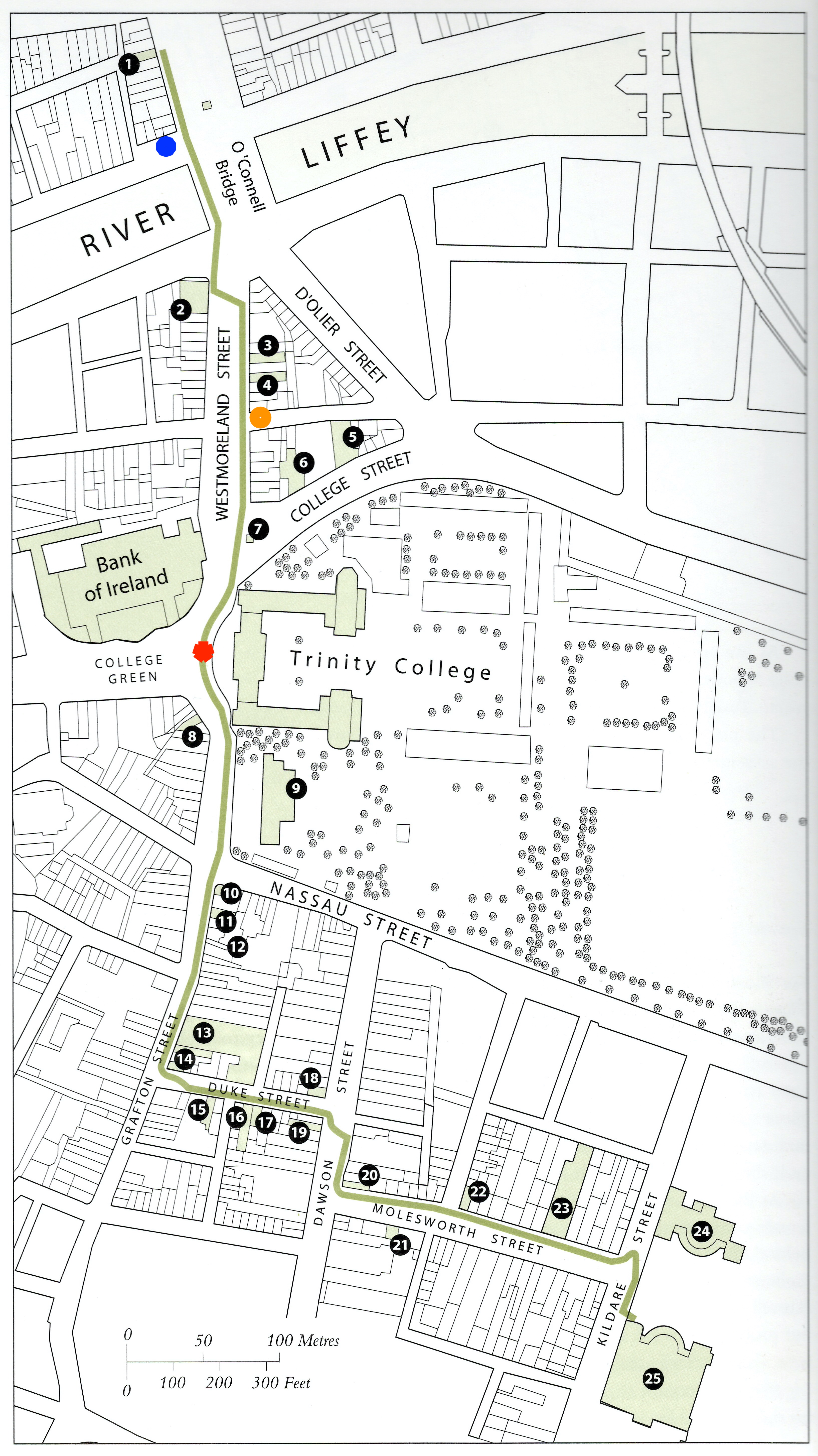
Lestrygonians starts with Bloom standing in front of "Graham
Lemon's," the Lemon
& Co. confectioner's shop at 49 O'Connell
(Sackville) Street Lower. After meditating on candy he walks
toward the river reading a "throwaway" that has been thrust
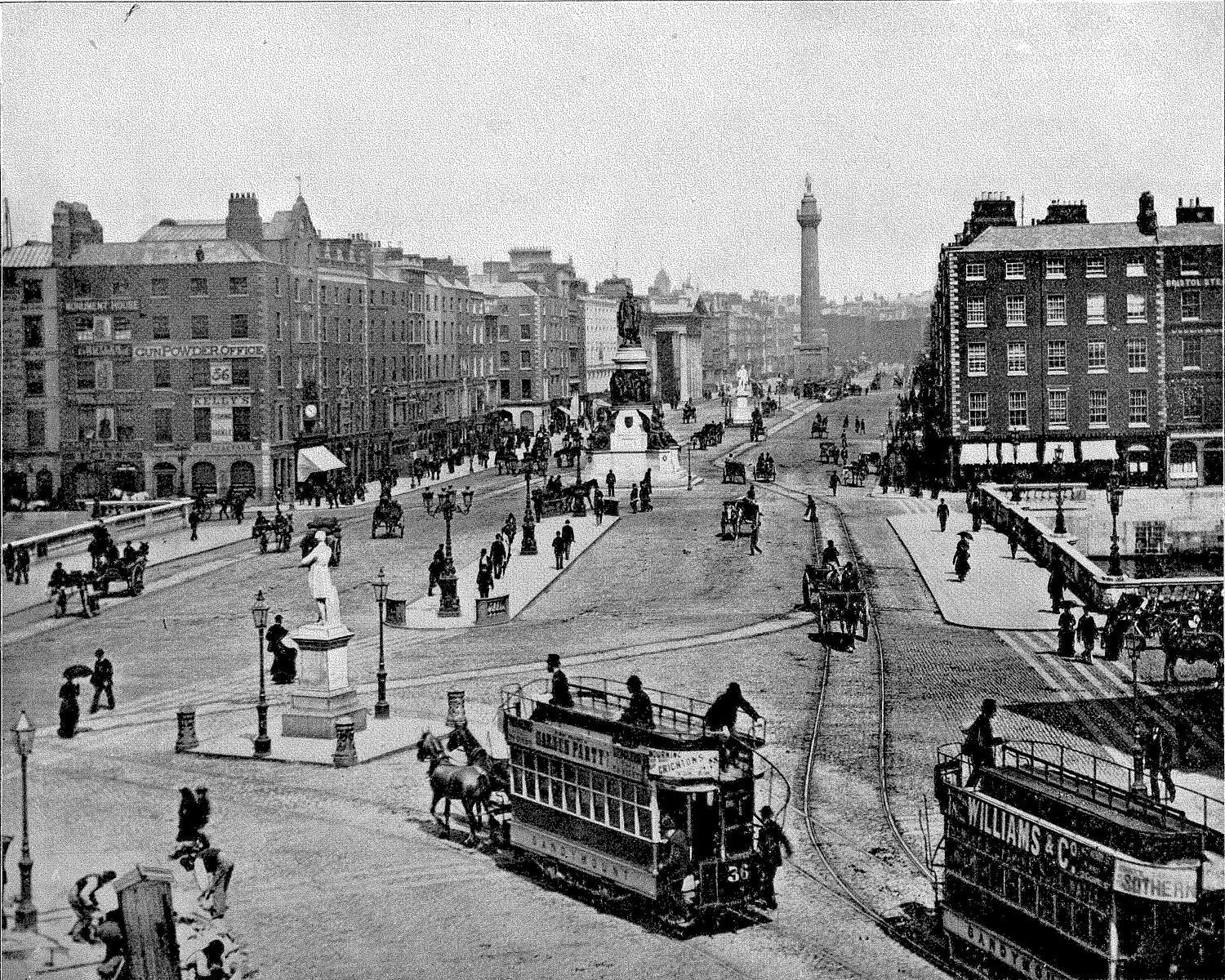
into his hand, past "Butler's monument house corner,"
which is called George Butler's "monument house, musical
instrument warehouse" in Thom's because it is located
across from the O'Connell
monument at the base of O'Connell Street. (Slote,
Mamigonian, and Turner observe that although this business was
the last house on the quay, it was not actually on the corner.
That honor belonged to 56 Lower O'Connell Street.) Bloom
glances down "Bachelor's walk," the quay on which
Butler's sits at number 34. At nearby number 25 he sees a
famished-looking Dilly Dedalus "there outside Dillon's
auctionrooms." In Wandering Rocks Dilly is still standing outside Joseph
Dillon's auction business, waiting patiently for her
improvident father to appear.
Bloom walks onto the "O'Connell bridge" and sees "a
puffball of smoke" rising from a Guinness brewery barge
passing underneath. He contemplates the vats of porter, the
sewage-laden waters of the Liffey, and the hungry gulls
flapping about, buys two cakes to feed the birds, and throws
away the throwaway. Having crossed the bridge, he looks up at
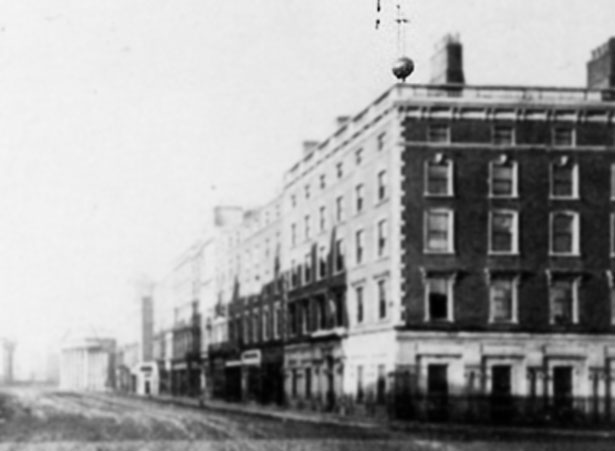
"the ballastoffice," a five-story building on the
corner of Aston's Quay and Westmoreland Street which housed
the offices of the Port of Dublin and held a very large and
accurate clock on its facade, as well as the large "timeball" on its roof
which makes him think of parallax.
He waits for a procession of sandwichboard bearers to pass by
him in the gutter, and then crosses "Westmoreland street when
apostrophe S had plodded by."
Walking along the sidewalk on the east side of the street, he
encounters Mrs. Breen and holds a long conversation with her.
As they talk, "Hot mockturtle vapour and steam of newbaked
jampuffs rolypoly poured out from Harrison's." This
business at 29 Westmoreland Street is listed as a
"confectioner's" in Thom's, like Lemon's, but it seems
to be a restaurant dedicated to baking and cooking rather than
candies. Bloom watches a street urchin breathing in the rich
aromas coming from its sidewalk grate to quell his hunger
pangs. Saying goodbye to Josie and moving on, he goes by "the
Irish Times" at number 31 and thinks of the
ads for a lady typist he has placed there.
At "Fleet street crossing," the midpoint of
Westmoreland Street, he thinks about where he should have
lunch—Rowe's? the Burton?—and then walks on "past Bolton's
Westmoreland house," a spirit grocer at numbers 35-36.
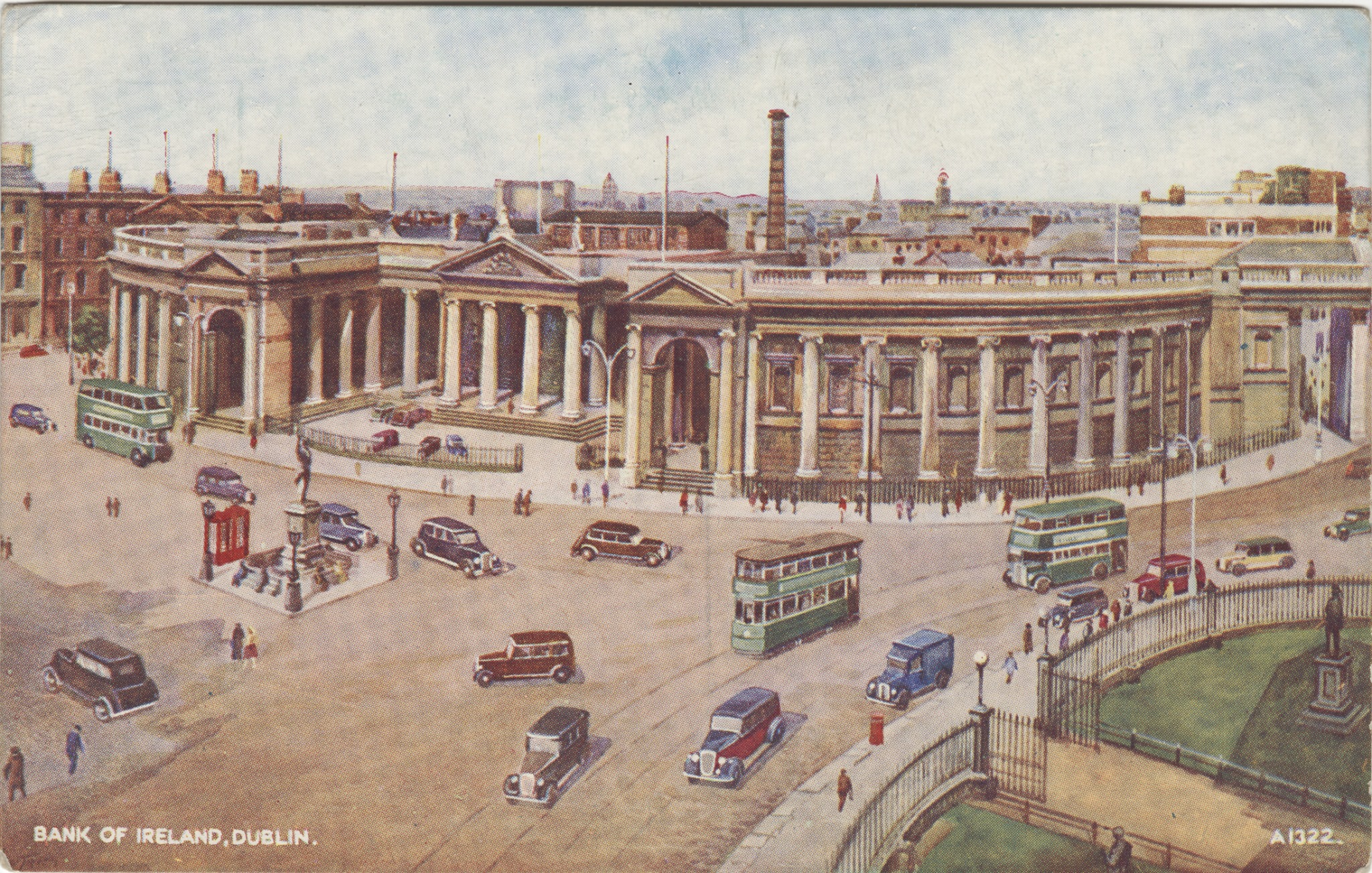
Soon he is at the end of Westmoreland Street, where the
imposing neoclassical building built to house the Irish
Parliament, and now owned by the
Bank of Ireland, begins its majestic semicircular wrap
around the north side of College Green: "Before the huge high
door of the Irish house of parliament a flock of
pigeons flew." Bloom thinks about pigeons voiding their bowels
on pedestrians: "Their little frolic after meals."
Then his attention is drawn in the opposite direction as "A
squad of constables debouched from College street,
marching Indian file." This street, which comes around the
northwest edge of Trinity College and joins Westmoreland
street from Bloom's left, held a police station and also the
M'Caughey Restaurant at numbers 3-4. The men's contented,
"Foodheated faces" tell Bloom that they have just finished
lunch, and he watches as "They split up into groups and
scattered, saluting towards their beats. Let out to graze." At
the same time, "A squad of others, marching irregularly,
rounded Trinity railings making for the station. Bound for
their troughs. Prepare to receive cavalry. Prepare to receive
soup." These policemen are marching northeast rather than
southwest, clearly comprising the next lunch shift.
Crossing College Street, Bloom walks "under Tommy Moore's
roguish finger." This freestanding bronze statue of
Irish poet Thomas Moore,
funded by public subscription, was erected in 1857 on a
granite base in a traffic island in the middle of the street.
Bloom thinks, "They did right to put him up over a urinal." He
is next seen walking where the second group of policemen had
been, by the iron railings that separate Trinity College's "surly front" from College Green.
This extremely busy intersection no longer has anything green
about it: "Trams passed one another, ingoing, outgoing,
clanging." Bloom contemplates the sheer numbers of human
beings packed into cities like sardines and concludes, "This
is the very worst hour of the day. Vitality. Dull, gloomy:
hate this hour. Feel as if I had been eaten and spewed."
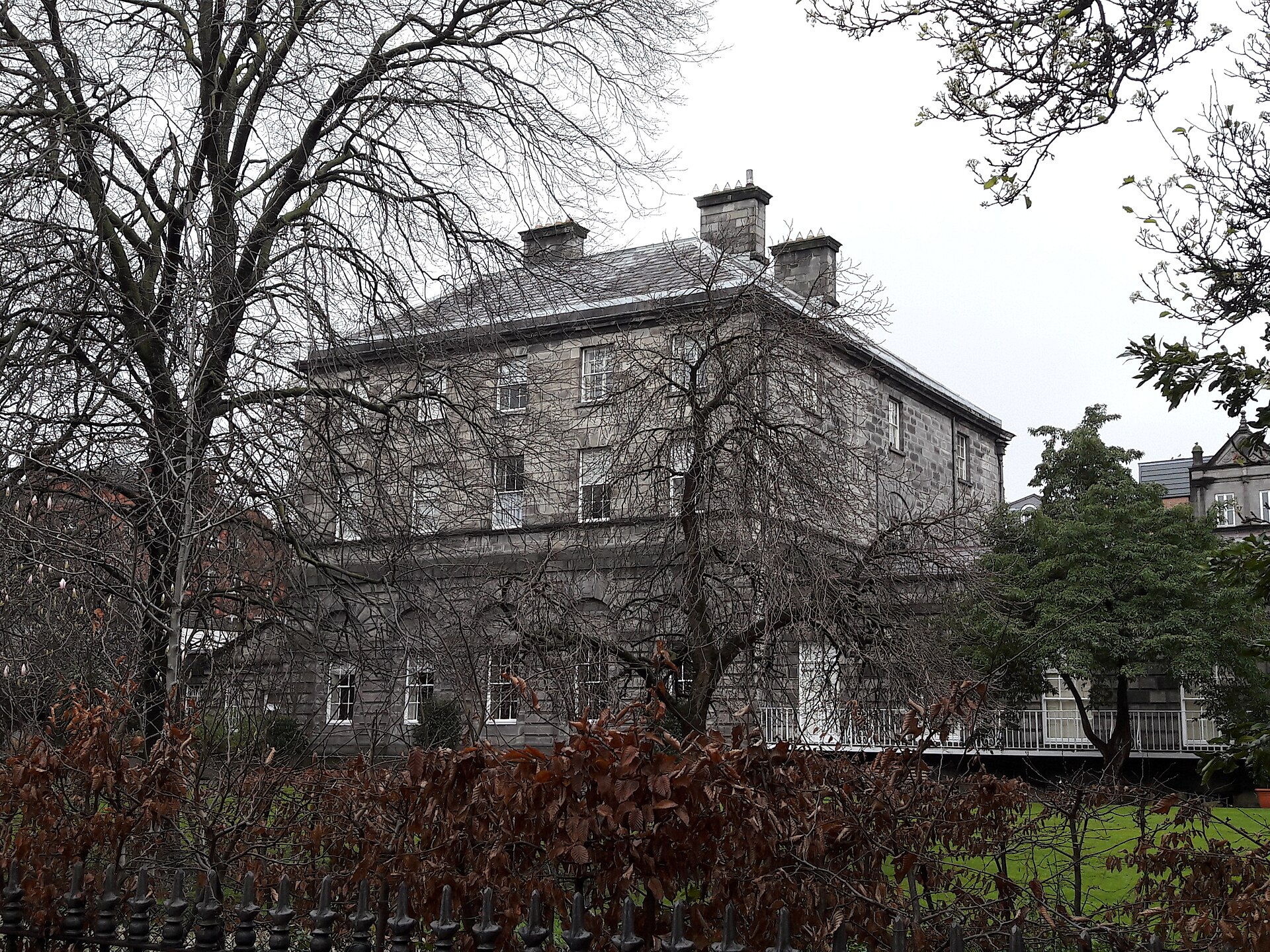
A few steps more and he is passing the "Provost's house,"
a large and imposing stone pile that stands on the
southwestern corner of the campus. Bloom thinks, "The reverend
Dr Salmon: tinned salmon. Well tinned in there. Wouldn't live
in it if they paid me." Slote and his collaborators point out
that the Reverend George Salmon, D.D., Regius professor of
divinity, was indeed the Provost of Trinity College in 1904,
but only until his death on January 22. They cite Eric
Partridge as authority that "tinned" can mean wealthy, and
point out that Salmon earned over 1,000 pounds a year as
Provost. According to the 20 April 1904 Freeman's Journal,
at his death he left an estate valued at £27,200. Tinned
salmon, indeed. This reflection, and the surly grandeur of the
house, provide more grist for Bloom's existential nausea.
Looking to the right across the first block of Grafton
Street, he sees sunlight glinting from "the silverware
opposite in Walter Sexton's window." Walter Sexton was
listed in Thom's as a "goldsmith, jeweller,
silversmith, and watchmaker" at 118 Grafton Street. Bloom
contemplates John Howard Parnell passing by the shop window,
and then he becomes aware of George
Russell passing him on the east side of the street and
thinks of his vegetarianism. Crossing at the "Nassau street
corner," he stands in front of the Yeates and Son
optical shop on the south side of Nassau Street and looks back
at the roof of the Parliament building, testing his vision and
thinking disconsolately of astronomy.
From this point, almost exactly halfway through the chapter,
the character of the cityscape changes subtly but distinctly.
Bloom enters Grafton Street proper, bounded on both sides by
fancy shops. Grand monumental displays are left behind and
commerce prevails. There are more restaurants and pubs, more
businesses in which he is personally interested, and a more
confusing warren of streets. Bloom follows a much less direct
path as his feet take him south, then east, then briefly back
to the west, then east again, then south, then east, and,
finally and abruptly, south to the entrance of the National
Museum. Given Joyce's gastrointestinal conceit, one may wonder
whether the relatively straight shot that he has taken from
O'Connell Street to Grafton Street, passing through the busy
churning of College Green, is meant to correspond to the
relatively straight line from mouth to duodenum via the
stomach. If so, then the much curvier walk that follows should
be imagined as intestinal.
Such a reading may be thought overly ingenious (I do not know
if anyone has suggested it before) but the schemas show that Joyce was
thinking of "peristaltic" movement through the alimentary
canal, and there can be little doubt about where he saw that
motion concluding: after Lestrygonians ends, Bloom
goes into the National Museum to see whether the statue of a
Greek goddess possesses an anus. (Buck Mulligan reports this
detail in Scylla.) Once a reader realizes that Bloom's
feet trace question marks
in Lotus Eaters, anything seems possible.