Historic
and hefty
Parody. "It was a historic and a hefty battle when
Myler and Percy were scheduled to don the gloves [...]
the frenzied cheers of the public who broke through the
ringropes and fairly mobbed him with delight": newspaper
writing inspires yet one more parodic send-up in response to
Alf Bergan's report on "that Keogh-Bennett match." The joke
here consists in elevating some vicious fighting into a
diverting spectacle fit for genteel readers. The parody draws
on the language of contemporary boxing reporting but blows it
up into something almost unrecognizable as a fistfight.
Joyce evokes such ferocity in Cyclops when Alf Bergan says that Keogh gave Bennett "the father and mother of a beating. See the little kipper not up to his navel and the big fellow swiping. God, he gave him one last puck in the wind, Queensberry rules and all, made him puke what he never ate." This "puck," or punch, evidently hit the Englishman in the stomach hard enough to take away his breath. The OED gives one definition of "wind" as "That part of the body in front of the stomach a blow upon which takes away the breath by checking the action of the diaphragm."
The parody uses the technical terms and decorous clichés of boxing reportage to portray a more gentlemanly bout of fisticuffs: "It was a historic and a hefty battle" in which the Irish champion, "Handicapped as he was by lack of poundage," compensated with "superlative skill in ringcraft," "his footwork a treat to watch." The hammering of the Irishman's face's becomes "some neat work on the pet's nose." Stinging blows become "a brisk exchange of courtesies." Drawing blood is tapping "some lively claret" (i.e., red wine). The last round is "The final bout of fireworks." "It was a fight to the finish and the best man for it. The two fought like tigers and excitement ran fever high." The "puck in the wind" becomes "a terrific left to Battling Bennett's stomach, flooring him flat. It was a knockout clean and clever."
Slote, Mamigonian, and Turner note that some of these expressions were standard fare in boxing reporting and popular speech. The phrase "on the ropes" is still current, as is "flooring" someone. Coming "to handigrips" is seldom heard now, but was once common. Eric Partridge recognizes "To tap one's claret" as a way of saying "to make one's nose bleed," and Pierce Egan's Boxiana (1829) quotes its use in a report of a match: "Belcher, by a sharp hit, made the claret fly copiously from his opponent." The parody's observation that Keogh "had been receivergeneral of rights and left" echoes another common expression cited in Boxiana: "It was evident McDermot was doomed to be a Receiver-General."
Although much of the language in the parody has precedents in common usage, Joyce uses them to produce a passage of impossibly purple prose. Slote and his colleagues quote from a Freeman's Journal article of 30 April 1904 that evidently gave him one journalistic source to work with. It is considerably more matter-of-fact: "J. Keogh (Dublin) beat "Private Garry (6th Dragoons). The former had the advantage in reach, and though Garry attacked for the first half minute Keogh had the best of the exchanges, and towards the close of the round Garry was in trouble. In the second round Garry did better but Keogh landed several times on the body and early in the third round knocked Garry out with a right hand punch on the mark." This language would not sound out of place in ring reporting today, more than a century later. Joyce's sounds like it belongs to another era and another social class.
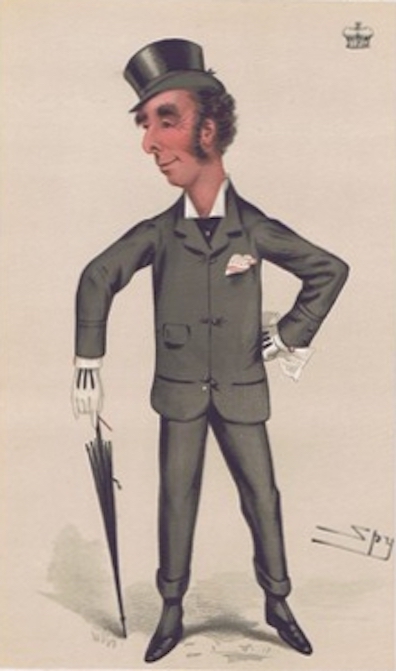
Caricature of the 9th Marquess of Queensberry run in
the 10 November 1877 issue of Vanity Fair with caption by
Leslie Ward: "A good light weight." Source: Wikimedia Commons.