Eblana
"Eblana" is used several times in Ulysses as a
synonym for Dublin. The name comes from the Geography
of Ptolemy (Claudius Ptolemaeus), a 2nd century AD Alexandrian
astronomer and cartographer. Ptolemy was probably referring to
an ancient settlement located a little north of Dublin, but
scholarly opinion in Joyce's time identified it with the
capital. He uses the name somewhat archly, as a grand-sounding
indicator of Dublin's antiquity.
The Cyclops parody that begins "In Inisfail the fair," which echoes a 7th century Irish poem translated by James Clarence Mangan, mentions Irish heroes "from Eblana to Slievemargy." Only one of these names is in the poem: Mangan's version reads, "From Dublin to Slewmargy's peak." Evidently Joyce substituted a name which he assumed was synonymous, aiming for a sound of noble antiquity. If Dublin had existed in Ptolemy's time it would be nearly two millennia old.
At other points in the novel the word is used to identify people as Dubliners. A later Cyclops parody describes an English boxer as being "confident of knocking out the fistic Eblanite in jigtime." Myler Keogh is a boxer, hence "fistic" (a word which the OED recognizes as meaning "pugilistic"), and he was born and raised in the Dublin suburb of Donnybrook, hence "Eblanite." (Slote, Mamigonian, and Turner gloss "jigtime" as "a short space of time.") A second use of the name to identify a Dubliner comes in Oxen of the Sun, when Madden recalls the death of "a woman of Eblana" in the National Maternity Hospital. The prose here is modeled on 15th and 16th century writers, so Joyce may be thinking of the era in which Ptolemy's Geography entered into European awareness.
Eblana has also been used to name ships. In Eumaeus Bloom stands gazing "for the space of a half a second or so in the direction of a bucketdredger, rejoicing in the farfamed name of Eblana, moored alongside Customhouse quay and quite possibly out of repair." Ports need dredgers to ensure adequate water depth for navigation, and the sands and silts they pull up are often used for land reclamation and construction. The Dublin Port and Docks Board maintained a small fleet of these vessels in the early 20th century, some employing suction and others buckets. The Eblana, a hopper barge evidently fitted with a bucket-ladder, was built in 1884 and altered in 1900. Slote and his colleagues cite a mention of it in 1901: "One of the Dublin Corporation dredgers in the Liffey was called the Eblana (Evening Herald, 19 Aug. 1901, p. 4, col. b)."
A truly impressive collection of photographs of bucketdredgers (53 in all) can be found at dredgepoint.org/equipment/historical-bucket-ladder-dredgers. These workhorses of the docks were admirably ingenious but could hardly be called elegant. The notion that such a bottom-dragging river barge, filthy with much and possibly needing repairs, is "rejoicing in the farfamed name of Eblana" may be taken as an expression of Bloomian irony. But nobler seagoing vessels have also boasted the name. In 1849 the Dublin-Holyhead mail service ordered the construction of a paddle steamer to be named the Eblana. It was put into service in 1850 and scrapped in 1884, the same year that the bucketdredger Eblana was built. Today, a fishing trawler called the Eblana, one of the last two operating out of the port of Howth northeast of Dublin, is still sailing the Irish Sea.
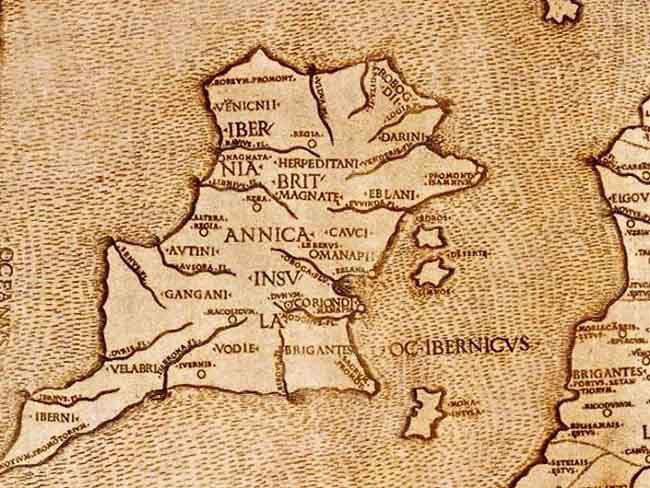
A Latinized (possibly 16th century?) copy of Ptolemy's 2nd
century map of Ireland, showing "Eblani" somewhere north of
present-day Dublin. Source: www.reddit.com.
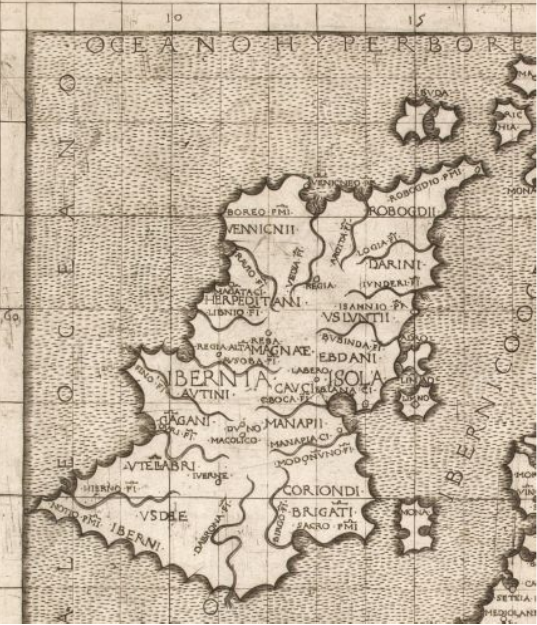
Another such map, published in Tabula Prima d'Europa (1482),
showing "Ebdani" slightly farther south. Source:
saxonhistory.co.uk.
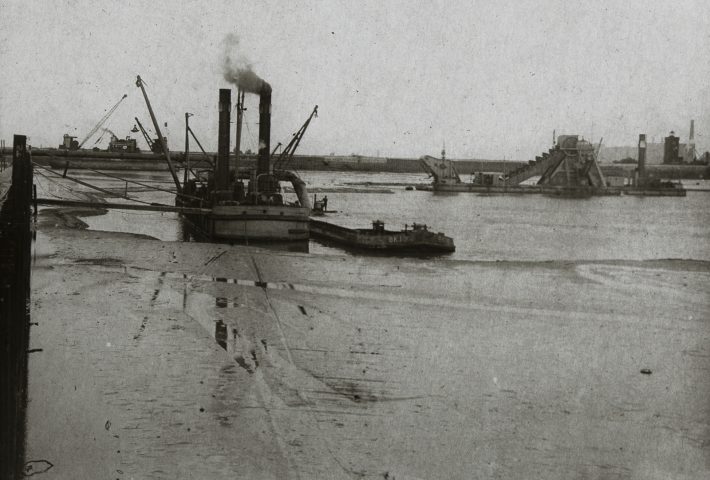
Ca. 1930 photograph of the clevely named Sandpiper, a suction
dredger commissioned by the Dublin Port and Docks Board in
1903 and active from 1904 to 1959, here seen working on the
reconstruction of the Alexandria Basin. Source:
www.dublinportarchive.com.
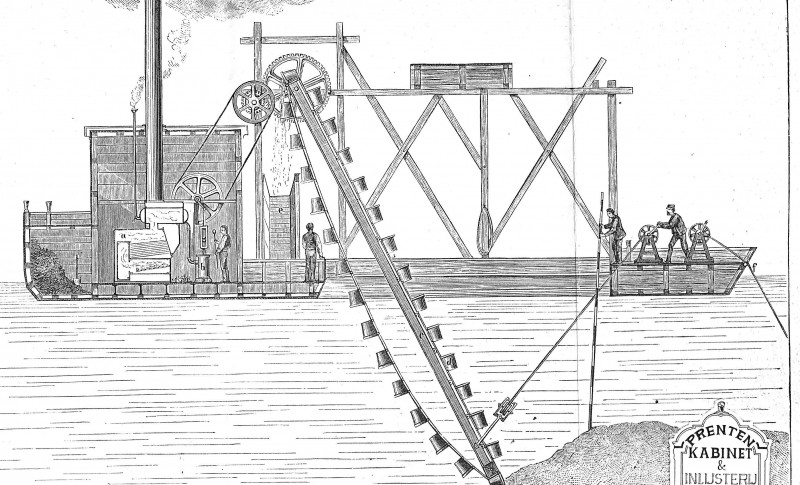
Schematic drawing of a bucket dredger. Source:
dredgepoint.org.
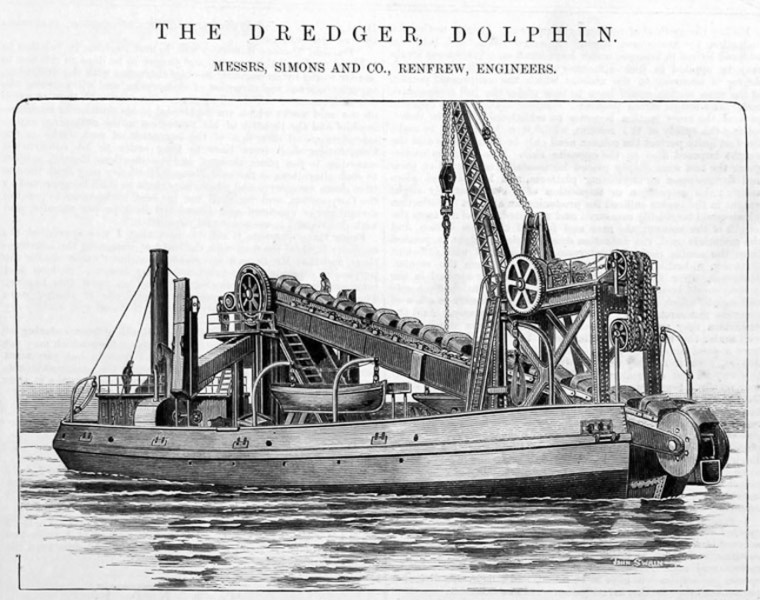
A Scottish-built bucket dredger called the Dophin, ca.
1886-87. Source: dredgepoint.org.
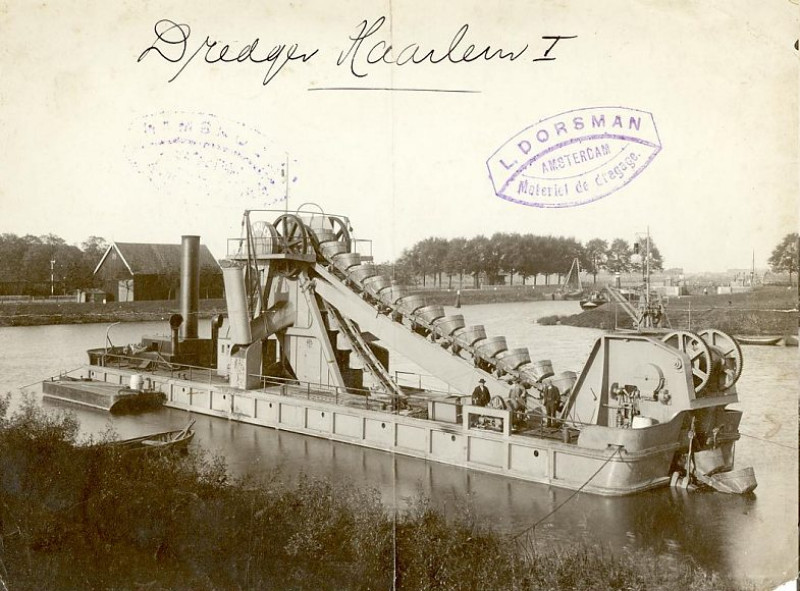
A Dutch bucket dredger called the Haarlem. Source:
dredgepoint.org.