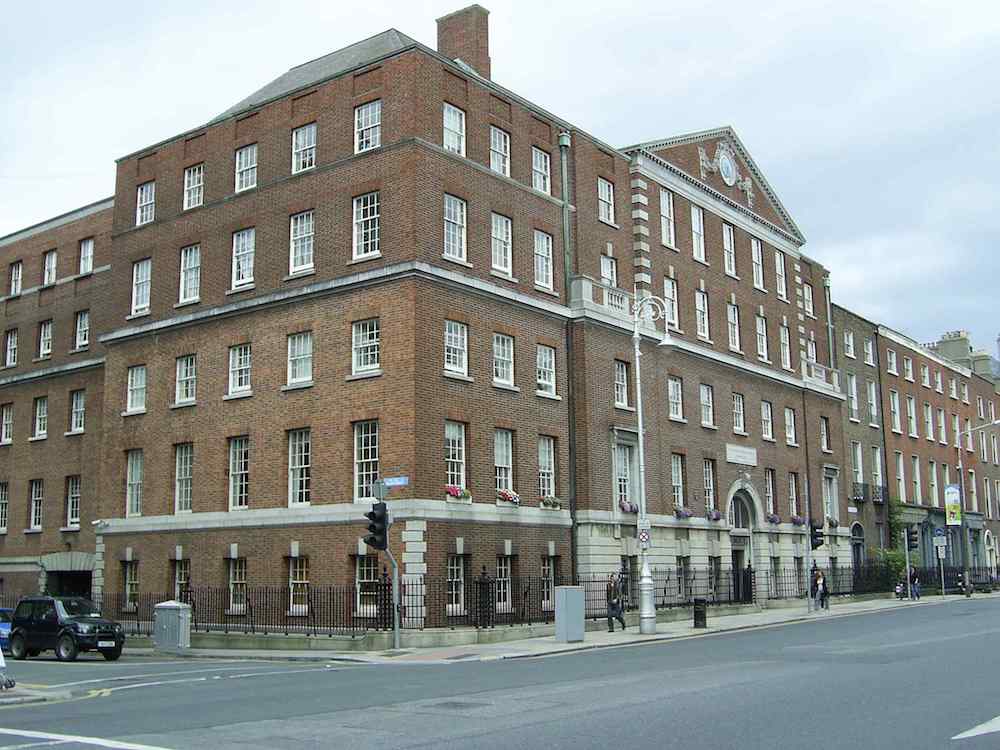
Episode 14, "Oxen of the Sun," takes place from 10 to 11 PM.
It shows a gaggle of young men carousing in the common room of
the National Maternity Hospital on Holles Street before
walking down the street for drinks at a pub and then going
their separate ways. This chapter proves even more difficult
than Proteus, because the parodic writing that kept
interrupting the narrator in Cyclops and then
commandeered half of Nausicaa now reigns unchecked, overlaying
the wild drunken talk of the young men with wildly
proliferating narrative viewpoints. One strange voice after
another grabs the microphone, simulating the historical
evolution of English literary prose and also, allegedly,
evoking the development of the human fetus from conception to
birth. The Odyssey's story of divinely protected
cattle enters in some of the voices' oracular affirmations of
the Catholic command to procreate. All of these threads come
together in a tapestry so densely disorienting that many
people consider Oxen unintelligible or tiresome. It is
neither. Its joy consists in almost, but not quite, liberating
language from the mundane business of reporting events. A
story is told, and quite precisely. But events emerge dimly
through a blizzard of words, in a virtuoso demonstration of
the many shapes that prose narration can take. Language itself
becomes the star of the show.
In book 12, after surviving the passage between Scylla and
Charybdis, Odysseus tells his men, "Tiresias and Circe both
insisted / we must avoid the island of the Sun, / the joy of
mortals. They said dreadful danger / lurks there for us"
(274-77, trans. Wilson). But the exhausted crew refuse to
spend another night at sea. Odysseus gives way after extorting
a promise not to kill any of the sheep or cattle sacred to
Helios, the Sun God. After bad weather maroons them on the
island, impending starvation compels the men to break their
vow. When they finally manage to depart the island, Zeus
destroys their ship with a thunderbolt. Everyone but Odysseus
drowns.
This brief adventure gave Joyce the germ of an idea for a
chapter. Oxen of the Sun begins with a pagan
invocation of the sun-god ("bright one, light one"), asking
for the blessing of children ("quickening and wombfruit").
Then two long and nearly untranslatable sentences praise "the
bounty of increase" and human care in making it happen.
Children are the sacred cows of this chapter, and the gods (or
God) have an interest in seeing that men and women keep
producing them. Various narrative voices, now and later in the
chapter, praise the founding of obstretrics hospitals, censure
people who make light of childbirth, condemn contraceptives
and masturbation, and celebrate the arrival of a new human
being on earth (Mina Purefoy's son, born near the end of the
chapter after three days of hard labor).
In a March 1920 letter to his friend Frank Budgen Joyce
wrote, "Am working hard at Oxen of the Sun, the idea
being the crime committed against fecundity by sterilizing the
act of coition." He went on to describe "a nine-parted episode
without divisions" that begins with very ancient Latin and
English prose styles and moves forward through medieval,
Renaissance, 18th and 19th century styles before concluding in
"a frightful jumble" of modern slang. This "progression," he
said, would parallel "natural stages of development in the
embryo and the periods of faunal evoluion in general."
Anglo-Saxon alliterations would "give the sense of the hoofs
of oxen," and symbolic correspondences would be revealed:
"Bloom is the spermatozoon, the hospital the womb, the nurse
the ovum, Stephen the embryo. How's that for high?"
Like the schemas, this
letter is both helpful and misleading. Probably no deception
was intended. An artist's intentions can never completely
account for what may emerge in the act of composition: plans
become adjusted, new insights arise, things that seemed
crucial turn out to be inessential. Joyce's notebooks show
that he was indeed working on a "nine-parted" structure, but
it is questionable whether the finished product displays it.
The verbal chaos at the beginning can be seen as the unformed
state before sperm and ovum unite, and the "frightful jumble"
at the end as the afterbirth, but dividing the rest of the
chapter into nine gestational months seems like an arbitrary
business, more interesting to the writer than to the reader.
And good luck finding analogues of blastocysts, neural tubes,
tadpole-forms, or forebrain development in the chapter, much
less a spermatic Bloom fertilizing Nurse Callan and producing
Stephen. As with the supposed fuga
per canonem in Sirens, which has led
generations of critics on wild goose chases, Joyce here
promised more than he could possibly deliver.
A historical progression of literary prose styles is far
easier to discern—indeed, it is the principal effect that
every reader will notice. But here too the finished product
defies the neat categories of imitation implied in the letter
to Budgen. Joyce found stylistic features of various
English-language authors, as well as characteristic words and
phrases, in an assortment of anthologies and critical studies.
In many cases it seems clear to me that he also read the
primary works themselves, in their entirety or at least in
much larger measure than anthologies could provide. On
notesheets he wrote down many of the materials he found in his
reading, and he found ways to use many of those when it came
time to write particular paragraphs of the chapter. But in the
act of writing he gave himself an extraordinary amount of
freedom. Far from composing slavishly imitative parodies, he
let his prose develop according to its own laws.
The letter to Budgen points to one small example of this
freedom: Anglo-Saxon alliteration recurs in several sections
of the chapter not devoted to Anglo-Saxon style. Joyce singled
out this one deviation from historical accuracy, but in fact
such anachronisms abound. Effects associated with one period
may continue to show up in later ones, or even arrive early in
anticipation. Words and phrases lifted from one author may get
used in the imitation of other. The more one compares
paragraphs of Oxen with their possible sources, the
more one gets the feeling that Joyce, after doing his
homework, simply allowed himself to have fun. His ways of
echoing source texts also vary widely. Some paragraphs
brilliantly ape the originals. Others engage in loose,
unmimetic burlesque. Still others meld diverse influences to
create impressionistic suggestions of an era or genre.
Occasionally the rules of the game are simply suspended: the
survey of English begins (ostensibly, at least) with
imitations of Latin writers, and the supposedly Anglo-Saxon
prose gets its alliteration mainly from Anglo-Saxon verse.
Like Stephen in Scylla and Charybdis, Joyce here is
more entertainer than scholar—and for anyone willing to
undertake a mad cerebral dash through 1,500 years of changing
prose styles, he is highly entertaining. With each new effort
(usually starting at paragraph breaks, but not always), new
ways of generating language bring with them new ways of
presenting characters and conversation, new ways of
understanding and judging human actions—a breathtakingly
kaleidoscopic succession of perspectives. Experiencing all
this variety, and struggling to see what the characters are
doing from moment to moment, one may suspect that mimetic
representation has been entirely abandoned. It hasn't. Things
are actually happening, and a coherent story is being told,
but parallax is taking on an entirely new kind of
significance.