When the Poulaphouca yews in Circe reveal to the
Nymph that a young Bloom "profaned our sacred shade" by
masturbating "In the open air...And on our virgin sward," he
responds with a gush of excuses: "I was precocious. Youth. The
fauna. I sacrificed to the god of the forest. The flowers that
bloom in the spring. It was pairing time. Capillary attraction
is a natural phenomenon." These lame excuses distract from the
much more relevant confession that comes next: the waterfall made Bloom
remembering spying on a urinating girl. The allusion to
a song in Gilbert and Sullivan's Mikado slyly
undermines Bloom's attempts at self-justification.
One of many memorable numbers in the Mikado is "The
flowers that bloom in the spring," which comes near the end of
the operetta as plot complications are being resolved. In
order to bring the supposedly executed Nanki-Poo back to life
and avoid being executed himself, Ko-Ko becomes convinced that
he must marry the elderly Katisha, whom Nanki-Poo has been
trying to avoid marrying. Nanki-Poo and his beloved Yum-Yum,
who have recently married, paint the situation in the rosiest
light:
The flowers that bloom in the spring,
Tra la,
Breathe promise of merry sunshine —
As we merrily dance and we sing,
Tra la,
We welcome the hope that they bring,
Tra la,
Of a summer of roses and wine,
Of a summer of roses and wine.
And that′s what we mean when we say that a thing
Is welcome as flowers that bloom in the spring.
Ko-Ko, however, is having none of it:
The flowers that bloom in the spring, Tra la, Have nothing to do with the case.
I've got to take under my wing,
Tra la,
A most unattractive old thing,
Tra la,
With a caricature of a face,
With a caricature of a face.
And that′s what I mean when I say, or I sing,
"Oh, bother the flowers that bloom in the spring."
Tra la la la la,
Tra la la la la,
"Oh, bother the flowers of spring."
The bolded words are among the most memorable in Gilbert's
libretto, and they bear brilliantly on Bloom's "case." Flowers
blooming in spring had nothing to do with his masturbation; it
was prompted by running water. As far as I know no Joyce
commentator has commented on this. It is one of countless
moments in Ulysses where an allusion demands not
merely to have its source recognized but to have its content
scrutinized.
John Hunt 2025
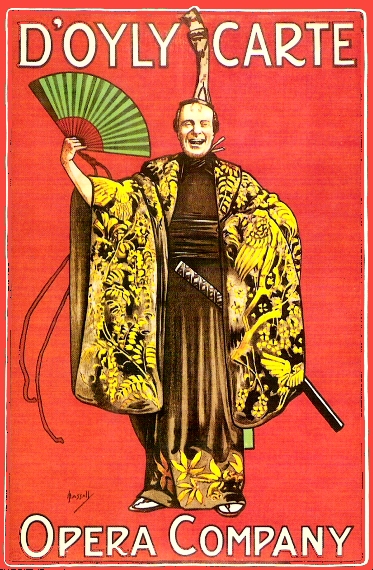
J. Hassal's 1919 publicity poster for The Mikado, from
Robin Wilson and Lloyd Frederic's Gilbert & Sullivan: The
Official D'Oyly Carte Picture History (1984). Source:
Wikimedia Commons.
The Flowers That Bloom in the Spring in the 1966 film
of the Mikado (audio upgraded with a 1965 stereo recording by
the same cast, conducted by Sir Malcolm Sargent). Source:
www.youtube.com.
Eric Idle as Ko-Ko in the same number (he substitutes
"bugger" for "bother") in a modern-setting 1986 English
National Opera production directed for television by Jonathan
Miller. Source: www.youtube.com.