Acting "unostentatiously" (i.e., discreetly or covertly—the
language of Eumaeus is often not quite right), Bloom
turns over the postcard and notes a "partially obliterated
address and postmark": "Tarjeta Postal, Señor A Boudin,
Galeria Becche, Santiago, Chile. There was no
message evidently, as he took particular notice." His
particularly noticing the lack of a message is made to sound
astute, but in fact the absence of one on the back of a
postcard would not have been remarkable in 1904. In a JJON
article, Aida Yared suggests that before 1907 it would have
been remarkable if any message had been written there.
Postcards, she notes, traditionally had an "undivided back,"
sometimes with instructions to write nothing but the address
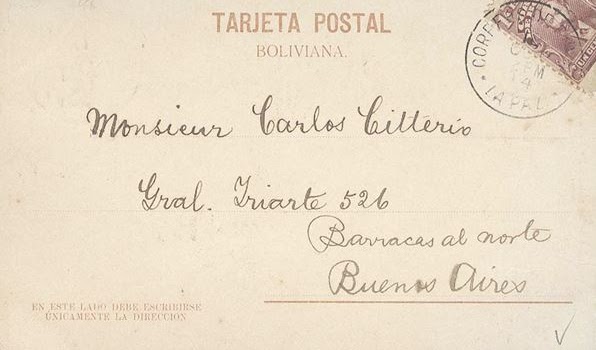
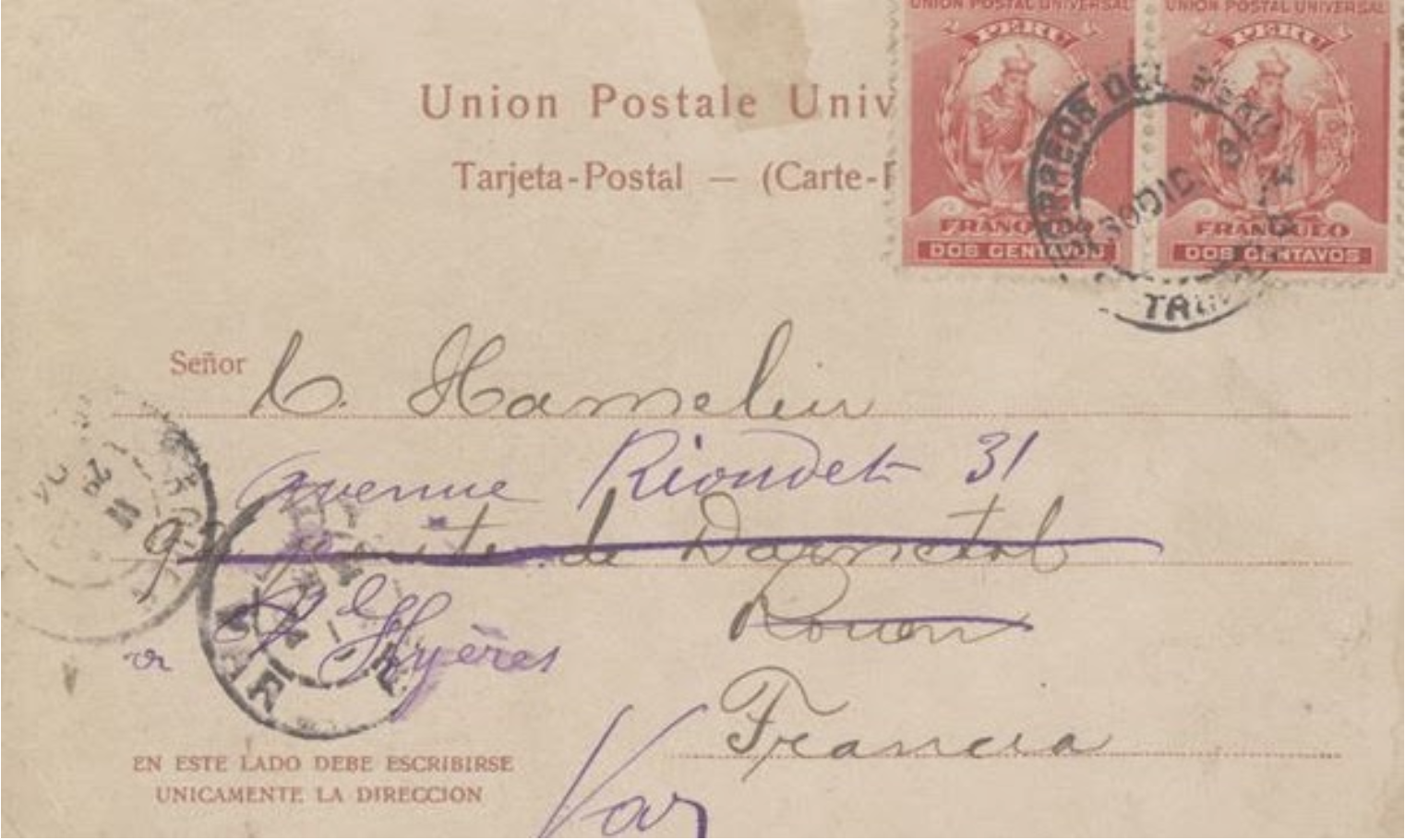
of the recipient there. She reproduces the backs of two 1904
postcards ("Tarjeta Postal"), one from Bolivia and another
from elsewhere in South America, whose lower left corners tell
users not to crowd the blank space with anything else: "En
este lado debe escribirse unicamenta la direccion" ("only the
address should be written on this side").
There is something suspicious about the name, though. Murphy
has said that "A friend of mine sent me" the postcard, so his
name should be on the back, but instead it is addressed to a
Señor Boudin. Bloom evidently prides himself on "having
detected a discrepancy between his name (assuming he was the
person he represented himself to be and not sailing under
false colours after having boxed the compass on the strict
q.t. somewhere) and the fictitious addressee of the missive
which made him nourish some suspicions of our friend's bona
fides." There certainly is a "discrepancy," and it
does suggest that Murphy is not being entirely truthful, but
why assume that the addressee is "fictitious"?
None of the logical possibilities seem very plausible. Murphy
could have bought or otherwise acquired a used postcard, in
which case he would be lying about a friend mailing it to him,
but not about the name of the recipient. Or he could be
telling the truth about receiving the card in the mail but
lying about his own name, which is actually Boudin—which would
be a strange name for an Irishman from County Cork, unless he
is Huguenot. But if, as Bloom provisionally assumes, his name
really is Murphy, why would the name on the card be made-up?
Did Murphy receive mail at a poste restante in
Santiago as Boudin, just as Bloom does on Westland Row as
Henry Flower? How would Bloom know that? If there is some
brilliant deduction going on in his mind, it is not made
apparent in the narrative.
Still, it is hard to ignore the invitation to regard "Señor
A Boudin, Galeria Becche, Santiago, Chile" as
"fictitious," because the address does not sound quite
convincing. Boudin is not a surname in Spanish-speaking
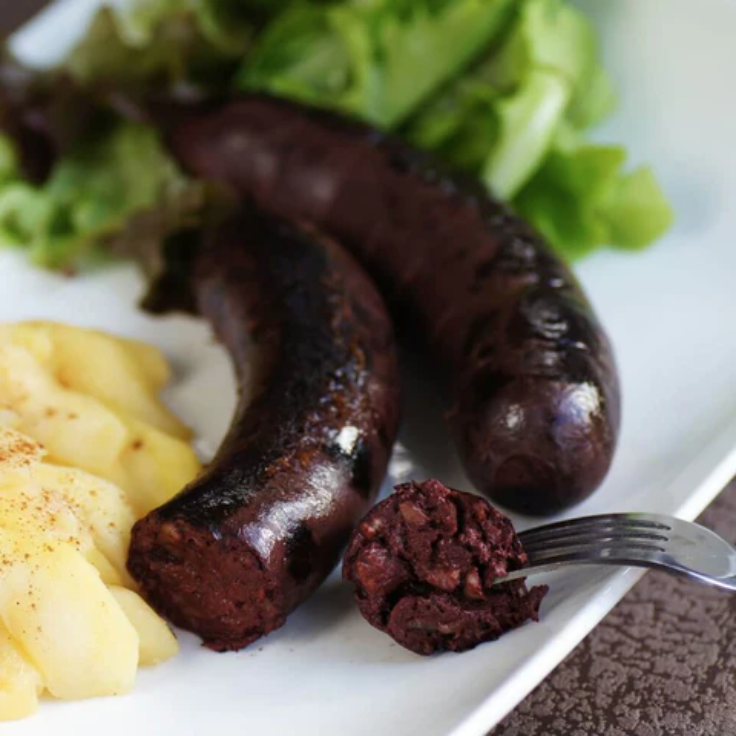
countries, though it is in France. The French word refers to
the kind of blood sausage that the English and Irish call a
"black pudding." (There is also a boudin blanc, a
finer-textured sausage that unlike the black boudin
contains no blood.) Reading the addressee as "A Sausage" is
supported by the possibility that the word "Señor" may not
have been written on the card. Yared notes that some South
American postcards sexistly pre-printed "Señor" at the
beginning of the address space—seen on one of the cards shown
here. Also, in the Rosenbach manuscript and the Gabler
edition, "A" is written without the period that should follow
an initial, allowing it to be read as an indefinite article.
(Although British usage omits the full stop when letters are
subtracted from the middle of a word, as in Fr for Father, it
requires it when the elision comes at a word's end. In Eumaeus
Bloom becomes L. Boom, not L Boom.)
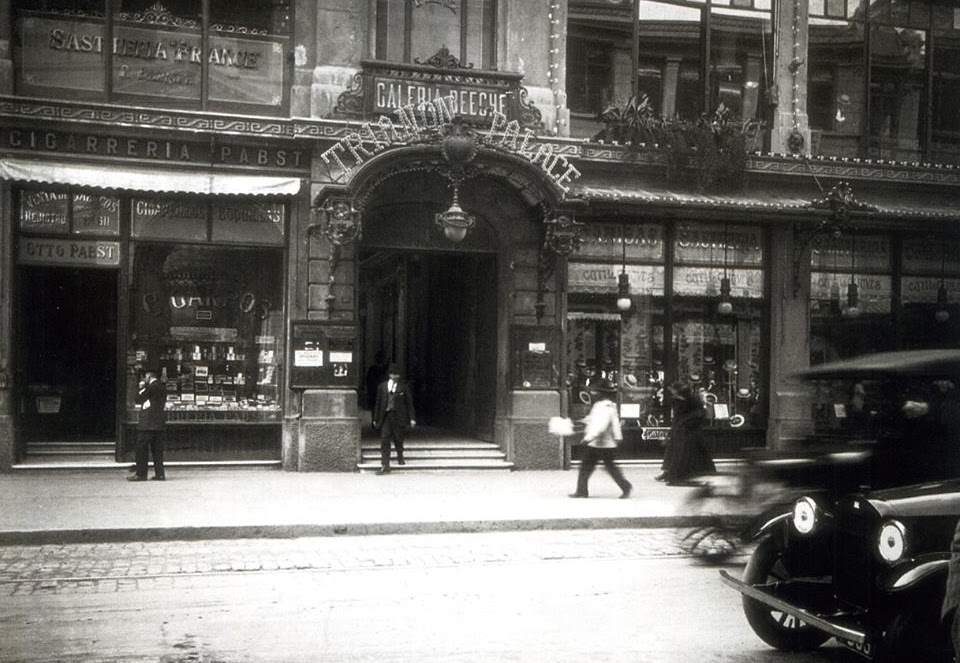
A similar not-quite-rightness attends the address. There was
an actual commercial arcade in downtown Santiago with almost
the name on the postcard: in another JJON article,
John Simpson reports that a Chilean businessman named Hector
Beeche (or Beéche) commissioned the construction of a large
building (one full city block, four stories) with a
first-floor internal passageway called the Galería Beeche
offering spaces for offices and elegant shops. But the
spelling was "ee," not "ec." The Beeche Building did not come
into existence until 1909, so the choice to set the address
there may have been driven less by a desire for mimetic
accuracy than for an opportunity to pun on its name. Again,
food resonances present themselves: in Italy a beccheria (synonymous
with macelleria) is a butcher's shop.
It seems possible, then, that someone has asked the postal
service to deliver the card to a sausage in a meat store. If
so, nothing about the conceit—referencing an actual landmark
in a Hispanic city but changing one letter of its name to
accommodate an Italian pun, and linking the address with a
French surname which contains a similar pun in that language,
all in the service of making a sophomoric joke—sounds like
something that the dull-witted D. B. Murphy might have dreamed
up. It does, however, sound very much like the fictive work of
James Joyce. Another postcard in Ulysses, the
meanspirited U.P. missive that
rouses Dennis Breen to fury and sends readers off in search of
ingenious explanations, signifies very little in itself but
means quite a lot to others. Joyce may be doing something
similar with the back of Murphy's postcard: having a lark in a
way that teases the earnest Bloom into a hunt for meaning.